Skip to content
Sunday 9 August 2026London --:--Frankfurt --:--Zurich --:--
NewslettersSearchEN · DE
MorningWire

European business, markets and politics

FTSE 100
10,901.09
+0.31%
DAX
26,319.45
+0.69%
CAC 40
8,714.93
+0.17%
STOXX 50
6,523.86
+0.33%
  • Europe
  • Markets
  • Business
  • Economy
  • Technology
  • Politics
  • Opinion
More
GermanyFranceBankingAIEnergyFintechPropertyCapital Markets
  • Germany
  • France
  • Europe
  • Markets
  • Business
  • Economy
  • Technology
  • Politics
  • Opinion
  • DE
Monday 07 July 2025 12:18 pm  |  Updated:  Monday 07 July 2025 12:19 pm

In defence of crying at work

By: Ann Francke

Add as a preferred source on Google
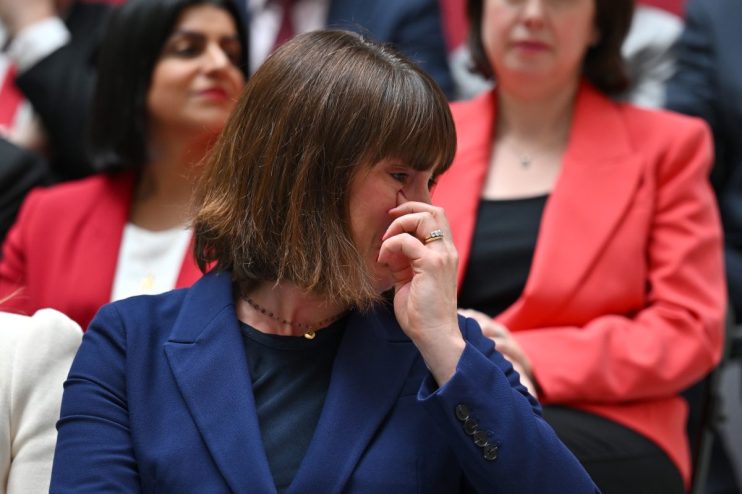
MANCHESTER, ENGLAND - JUNE 13: Rachel Reeves, Shadow Chancellor of the Exchequer, cries during the launch of Labour's general election manifesto on June 13, 2024 in Manchester, United Kingdom. Labour is consistently leading the polls by over 20 points, according to the latest YouGov data. (Photo by Anthony Devlin/Getty Images)

Was Rachel Reeves really too emotional, or have we just got a gender issue when it comes to leadership, Anne Francke asks

If men in a professional setting have an outburst – when they’re upset, frustrated, shouty or have bursts of anger – commentary often revolves around how their fiery displays can “energise a room”. When women express emotion – be it anger, concern, frustration or even tears – it’s often portrayed as a professional liability rather than as a genuine, human reaction. 

The amount of speculation and accusations that swirled around Rachel Reeves’ visibly crying in the House of Commons last week highlights the reality that powerful women are often penalised for showing emotion – whether it’s anger or vulnerability. 

The penalty women pay for showing strong emotion raises some important questions: Why do women often feel they must adopt and mirror male behaviours – dress, sound and behave like men – and project a constant facade of toughness just to earn the respect that is automatically afforded to their male counterparts? Furthermore, why is there such discomfort with politicians, particularly women, being tearful? Shouldn’t their ability to express genuine emotion be seen as a sign that they are human like the rest of us?

The impact on reputation is real: emotional expression may be interpreted not as strength, but as a lack of self-control. This can lead to self-censorship, disengagement and stifled leadership.

Research by my organisation, the Chartered Management Institute (CMI), has uncovered a worrying trend: a growing resistance to gender equality efforts in the workplace, and a stark gender divide therein. One in three male managers (33 per cent) working across the UK economy said they felt too much effort is being made to achieve gender balance in the workplace, compared to just 13 per cent of women. This gap points to a backlash, sometimes passive, but sometimes more active and rooted in the misconception that equality for some comes at the expense of others.

Women hold a mere 38 per cent of senior management roles in the UK.  And only 61 per cent of respondents say men and women have an equal voice in decision making. Below the surface, cultural bias is alive and well, reinforced when women are penalised for “too much emotion” whilst the same behaviour is often applauded in male colleagues.

Emotion is a strength

We know diversity is a powerful driver of performance – not least to avoid groupthink at senior levels. We also know that cultural biases continue to hold sway, and men and women are judged differently for leading with their emotions. Men leading with emotion, which can be anger, agitation and raised voices, are seen as strong leaders. Women are seen as unpredictable, lacking poise and control. In reality, leading with emotion is just being human.

So what if emotion was a strength rather than a weakness? Leaders who show empathy, admit fear, express passion or disappointment and convey authenticity often build deeper trust. We’re human, and our teams respond best to leaders who acknowledge that. We’ve all felt impostor syndrome or self‑doubt, even when the data shows we’re prepared. 

Leaders who speak candidly about pressures inspire loyalty. Teams that feel heard are more likely to innovate. And senior women who no longer have to “dial down” their presence, bring full insight and power to the table. 

As we strive for gender balance, it isn’t just about counting heads. It’s about changing cultures so that when a woman shows emotion, she’s not seen as unprofessional, unstable or ‘soft’. She’s seen as fully human: equipped to lead, inspire, and deliver in a world where compassion and clarity go hand in hand. Emotion is leadership. 

Ann Francke is chief executive of the Chartered Management Institute, the UK’s leading professional body for management and leadership

Read more

The Debate: should Andy Burnham have made a woman his Chancellor?

Rachel Reeves delivering a speech at a press event, wearing a navy blazer and standing in front of a backdrop with logos.

Share this article

  • Facebook
  • X
  • LinkedIn
  • WhatsApp
  • Email

Similarly tagged content:

Sections

  • Opinion

Categories

  • Opinion
  • Business

People & Organisations

  • gender
  • gender divide
  • Rachel Reeves

Trending Articles

  • Stop burying us in swollen corporate reports, says audit watchdog boss

  • Hargreaves Lansdown orders staff back to office

  •  Burnham to unveil new cost of living measures on UK tour

  • How Britain can stay clear of rivals as home of overseas sport club owners

  • Why the Loire Valley is about so much more than fairytale castles

More from Morning Wire

  • The Debate: should Andy Burnham have made a woman his Chancellor?

    Opinion
    Rachel Reeves delivering a speech at a press event, wearing a navy blazer and standing in front of a backdrop with logos.
  • The City will bid good riddance to Rachel Reeves

    Opinion
    Reeves Bank exterior with modern architecture, showcasing its sleek design and prominent logo on a sunny day.
  • The Capitalist: A Reeves speech or swan song? Dispatch from Mansion House

    Opinion
    Rachel Reeves delivering a speech at Mansion House, addressing economic policies and future plans in a formal setting.
  • Rachel Reeves’ sister takes top legal role in Burnham’s Cabinet overhaul

    Politics
    Close-up of a business professionals hands typing on a laptop keyboard with financial charts on screen
  • Reeves: Burnham will face ‘shocks and challenges’ as Prime Minister

    Politics
    Rachel Reeves delivering a speech at a press event, wearing a navy blazer and standing in front of a backdrop with logos.
  • Rachel Reeves to unveil next steps for ring-fencing reform at Mansion House

    Banking
    Descriptive image related to a news or business article with focus on general themes and engaging visual elements.
  • IHT receipts hit record high as Rachel Reeves’ frozen bands raid plague Brits

    Personal Finance
    Inheritance tax receipts are on track for a record breaking year
  • Rachel Reeves’ legacy of tinkering with the City is not enough, says Mel Stride

    Economics
    Mel Stride addressing an audience at a business conference, standing at a podium with a presentation screen behind him
MorningWire

Independent European business, markets and political news for decision-makers.

Morning Briefing

Europe

  • Germany
  • France
  • Europe
  • UK & Ireland

Business

  • Markets
  • Banking
  • Technology
  • Energy
  • Property
  • Fintech

Editorial

  • Opinion
  • Editorial Policy
  • Corrections
  • Contact

Company

  • About Morning Wire
  • Privacy Policy
  • Terms of Use
  • Cookie Policy
© 2026 Morning Wire Ltd · Published by Morning Wire Media, Bahnhofstrasse 65, 8001 Zürich, Switzerland
Privacy · Terms · Cookies · Facebook