Skip to content
Friday 7 August 2026London --:--Frankfurt --:--Zurich --:--
NewslettersSearchEN · DE
MorningWire

European business, markets and politics

FTSE 100
10,867.89
-0.19%
DAX
26,140.13
0.00%
CAC 40
8,699.71
0.00%
STOXX 50
6,502.56
0.00%
  • Europe
  • Markets
  • Business
  • Economy
  • Technology
  • Politics
  • Opinion
More
GermanyFranceBankingAIEnergyFintechPropertyCapital Markets
  • Germany
  • France
  • Europe
  • Markets
  • Business
  • Economy
  • Technology
  • Politics
  • Opinion
  • DE
Tuesday 05 May 2026 5:22 am  |  Updated:  Monday 04 May 2026 3:04 pm

It’s not the Bank of England’s job to support the Chancellor

By: Paul Ormerod

Add as a preferred source on Google
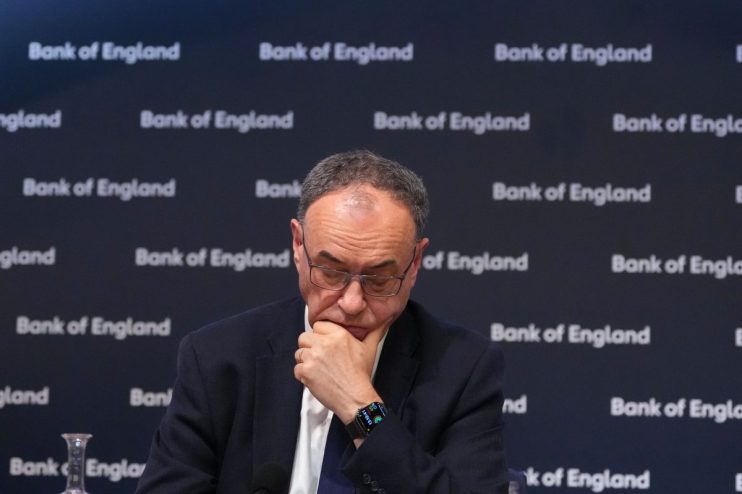
Andrew Bailey, Bank of England governor, discusses economic policy during a press conference at the central bank headquart...
The Bank of England, headed up by Andrew Bailey, held interest rates last week

the Bank of England’s MPC is acting as if its role is to support the Chancellor and protect the real economy, rather than control inflation, writes Paul Ormerod

The Bank proclaims on its website that “We set monetary policy to achieve low and stable inflation. This is our primary monetary policy objective”. It goes on to note that in practice this means “keeping inflation at two per cent over the medium term”.

Taking the broad measure of inflation, the consumer price index (CPI), the last time it was below two per cent was in September 2024, at 1.7 per cent. But that was the only month in the past five years when this was the case.

In April 2021 inflation was 1.5 per cent. By the end of that year it had risen to 5.4 per cent. It rose almost throughout the whole of 2022, finishing the year at 10.5 per cent. Since then it has averaged 4.3 per cent, more than double the Bank’s target rate.

The Monetary Policy Committee (MPC) believes the main tool to control inflation is Bank Rate, the interest rate the Bank pays on deposits placed with it overnight by commercial banks. Increasing the rate is believed to slow down economic activity, which in turn will lead to a moderation in inflation.

Inflation in not under control

Given that inflation has consistently been above target, it seems rather curious that since August 2023 the only movements in Bank Rate have been down, from 5.25 per cent to 3.75 per cent.
At the MPC meeting last week, eight members voted to leave Bank Rate as it is, with only the Bank’s chief economist, Huw Pill, voting for a modest increase to four per cent.

The Bank attempted to justify the decision by publishing three scenarios on the projected path of inflation over the next few years. The scenarios differ in essence on what happens to the price of oil. In the most pessimistic outlook, in which oil is at $130 a barrel for the rest of 2026, inflation peaks at six per cent and remains above the two per cent target even in 2028. But even in the other two scenarios, which assume lower oil prices, inflation is projected to be higher than the target in both 2026 and 2027.

Read more

Healey faces £24bn spending squeeze as inflation puts tax rises in play

Bank of England headquarters in 2025, showcasing modern architecture and iconic London skyline in the background.

According to the Bank It is only in 2028 that inflation comes under control – a full eight years since it was last below two per cent.

Economics is full of rather elastic phrases such as the “medium term”, the time period over which the Bank is expected to keep inflation at two per cent. But it would require very substantial generosity to describe eight years as being the “medium term”. And it will be that length of time over which inflation has exceeded its target – always provided that the Bank’s call on oil prices proves correct, otherwise it will be for the entire decade of the 2020s.

The Bank of England is not like the Fed

The Federal Reserve, the American counterpart of the Bank of England, has an explicit dual mandate. It is meant to try to control inflation, but it is also expected to pay attention to the consequences of interest rate changes for growth and unemployment.

When Gordon Brown made the Bank independent in 1997, its focus was meant to be on controlling inflation. It was not given the wider brief of the Federal Reserve.

The inflation outlook over the next couple of years requires both tight monetary policy and a sharp rise in interest rates. Given the Bank’s own scenarios, an immediate increase in Bank Rate to five per cent would be perfectly reasonable.

This would of course slow down the economy, already in a fragile state. But the MPC is acting as if it thinks its role is to support the Chancellor and protect the real economy rather than its actual job – getting to grips with inflation.

Paul Ormerod is an economist at Volterra Partners LLP and an honorary professor at the Alliance Business School at the University of Manchester

Read more

Interest rate cut is ‘off the table’, says Bank of England governor

Governor Andrew Bailey has launched a defence of the Federal Reserve's independence.

Share this article

  • Facebook
  • X
  • LinkedIn
  • WhatsApp
  • Email

Similarly tagged content:

Sections

  • Opinion
  • News

Categories

  • Opinion
  • Business

People & Organisations

  • Andrew Bailey
  • Bank of England
  • Bank Rate
  • chancellor
  • Federal Reserve
  • Gordon Brown
  • Huw Pill
  • Inflation
  • interest rates
  • Monetary policy committee
  • mpc
  • Paul Ormerod
  • Rachel Reeves

Trending Articles

  • Rupert Lowe axes pensions triple lock and pledges tax cuts in economic plan

  • Revolut founder’s wealth set to balloon amid talks of share award at $500bn valuation

  • As it happened: Stocks rise as oil fluctuates after Red Sea attack; US-Iran deal ‘being circulated’

  • Liverpool owners tipped to sell – but not to Amazon boss Bezos – by former CEO

  • WPP slashes jobs as revenue continues to fall

More from Morning Wire

  • Healey faces £24bn spending squeeze as inflation puts tax rises in play

    Economics
    Bank of England headquarters in 2025, showcasing modern architecture and iconic London skyline in the background.
  • Interest rate cut is ‘off the table’, says Bank of England governor

    Economics
    Governor Andrew Bailey has launched a defence of the Federal Reserve's independence.
  • How patient can the Bank of England be?

    AD
    Historic Royal Exchange building in London with modern skyscrapers behind, clear blue sky.
  • IMF warns Bank of England against cutting interest rates

    Economics
    IMF Chief Kristalina Georgieva issues caution to Bank of England amid economic concerns
  • ‘False dawn’: June inflation falls to 2.6 per cent but analysts say rises ahead

    Economics
    Till sales growth slowed to 2.7 per cent in the last four weeks
  • Bank of England may set the stage for interest rate hikes this year

    Economics
    Bank of England recession warning
  • Hold interest rates but ‘sound hawkish’, Morning Wire Shadow MPC tells Bank of England

    Economics
    Andrew Bailey, Governor of the Bank of England, with the Bank of England building and Union Jack flag in the background
  • Bank of England holds interest rates but warns of rises to come

    Economics
    Bank of England headquarters in 2025, showcasing modern architecture and iconic London skyline in the background.
MorningWire

Independent European business, markets and political news for decision-makers.

Morning Briefing

Europe

  • Germany
  • France
  • Europe
  • UK & Ireland

Business

  • Markets
  • Banking
  • Technology
  • Energy
  • Property
  • Fintech

Editorial

  • Opinion
  • Editorial Policy
  • Corrections
  • Contact

Company

  • About Morning Wire
  • Privacy Policy
  • Terms of Use
  • Cookie Policy
© 2026 Morning Wire Ltd · Published by Morning Wire Media, Bahnhofstrasse 65, 8001 Zürich, Switzerland
Privacy · Terms · Cookies · Facebook