Let’s be honest, inflation is down and the Bank of England could create a recession

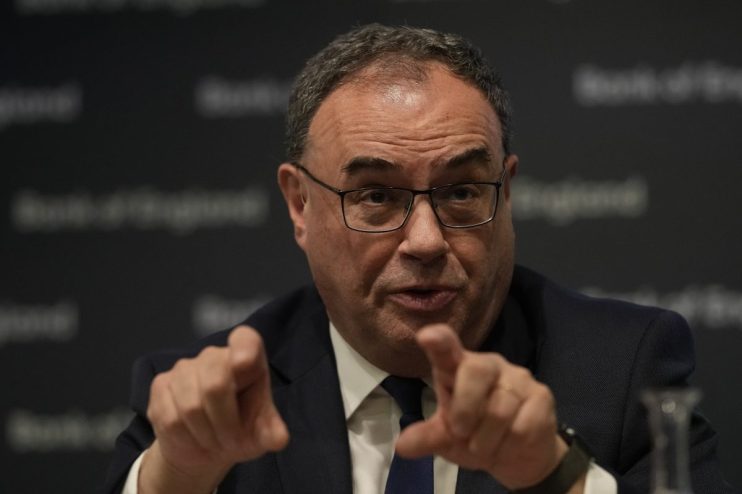
The Bank of England is now at risk of overcorrecting after ignoring monetary policy for far too long, writes Matthew Lesh
In July 2021, Bank of England governor Andrew Bailey cautioned against a temptation to “over-react to temporarily strong growth and inflation”. At the time, the consumer price index had just reached 2.1 per cent, marginally surpassing the Bank’s official target. Yet Bailey believed this would be a “temporary feature of the bounce-back” rather than a persistent curse. Just a year later, inflation had climbed to over ten per cent and has remained above the two per cent target ever since.
The oft-heard excuse from those who failed to see the inflation threat is to attribute blame to the war in Ukraine and the consequential skyrocketing energy and food costs. But, in truth, inflation was already out of control before Russian troops kickstarted the full-scale invasion in February last year. In January 2022, inflation had already reached 5.5 per cent.
Inflationary conditions were baked in during the pandemic. The Bank of England expanded its qualitative easing programme by an astonishing £450bn in 2020 and 2021, effectively printing more money in a shorter period than ever. In practice, this involved purchasing government bonds, keeping down the cost of borrowing for Covid support programmes.
But nothing in life is free. Putting an immense amount of cash into bank accounts resulted in too much money chasing too few goods when people began spending again as restrictions were lifted.
Nobel-prize-winning economist Milton Friedman famously said, “Inflation is always and everywhere a monetary phenomenon.” Modern central bankers tend to scoff at this idea, instead focusing on the importance of inflationary expectations, supply shocks, demand pressures and the state of the labour market. The issue of “long and variable lags” in Friedman’s theory also raises practical challenges for monetary policymakers – namely, it is hard to know precisely when a change in money supply will filter through to inflation, making it difficult to use monetary measures to fine-tune policy.
Nevertheless, it seems evident and recent experience demonstrates money plays a role. The lesson for central bankers is obvious: do not ignore monetary factors in setting monetary policy.
Yesterday, it emerged that inflation had fallen sharply to 4.7 per cent. This means Prime Minister Rishi Sunak has met his target of halving inflation. Inflation is also likely to reach the two per cent target next year. There is, however, a risk that after failing to see the threat of inflation on the horizon, the Bank is overcorrecting by keeping interest rates too high for too long, excessively slowing down the economy.
The money supply is again an essential reference point. The best measure of ‘broad money’ is M4x, which takes account of the private sector’s holding of hard currency, deposits, and other short-term financial instruments similar to cash. This measure, which should grow at a steady and low rate, has taken a negative turn. M4x fell by minus 4.2 per cent in September.
The Bank believes this relates to the undoing of the liability-driven investment crisis a year earlier. But it is also part of a much broader trend of sharply declining money supply. The Institute of Economic Affairs’ Shadow Monetary Policy Committee has warned that monetary growth turning negative could be a harbinger of deflation, pushing the UK’s faltering economy into a damaging recession.
Despite this risk, the Bank of England has a bias towards further rate rises. Bailey said earlier this month, “it is much too early to be thinking about rate cuts”. This could all be about to change – hopefully this time the Bank is not too slow to act.