Skip to content
Monday 10 August 2026London --:--Frankfurt --:--Zurich --:--
NewslettersSearchEN · DE
MorningWire

European business, markets and politics

FTSE 100
10,864.47
-0.34%
DAX
26,351.43
+0.12%
CAC 40
8,726.60
+0.13%
STOXX 50
6,536.50
+0.19%
  • Europe
  • Markets
  • Business
  • Economy
  • Technology
  • Politics
  • Opinion
More
GermanyFranceBankingAIEnergyFintechPropertyCapital Markets
  • Germany
  • France
  • Europe
  • Markets
  • Business
  • Economy
  • Technology
  • Politics
  • Opinion
  • DE
Wednesday 02 October 2024 5:14 am  |  Updated:  Tuesday 01 October 2024 11:45 am

The main task of the next Tory leader is to repaint the party’s image

By: Paul Ormerod

Add as a preferred source on Google
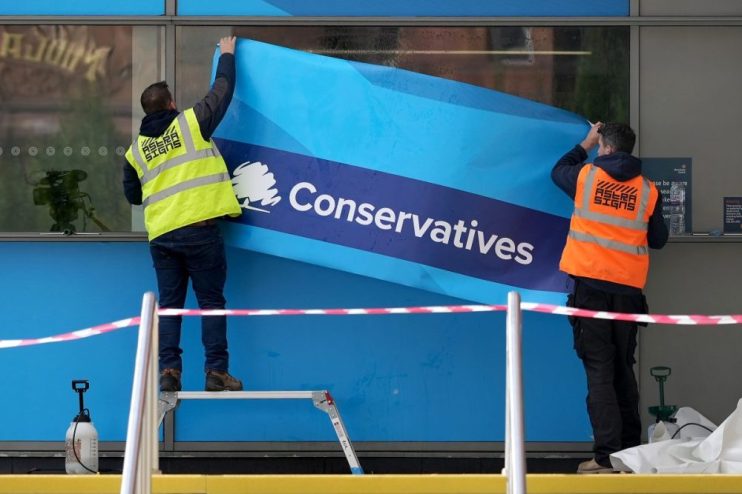
MANCHESTER, ENGLAND - OCTOBER 01: Workers erect Conservative Party branding on the windows of Manchester Central ahead of the Conservative party conference on October 01, 2021 in Manchester, England. The Conservative conference takes place between 3rd–6th October. (Photo by Christopher Furlong/Getty Images)
Conservative Party Conference has been a chance for the leadership candidates to set out their pitches to the party

The dominant narrative around a government’s record is more important than the facts, writes Paul Ormerod

Since the election in July, Starmers have been the stock to short. In the middle of that month, the Prime Minister had a net approval rating of plus 19 per cent. It is now minus 26 per cent, a huge 45 point turnround.

But as with all stocks, past performance is not necessarily a guide to the future. In terms of medium to long-term planning, a Labour government in 2029 certainly cannot be written off.

True, the Labour Party itself has been performing badly in council by-elections, losing seats to the Conservatives and, last week, to the SNP. This is very unusual so early in the life of a government.

But current polls can be a very poor guide to the outcome of elections held several years in the future. The electorate has certainly become more volatile in recent years. But even in what to many voters now seems like ancient history, opinions were subject to large shifts.

For example in 1959 the Tories won with a majority of 100. A year later, polls were still giving them double-digit leads. The media was full of articles proclaiming that Labour could never win again. The then-leader, Hugh Gaitskell, even contemplated changing the name of the party. But Labour went on to win, albeit narrowly, the 1964 election.

By 1968, though, Labour was massively unpopular. Yet by the early spring of 1970 the party had regained the lead in opinion polls. This prompted the then leader and prime minister Harold Wilson to call a general election in June. Labour lost.

In 1987 Margaret Thatcher won a landslide majority. In early 1989, the Conservatives still held a poll lead of some 10 percentage points.

This collapsed dramatically. By the spring of 1990 Labour led by incredible margins of over 20 per cent. But the April 1992 election saw the Conservatives squeak back with a small majority.

Read more

Labour defends Burnham’s ‘very powerful’ No 10 North plans

Houses of Parliament in Westminster showcasing historic architecture under a clear sky, central to UK government and politics

It’s the story that matters

The performance of the government is the key factor. Yet it is not so much the performance measured on objective grounds, but on how it is perceived.  

The dominant narrative around a government’s record is more important than the facts.

The Major government of 1992-97 provides a clear example. The actual economic record is arguably the most successful five-year period in Britain’s post-war economic history. 

The economy boomed, unemployment fell and at the same time inflation was brought under control for the first time in 20 years. At the beginning of the 1990s it was still seven per cent. By the middle of the decade, it was just two per cent.

But the Conservatives never recovered from the damage to their reputation for competence caused by the ejection of sterling from the Exchange Rate Mechanism, the precursor to the euro, in the autumn of 1992. It was actually the driving factor of the economic boom, but it was perceived as being a disaster.

The risk for Labour is of course that the current prominence of stories about sleaze, hypocrisy and cronyism stick and become the defining image of the government in the same way so-called Black Monday in 1992 defined the Conservatives.

Starmer performed a valuable task for Labour as leader of the opposition. He focused on the boring, backroom work of clearing out the influence of Corbynism, to give Labour a credible image.  

The Tories can learn from this. The main task of whoever becomes leader is not to make dramatic policy announcements, but to erase the negative image of the Conservatives which is still widely held.

Paul Ormerod is an economist at Volterra Partners LLP

Read more

Exclusive: Government to reject Reform’s offer to cover Farage by-election cost

Nigel Farage speaking at a podium, dressed in a suit, addressing an audience at a business conference event

Share this article

  • Facebook
  • X
  • LinkedIn
  • WhatsApp
  • Email

Similarly tagged content:

Sections

  • Opinion

Categories

  • Opinion

Related Topics

  • Conservative leadership race
  • Conservative Party
  • Conservative party conference
  • Keir Starmer

Trending Articles

  • Back to basics: Sainsbury’s gradual retreat from the British high street

  • Thames Water faces fresh threat to survival after pensions regulation breach

  • Hargreaves Lansdown orders staff back to office

  • FTSE 100 Live: Intel, Arm shares slide; Oil climbs higher

  • PwC’s Embankment HQ to get major makeover ahead of Canary Wharf move

More from Morning Wire

  • Labour defends Burnham’s ‘very powerful’ No 10 North plans

    Politics
    Houses of Parliament in Westminster showcasing historic architecture under a clear sky, central to UK government and politics
  • Exclusive: Government to reject Reform’s offer to cover Farage by-election cost

    Politics
    Nigel Farage speaking at a podium, dressed in a suit, addressing an audience at a business conference event
  • Has Nigel Farage peaked too soon?

    Opinion
    Nigel Farage delivering a speech in July 2026, wearing a suit, addressing an audience at a political event.
  • On this day: the birth of Michael Foot

    Opinion
    Michael Foot speaking at a public rally in a city square with a large crowd and buildings in the background.
  • Burnham scraps digital ID scheme

    Politics
    Andy Burnham speaking at a public event, emphasizing local governance and policy changes, wearing a suit and gesturing pas...
  • Miliband opponents pour cold water on Chancellor hopes

    Politics
    Ed Miliband outside Downing Street
  • Andy Burnham is utterly delusional

    Opinion
    Andy Burnham speaking at a press conference, expressing confidence despite challenges, highlighting leadership and resilie...
  • ‘Pro-business’ Burnham eyes Reynolds return to top business job

    Business
    Jonathan Reynolds addressing the SMMT's annual International Automotive Summit (image courtesy of SMMT)
MorningWire

Independent European business, markets and political news for decision-makers.

Morning Briefing

Europe

  • Germany
  • France
  • Europe
  • UK & Ireland

Business

  • Markets
  • Banking
  • Technology
  • Energy
  • Property
  • Fintech

Editorial

  • Opinion
  • Editorial Policy
  • Corrections
  • Contact

Company

  • About Morning Wire
  • Privacy Policy
  • Terms of Use
  • Cookie Policy
© 2026 Morning Wire Ltd · Published by Morning Wire Media, Bahnhofstrasse 65, 8001 Zürich, Switzerland
Privacy · Terms · Cookies · Facebook