Keir Starmer wants business to know it’s a ‘partnership.’ Will it be enough?

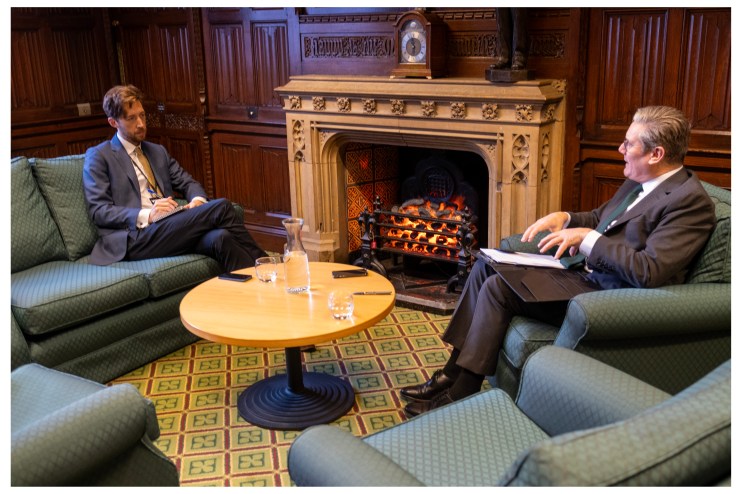
Keir Starmer is highly likely to be the next Prime Minister. He wants business and the City on side whilst he does so, he tells Morning Wire editor Andy Silvester.
Keir Starmer is not, he tells me, a complacent man. But even he can’t help but occasionally sound like he’s already preparing for government – at least when it comes to what he’d do with the economy.
“Rachel and I,” he says of his shadow chancellor Rachel Reeves, “are in lockstep. The economy and the country tends to work better when you’ve got a Prime Minister and a Chancellor that think together.”
With the polls as they are, the current Leader of the Opposition and his political ally may soon take those job titles for real.
Starmer’s Labour is consistently more than twenty points ahead of the Tories, and he and Reeves appear to have turned the party’s traditional weakness on the economy into a strength.
Certainly it’s a far cry from where the opposition was in 2019, with Starmer’s predecessor Jeremy Corbyn and the country’s business leaders barely on speaking terms.
A lot of our policy positions are now clearly being moulded by those conversations. Businesses take heart from that.
Keir Starmer
“I’m pleased that we’ve done this so quickly, because we needed to change the Labour party and do it at speed. I was very clear that in the five years that we had from 2019 we needed to change the Labour party first and at speed. We didn’t have a platform to stand on until we had done that,” he tells me in his oak-panelled parliamentary office.
Starmer has, of course, benefitted from external events; whilst he’s been successfully wrestling his own party into his image, the Conservative party has equally successfully torn itself apart not once but twice. That lack of stability has certainly given business leaders much to complain about.
Now, he says, it’s about making the “positive case for the future – what does a new relationship with business actually look like. We’ve moved at speed because we’re not in the broad slogans and phrases – we’re in the weeds with them on what this would actually mean in practice.
“A lot of our policy positions are now clearly being moulded by those conversations. Businesses take heart from that,” he reckons.
If that continues to be the case, does he expect to be criticised by some in his party for being too close to business? After all, Corbyn may be gone, but many of his acolytes remain in the parliamentary and wider party.
“Accusations come thick and fast,” he laughs, “on almost everything. I’m sure that will continue in government.”
MEAT ON THE BONES
Starmer is sometimes criticised for a lack of clarity on what his plans for government actually entail, admittedly not unusual criticism of any opposition leader.
But listening to him, it’s apparent that he’s not pulling his punches in some of the scraps to come.
The north London MP is a self-confessed ‘YIMBY’ and has said the planning system needs substantive change, making it the heart of his conference speech in September. Many administrations have said similar in the past, but have rapidly reversed course under political pressure. Is Starmer up for the battle?
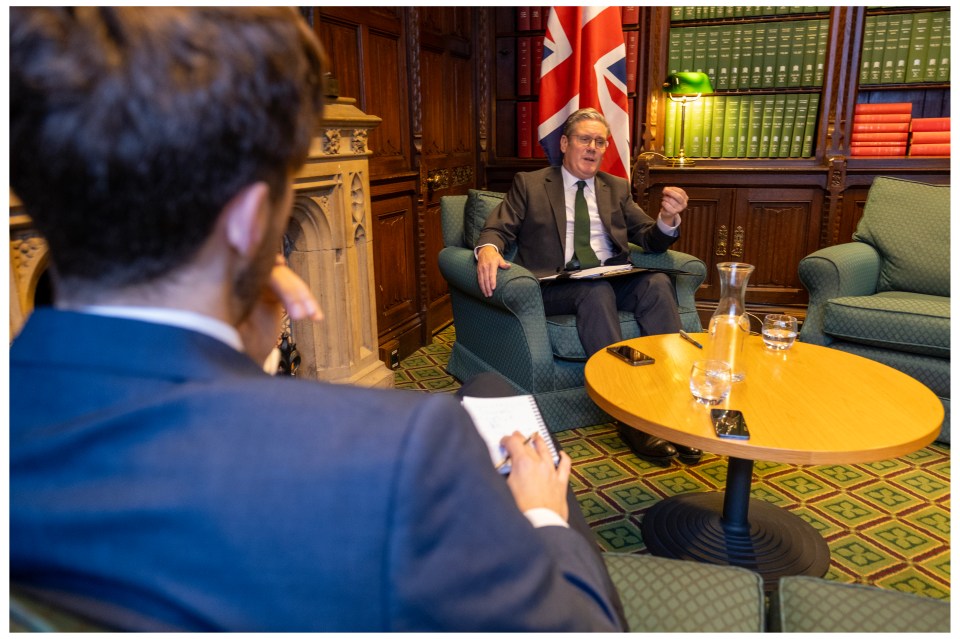
“It’s a fight we need to have and a fight we will have. We can navigate our way through,” he claims, saying local people can be brought on board with local projects if they’re involved in the process early enough – and feel the benefits.
Starmer is also set, he says, for reform of a different kind, across public services.
“If you put in more money at the top of a public service and get a slightly better product coming out. If you want a much better product, you’ve got to change the model” is his pithy assessment.
I ask him, echoing a question famously asked of a former Labour leader, whether he’s tough enough for that battle – and the inevitable fight with the unions it would involve. Starmer answers simply “yes.”
HAND IN HAND?
The Labour leader knows how to hammer home his point.
Words like ‘partnership’ and ‘together’ feature in almost all of his answers about the party’s relationship with business. Twice in our half hour conversation he says businesses want people they can work with, with “sleeves rolled up.”
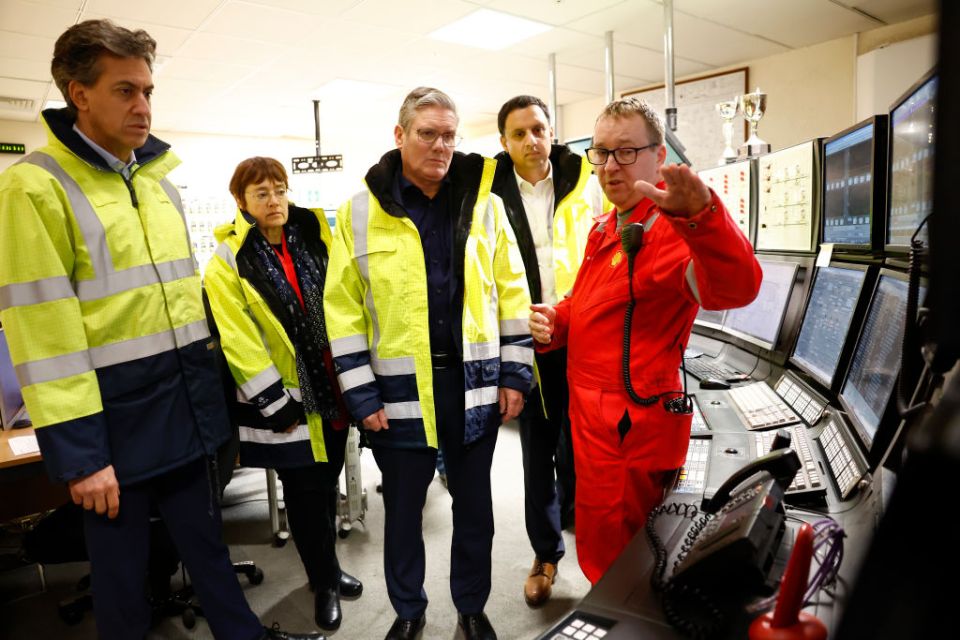
Perhaps, then, we are set to see more of Starmer’s forearms as the election campaign ramps up. He tells me he’s been on two recent visits – to Macclesfield, to see Astra Zeneca’s site there, and to Aberdeen, for a meeting with the oil and gas industry. Both he says were positive, with engaged business leaders looking for an “active” government.
In his mind, at least, there is an international shift in what businesses expect from their political leadership, driven in part by the US.
Joe Biden’s Inflation Reduction Act – a huge, Keynesian industrial strategy that resembles nothing so much as a gold rush for green industries – has in Starmer’s mind forced the hand of the UK to compete.
It’s “impossible,” he says, to have a conversation with any global business about investment without it being brought up. Serving as a “magnet,” Starmer says the EU has moved to respond with its own package.
“The UK government is sitting on its hands under its mistaken assumption that government should get out of the way,” he reckons.
“The business leaders we’re talking to aren’t saying get out of the way, and they aren’t saying suck it all up and make decisions at the centre. They’re saying if you’re going to get (growth) we want to” – that word again – “partner with you.”
There are some in the City who quietly flag their worries. One FTSE 100 CEO said that whilst Starmer and Reeves had won him over, they didn’t necessarily trust that when push came to shove the historic instinct of the Labour party to centralise power wouldn’t show up.
We haven’t had significant growth for a long time. I don’t think they truly understand the modern economy anymore
Keir Starmer
“They’re wrong about that – that’s why we need to model it,” he says, of his current work. “I’m absolutely convinced this is the only way we can deliver on the economy.”
Starmer compares himself to “many previous incarnations of the Labour party and Labour leadership (who) tend to go to public services first, and major on the NHS etc going into an election.”
By contrast, his party “are absolutely laser-focussed on the economy. Yes, of course we need to improve our NHS- but that’s a story about growth. Yes, of course we need to improve our schools – but that’s a story about growth,” he says.
Policies are clearly in development – Starmer mentions sorting out the power grid to speed up connections – but for him there is something more “fundamental” at work.
“It’s a bit about them and a bit about us. We haven’t had significant growth for a long time. I don’t think they truly understand the modern economy anymore.”
The promise is sector by sector, private sector-led plans with public sector support – and the impediments “knocked out of the way.”
Such warm words must make for enjoyable meetings between the Labour leader and British business.
Much like the relationship between leader and chancellor, that partnership may be easier in opposition than in government. For now, though, it appears smooth sailing.