Skip to content
Saturday 5 September 2026London --:--Frankfurt --:--Zurich --:--
NewslettersSearchEN · DE · FR
MorningWire

European business, markets and politics

FTSE 100
10,831.09
0.00%
DAX
26,046.40
+0.17%
CAC 40
8,278.77
-0.09%
STOXX 50
6,392.93
+0.16%
  • Europe
  • Markets
  • Business
  • Economy
  • Regulation
  • Politics
  • Opinion
More
GermanyFranceEU InstitutionsCompetitionPublic AffairsBankingTechnologyEnergy
  • Germany
  • France
  • Europe
  • Markets
  • Business
  • Economy
  • Regulation
  • Politics
  • Opinion
  • DE
Friday 24 January 2014 12:20 pm

No Facebook, you haven’t just debunked Princeton

By: Peter Spence

Add as a preferred source on Google

A recent Princeton study estimated that 80 per cent of Facebook's users will leave the site by 2017, and as the research went viral, the social network just had to respond.

It's a shame, because while Facebook data scientist Mike Develin makes good points about the follies of extrapolation generally, he manages to miss the point in an epic way.

Princeton in decline?

Develin uses data from Google Scholar to show that articles citing Princeton are in decline.

But this trend is not quite as damning for Princeton as Develin suggests. Princeton can survive, and survive well, in a world where we have more places of higher learning.
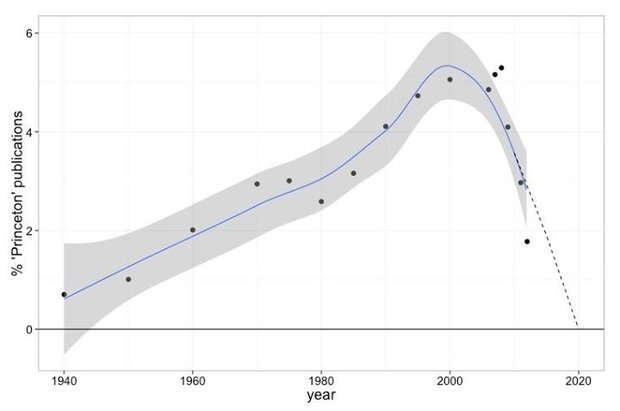
The number of publications naming Princeton is more a reflection of the increasing number of colleges and universities around the world, not of Princeton's fall from prestige.

Develin makes similar comments about air with Google Trends data. His extrapolation showed that "by the year 2060 there will be no air left".

It's true that you can draw some very stupid conclusions from extrapolation (as well as some fun ones).

Social networks, however, are a very different ball game.

Network effects

Sites like Facebook need to have the critical mass of users – your friends and family – for you to want to use them.

If interest in Facebook wanes, especially in younger demographics, then what starts as a small decline in numbers has the potential to snowball.

Princeton doesn't need everyone to attend its college or to cite its research to be sustainable – but if you don't know enough people using a social network, there's no reason to log on.

Every user that joins the network expects to stay indefinitely, but ultimately loses interest as their peers begin to lose interest.

Thus a user that joins early on is expected to stay on the network longer than a user that joins later. Eventually, users begin to leave and recovery spreads infectiously as users begin to lose interest in the social network.

The authors call that first decline in users the "an abandonment phase" in their paper, and it's a possibility that Facebook need to take seriously.

Accordingly, when social networks die, they do it quickly. Princeton authors note how MySpace had 75.9m users in 2008, but decayed "to obscurity" by 2011.

Is Facebook doomed?

None of this is to say that the Princeton paper is right – but to compare their analysis for a social network to a college, or anything that isn't community-orientated, just makes no sense.

Facebook's survival is dependent on its user base, and on its continual replacement by younger members.

That's why investors got scared when the social network revealed that its demographic share of young US teens declined during the third quarter of 2013.

Share this article

  • Facebook
  • X
  • LinkedIn
  • WhatsApp
  • Email

Similarly tagged content:

Sections

  • Opinion

Categories

  • Opinion

Trending Articles

  • Victoria Beckham owed £350,000 by Harvey Nichols

  • M&G: FTSE 100 giant hits out at Rayner’s ground rent cap as it suffers loss

  • Fulham owner Khan sees his £1bn stadium construction project take next steps

  • John Lewis boss: UK economy facing a ‘permacrisis’ 

  • Don’t underestimate the free trade agreement Britain just joined

More from Morning Wire

  • Exclusive: Blackstone set to back AI ‘droid’ firm at $3.5bn valuation

    AI
    Blackstone skyscraper with modern architecture under clear blue sky, symbolizing financial power and urban development.
  • Drive to Survive renewed by Netflix as Formula 1 docuseries gets ninth season

    Sport Business
    Lando Norris, in an orange racing suit, holds up a white and blue patterned trophy, cheering on a podium.
  • Chelsea fans stunned as ticket sharing equated with sexual misconduct

    Sport Business
    Crowds of fans gather outside the Chelsea FC stadium on a sunny day, with a Matchday Programmes On Sale sign visible.
  • Richard Branson: Support founders to build the next Virgin in Britain

    Opinion
    Richard Branson smiling with arms outstretched in front of a blue HBO Max Branson backdrop
  • 3 ways AI is rewriting the rules of private equity

    AD
    A person interacting with a chatbot on a smartphone, with a laptop in the background, showcasing AI and technology.
  • Claude to watermark AI ‘slop’ – including edited human writing

    Tech
    Smartphone displaying the Claude by Anthropic AI assistant app, showing the app icon and interface.
  • Meta trial risks reputational damage that ‘dwarfs’ financial hit

    Tech
    Mark Zuckerberg in a dark suit, looking intently with a red light blurred in the background
  • Lattice to Showcase Industrial FPGA Innovations at FPGAWorld Conference 2026

    Business Wire
MorningWire

Independent European business, markets and political news for decision-makers.

Morning Briefing

Europe

  • Germany
  • France
  • EU Institutions
  • Europe

Business

  • Markets
  • Business
  • Economy
  • Regulation
  • Competition
  • Public Affairs

Editorial

  • Opinion
  • Editorial Policy
  • Corrections
  • Contact

Company

  • About Morning Wire
  • Privacy Policy
  • Terms of Use
  • Cookie Policy
© 2026 Morning Wire Ltd · Published by Morning Wire Media, Bahnhofstrasse 65, 8001 Zürich, Switzerland
Privacy · Terms · Cookies · Facebook