Skip to content
Thursday 13 August 2026London --:--Frankfurt --:--Zurich --:--
NewslettersSearchEN · DE
MorningWire

European business, markets and politics

FTSE 100
10,772.67
-0.56%
DAX
26,299.74
-0.12%
CAC 40
8,650.56
-0.28%
STOXX 50
6,545.47
+0.18%
  • Europe
  • Markets
  • Business
  • Economy
  • Technology
  • Politics
  • Opinion
More
GermanyFranceBankingAIEnergyFintechPropertyCapital Markets
  • Germany
  • France
  • Europe
  • Markets
  • Business
  • Economy
  • Technology
  • Politics
  • Opinion
  • DE
Thursday 12 September 2024 10:25 am  |  Updated:  Thursday 12 September 2024 12:12 pm

OBR warns national debt is on ‘unsustainable path’ unless government takes action

By: Chris Dorrell

Add as a preferred source on Google
Chancellor Rachel Reeves at Treasury discussing £115bn government spending cuts amid public finance pressures
The Treasury has been warned by MPs against changing the cash ISA.

Public finances will be set on an “unsustainable path” in the coming years unless the government takes action, the spending watchdog warned today.

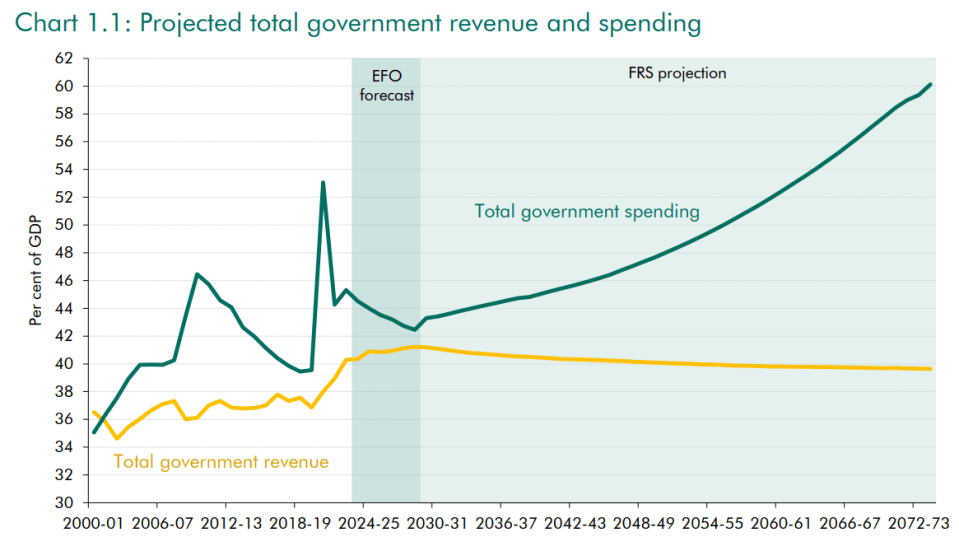
In a report released today, the Office for Budget Responsibility (OBR) forecast that public debt would rise to over 270 per cent of GDP by the mid-2070s, up from just under 100 per cent at the moment, due to a big projected increase in public spending.

The OBR’s forecasts – which are based on stated government policy – suggest public spending will rise to 60 per cent of GDP, from 45 per cent at the moment, whereas revenue will remain flat.

The increase in public spending will mainly be driven by the transition to net zero, the costs of supporting an ageing population and increased geopolitical tensions putting upward pressure on defence spending.

The OBR said rising health spending was likely to be the “single most important driver” of the projected increase in government debt. Health spending is forecast to rise to 14.5 per cent of GDP by 2074, up from 7.9 per cent, largely as a result of demographic changes.
Source: OBR

The triple-lock, meanwhile, will see spending on state pensions rise to 7.9 per cent from 5.2 per cent in the same period.

The biggest single cost to net zero will be the fall in fuel duty revenue as a result of the looming 2035 ban on petrol car sales. Fuel duty revenue is set to fall to 0.1 per cent of GDP from 1.0 per cent.

With the debt pile set to increase significantly, the OBR warned that net interest spending would quadruple to 11.3 per cent of GDP by the 2070s.

“If these pressures and shocks were to materialise as we project, then governments would need to take mitigating policy action to prevent this debt spiral from occurring,” the OBR said.

David Miles, a senior official at the OBR, said: “The report shows…a strategy of staying where we are (on taxes) and increasing government spending in line with demands is unsustainable”.

Read more

Pension pressure to help swell UK debt to three times size of economy

Two older women exercising at an outdoor gym in sunshine

It warned that returning debt to its pre-pandemic levels would require tax increases or spending cuts worth around £40bn per decade over the next 50 years.

If a government opted for spending cuts, the OBR said that this would require “significant improvements” in public sector productivity or “strict prioritisation” between competing pressures.

A government that opted for tax increases would have to weigh up the impact of a higher tax take on “incentives to work, investment and save,” it said.

Although the OBR acknowledged that its forecasts were highly uncertain, it warned that there was a “similar upward debt trajectory in nearly all the alternative scenarios that we consider”. Indeed, if further shocks were added to the forecasts, public debt would surpass 300 per cent of GDP.

However, the report also showed that there were actions which could make a meaningful difference to the path of public debt.

“Limiting the rise in global temperatures to less than 2°C rather than 3°C could alleviate around 10 percentage points of upward pressure on the debt-to-GDP ratio,” the OBR said.

“Improving the health of the population could reduce the rise in debt by a further 40 per cent of GDP,” it added.

Improving productivity would make the biggest difference of all, with every 0.1 per cent increase in productivity growth reducing the rise in the debt-to-GDP ratio by 25 percentage points.

The OBR’s report chimes with a House of Lords report released earlier this week, which urged the government to face the “grim reality” of the growing national debt.

Read more

The devastating prognosis for the UK’s public finances

Dramatic cloud formation over Westminster, capturing a striking skyline with iconic landmarks under a moody sky.

Share this article

  • Facebook
  • X
  • LinkedIn
  • WhatsApp
  • Email

Similarly tagged content:

Sections

  • News

Categories

  • Economics

People & Organisations

  • borrowing
  • national debt
  • OBR
  • public finances
  • Treasury

Related Topics

  • office for budget responsibility

Trending Articles

  • Five-star Mayfair hotel hit with HMRC winding-up petition

  • Revolut takes flight with launch of new airport lounges

  • It’s not just Jason Arday, most of sociology is a scam

  • IT consultant ordered to pay £50,000 after being accused of stealing Soho House members’ personal details

  • As it happened: FTSE 100 falls as Iran and US clash over Strait of Hormuz; Oil stockpiles ‘rapidly depleting’

More from Morning Wire

  • Pension pressure to help swell UK debt to three times size of economy

    Economics
    Two older women exercising at an outdoor gym in sunshine
  • The devastating prognosis for the UK’s public finances

    Economic News/Analysis
    Dramatic cloud formation over Westminster, capturing a striking skyline with iconic landmarks under a moody sky.
  • Government debt repayment ‘could rise to half’ of total taxes

    Economics
    OBR chiefs told the Treasury Select Committee that a higher tax burden could stifle growth.
  • OBR misery makes tax rises inevitable

    Opinion
    Treasury Department building with government bonds signage, representing financial management and bond issuance responsibi...
  • Andy Burnham is on course to rack up the second highest debt interest bill on record

    Opinion
    UK National Debt Clock showing £3 trillion, with Big Ben and the Union Jack in the background.
  • Warning for John Healey as key fiscal target missed

    Economics
    Labour MP John Healey in a professional headshot, likely for news or political profile.
  • Healey faces £24bn spending squeeze as inflation puts tax rises in play

    Economics
    Bank of England headquarters in 2025, showcasing modern architecture and iconic London skyline in the background.
  • The pensions triple lock is a travesty. Our politicians must fess up

    Opinion
    Young people face the risk of failing to save enough in their pension
MorningWire

Independent European business, markets and political news for decision-makers.

Morning Briefing

Europe

  • Germany
  • France
  • Europe
  • UK & Ireland

Business

  • Markets
  • Banking
  • Technology
  • Energy
  • Property
  • Fintech

Editorial

  • Opinion
  • Editorial Policy
  • Corrections
  • Contact

Company

  • About Morning Wire
  • Privacy Policy
  • Terms of Use
  • Cookie Policy
© 2026 Morning Wire Ltd · Published by Morning Wire Media, Bahnhofstrasse 65, 8001 Zürich, Switzerland
Privacy · Terms · Cookies · Facebook