Skip to content
Monday 14 September 2026London --:--Frankfurt --:--Zurich --:--
NewslettersSearchEN · DE · FR
MorningWire

European business, markets and politics

FTSE 100
10,697.57
+0.44%
DAX
25,440.81
-0.50%
CAC 40
8,117.78
-0.76%
STOXX 50
6,260.38
-1.02%
  • Europe
  • Markets
  • Business
  • Economy
  • Regulation
  • Politics
  • Opinion
More
GermanyFranceEU InstitutionsCompetitionPublic AffairsBankingTechnologyEnergy
  • Germany
  • France
  • Europe
  • Markets
  • Business
  • Economy
  • Regulation
  • Politics
  • Opinion
  • DE
Sunday 19 April 2020 3:26 pm  |  Updated:  Sunday 19 April 2020 3:30 pm

OECD boss: Coronavirus crash will not be as bad as Great Depression

By: Stefan Boscia

Add as a preferred source on Google
POLITICS ECONOMY OECD STUDY 2019
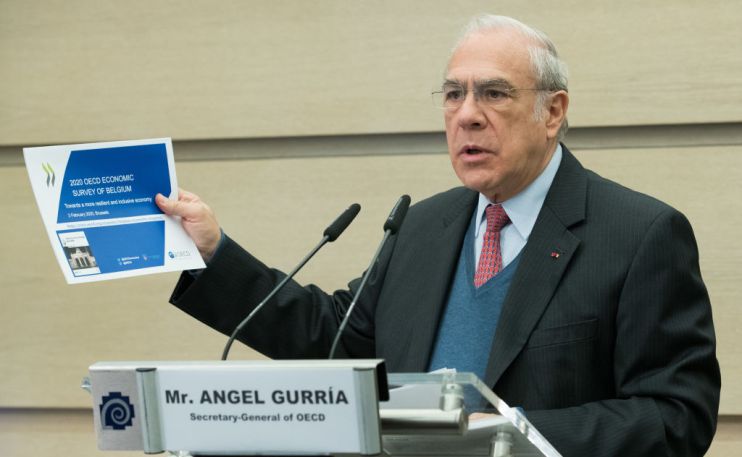
OECD secretary-general Angel Gurria answers questions during a press conference regarding a study on the economical situation of Belgium by the Organisation for Economic Co-operation and Development (OECD), Monday 03 February

The coronavirus economic downturn will be “very bad”, but not as bad as the Great Depression despite fears to the contrary, according to the head of the Organisation for Economic Co-operation and Development (OECD).

Angel Gurria, secretary-general of the OECD, said today that the impending global economic crash will not last for four years like the Great Depression and that he hoped for a recovery by 2021 or 2022.

It was announced on Friday that China’s gross domestic product (GDP) shrank by 6.8 per cent year-on-year between January and March – its first quarterly contraction in decades.

Other OECD countries are expected to follow suit when their first quarter data is released, however there may be a reprieve as China began its coronavirus lockdown far earlier than other nations.

The Office for Budget Responsibility (OBR) said this week it was forecasting a mammoth 35 per cent drop in real UK GDP in the second quarter, with unemployment rising by two million to 10 per cent.

A new study out today by fintech firm Wollit found that self-employed Londoners are expected to be hit particularly hard, with an estimated 37 per cent currently struggling to pay their bills due to the effects of the pandemic.

However, the OBR report also predicted the British economy would “bounce back quickly”.

Gurria, speaking to the BBC today, said he also thought a recovery was possible by next year at the earliest.

“It’s very bad, and it’s going to be very bad, but it’s not the Great Depression, it’s a recession and the difference is that the Great Depression lasted for four years and then of course we had a very bad few years after that,” he said.

“Still, 2020 is going to be a year in which there is going to be negative growth throughout, and there are going to be a lot of wounds. Hopefully [they will be] scars by 2021 and 2022.

Read more

The answer to regional inequality isn’t public money, it’s productivity

Two men setting up a black banner with 10 NORTH in white text on a grey patterned carpet.

“What we have is a situation where as the virus advances and as the crisis advances, we are actually having the immediate consequences on the economic side, i.e. unemployment and the survival, or not, of hundreds of thousands, maybe millions, small and medium enterprises and even very large enterprises related to some of the more vulnerable sectors like tourism, travel, restaurants, etc.”

The government will roll out its job retention scheme tomorrow, which will see the Treasury pay 80 per cent of wages, up to £2,500 a month, to furloughed employees unable to work due to Covid-19.

It will go alongside the government’s £330bn programme of underwriting bank loans to businesses struggling through the coronavirus crisis.

Just over 6,000 businesses have been able to access £1.1bn of loans, prompting calls that the scheme needs to be adjusted to facilitate a greater amount of lending at a faster rate.

The government has guaranteed 80 per cent of each loan, however there are now calls for that to be increased to 100 per cent to incentivise more lending by the banks.

Shadow chancellor Anneliese Dodds told the BBC today that the government’s roll out of the scheme had been poor.

“Our main concern right now is that a number of those programmes are not fulfilling the promise that has been placed on them,” she said.

“I think that’s most critical when it comes to the small business loans programme, so called CBILS (coronavirus business interruption loan scheme.

“We’ve actually seen only about two per cent of businesses benefitting from that programme that could do.

“Now that’s enormously worrying because that means that businesses are going to be going bust when they don’t need to be going bust.”

Read more

The real scrutiny of Burnham begins now

Andy Burnham smiling and playing guitar in Ukraine next to a soldier in uniform adjusting audio equipment

Share this article

  • Facebook
  • X
  • LinkedIn
  • WhatsApp
  • Email

Similarly tagged content:

Sections

  • Markets & Economics

Categories

  • Economics

Trending Articles

  • Wetherspoon boss: ‘Not up to Burnham’ to choose who is on the high street 

  • Revolut facing extortion threat after hackers steal customers’ data

  • Former Formula 1 champion loses £1.4m HMRC tax bill appeal

  • Reform hits back at Tory plan to ‘abolish inheritance tax’

  • Four interest rate hikes loom despite surprise economic growth

More from Morning Wire

  • The answer to regional inequality isn’t public money, it’s productivity

    Opinion
    Two men setting up a black banner with 10 NORTH in white text on a grey patterned carpet.
  • The real scrutiny of Burnham begins now

    Opinion
    Andy Burnham smiling and playing guitar in Ukraine next to a soldier in uniform adjusting audio equipment
  • Limbic Becomes First AI-Led Mental Healthcare Company Selected for FDA TEMPO

    Business Wire
  • Anthropic touts ‘strongest safeguards’ as AI warning dogs IPO push

    Tech
    Dario Amodei, CEO of Anthropic, speaking at a tech conference podium, wearing a suit and addressing the audience.
  • The decline of Harvey Nichols is a tale of London’s decline too

    Opinion
    Harvey Nichols department store at night, illuminated with neon signs and colorful window displays.
  • 22 months of cuts: Jobs crisis deepens despite growth boost 

    Economics
    London has defied national trends as job postings in the capital rose.
  • Fintech leaders still back the UK. Don’t make them regret it

    Opinion
    Sleek modern design of Revoluts new office space featuring open workstations and collaborative meeting areas
  • Londoners can no longer afford the Notting Hill Carnival

    Opinion
    Joyful reveler in vibrant feathered and jeweled costume at Notting Hill Carnival 2025, holding a pink mug.
MorningWire

Independent European business, markets and political news for decision-makers.

Morning Briefing

Europe

  • Germany
  • France
  • EU Institutions
  • Europe

Business

  • Markets
  • Business
  • Economy
  • Regulation
  • Competition
  • Public Affairs

Editorial

  • Opinion
  • Editorial Policy
  • Corrections
  • Contact

Company

  • About Morning Wire
  • Privacy Policy
  • Terms of Use
  • Cookie Policy
© 2026 Morning Wire Ltd · Published by Morning Wire Media, Bahnhofstrasse 65, 8001 Zürich, Switzerland
Privacy · Terms · Cookies · Facebook