Skip to content
Friday 21 August 2026London --:--Frankfurt --:--Zurich --:--
NewslettersSearchEN · DE · FR
MorningWire

European business, markets and politics

FTSE 100
10,810.28
+0.58%
DAX
26,117.98
+0.52%
CAC 40
8,479.18
+0.31%
STOXX 50
6,457.28
+0.55%
  • Europe
  • Markets
  • Business
  • Economy
  • Regulation
  • Politics
  • Opinion
More
GermanyFranceEU InstitutionsCompetitionPublic AffairsBankingTechnologyEnergy
  • Germany
  • France
  • Europe
  • Markets
  • Business
  • Economy
  • Regulation
  • Politics
  • Opinion
  • DE
Wednesday 25 August 2021 2:52 pm  |  Updated:  Friday 05 November 2021 3:09 pm

ONS: Remote working to stimulate employment among older Brits, adding billions to UK economy

Remote working could stimulate employment rates among older workers, potentially adding billions to the UK economy, according to fresh figures published today. 

Data from the Office for National Statistics shows older workers who have switched to working from home entirely are more likely to retire later than those who are still working in physical work spaces.

In June and July of last year, 11 per cent of older workers who were working entirely from home were more likely to retire later, compared to five per cent of those not working from home, the ONS said.

According to the statistics agency’s estimates, if employment rates among older workers matched those aged between 35 and 49, it would add £88bn to the UK economy.

Tom Selby, head of retirement policy at AJ Bell, said: “The early exit of people aged between 50 and state pension age from the workforce has a significant impact on both individual retirement plans and the wider economy.”

“While in some cases stopping work early will be a voluntary decision – for example as a result of early retirement – in other situations it will be less voluntary, such as ill-health.”

Access to remote working could narrow economic inactivity – a measure of whether people are engaged in the labour market – disparities between older men and women, the ONS study found.

Read more

Britain should look to Japan to manage its ageing population

Elderly pedestrians crossing a busy street in Tokyo, illustrating Japans ageing population challenge.

“At age 50 years, 17.9 per cent of women were economically inactive compared with 9.6 per cent of men and at age 64 years, 58.6 per cent of women compared with 44.9 per cent of men,” the ONS said.
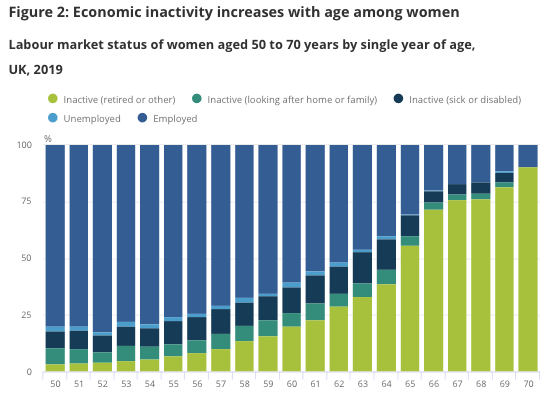
SOURCE: ONS

A large proportion of older female workers are economically inactive due to them being more likely to have to look after family members or their home. The ONS’s data indicates having access to remote working opportunities could enable female workers to balance home care responsibilities and their jobs.

Higher levels of economic inactivity rates among women is likely to exacerbate inequality in retirement resources between men and women.

“Women are more likely to stop working early than men, potentially further perpetuating the gap in pensions between the sexes,” Selby added.

Older workers in their 50s typically increase pensions contributions as they approach retirement due to having fewer expenditure pressures. 

Selby continued: “Stopping working in your 50s – when in theory your earning power and ability to save should be at its highest – could also have a significant impact people’s retirement outcomes.”

“In many cases it will mean making your retirement income stretch for much longer, meaning you have to live for less in your later years.”

Read more

Staff would turn down promotion to keep flexibility at work

Keir Starmer is heading to China

Share this article

  • Facebook
  • X
  • LinkedIn
  • WhatsApp
  • Email

Similarly tagged content:

Sections

  • Markets & Economics

Categories

  • Business
  • Economics

Trending Articles

  • House prices in wealthy London boroughs fall by up to £300,000

  • As it happened: Miners fuel FTSE 100 recovery; oil jumps as Trump claims Strait of Hormuz

  • City law firm sues prominent Emirati business family

  • Amanda Blanc has worked her magic at Aviva

  • As it happened: FTSE 100 rallies after JD Sports drags on blue chips; oil jumps again

More from Morning Wire

  • Britain should look to Japan to manage its ageing population

    Opinion
    Elderly pedestrians crossing a busy street in Tokyo, illustrating Japans ageing population challenge.
  • Staff would turn down promotion to keep flexibility at work

    Retail
    Keir Starmer is heading to China
  • Top court ‘opens the floodgates’ for part-time workers’ claims

    Lawsuit
    Supreme Court building under clear sky, symbolizing justice and authority, relevant to recent judicial news coverage
  • Burnham’s devolution drive could ‘push 90,000 jobs out of London’

    Economics
    In 2022, rolling Tube strikes led to massive queues for crowded buses. (Photo by Chris J Ratcliffe/Getty Images)
  • London workers most exposed to AI jobs cull

    Economics
    London skyline with modern skyscrapers and lush green foliage in foreground on a clear day, highlighting urban nature balance
  • Starmer’s final act will expose firms to more bogus equality claims

    Opinion
    Business conference attendees networking at a corporate event with banners and presentation screens in the background
  • Goldman: Junior white-collar workers squeezed hardest by AI hiring slump

    AI
    People waiting outside a job centre, highlighting unemployment issues and job search challenges in the current economy.
  • Half of Gen Z Workers Report AI Guilt Despite Rising Demand for AI Skills

    Business Wire
MorningWire

Independent European business, markets and political news for decision-makers.

Morning Briefing

Europe

  • Germany
  • France
  • EU Institutions
  • Europe

Business

  • Markets
  • Business
  • Economy
  • Regulation
  • Competition
  • Public Affairs

Editorial

  • Opinion
  • Editorial Policy
  • Corrections
  • Contact

Company

  • About Morning Wire
  • Privacy Policy
  • Terms of Use
  • Cookie Policy
© 2026 Morning Wire Ltd · Published by Morning Wire Media, Bahnhofstrasse 65, 8001 Zürich, Switzerland
Privacy · Terms · Cookies · Facebook