Skip to content
Thursday 20 August 2026London --:--Frankfurt --:--Zurich --:--
NewslettersSearchEN · DE · FR
MorningWire

European business, markets and politics

FTSE 100
10,712.87
-0.28%
DAX
25,982.14
-0.42%
CAC 40
8,472.06
-0.35%
STOXX 50
6,426.72
-0.28%
  • Europe
  • Markets
  • Business
  • Economy
  • Regulation
  • Politics
  • Opinion
More
GermanyFranceEU InstitutionsCompetitionPublic AffairsBankingTechnologyEnergy
  • Germany
  • France
  • Europe
  • Markets
  • Business
  • Economy
  • Regulation
  • Politics
  • Opinion
  • DE
Tuesday 07 April 2026 5:00 am  |  Updated:  Monday 06 April 2026 4:21 pm

OpenAI calls for ‘tax on automated labour’ as it sounds alarm on economic risks

By: Simon Hunt

City Editor

Add as a preferred source on Google
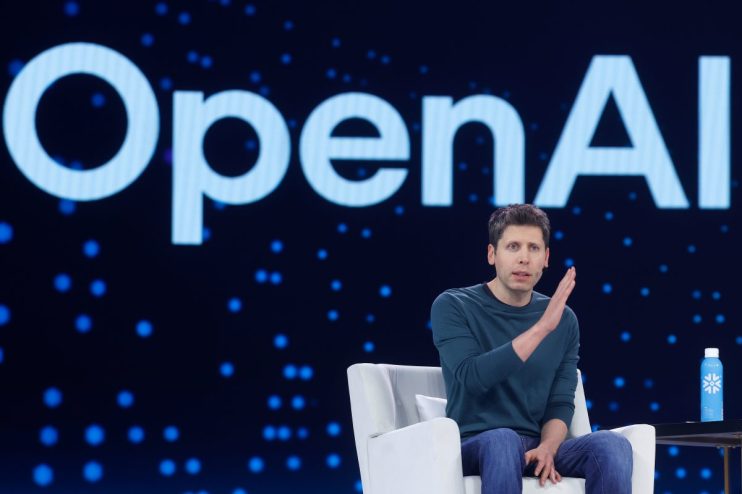
Sam Altman discussing OpenAIs ChatGPT advancements at a press conference, emphasizing AI innovation and future developments
OpenAI has called for a reduction in the reliance on payroll taxes

OpenAI has called for a tax on automated labour as the firm laid bare the scale of the structural risks to the global economy that could be wrought by the rise in artificial intelligence.

In a wide-ranging set of proposals in a paper described as “Industrial Policy for the Intelligence Age”, the ChatGPT maker called for major economies to reduce their reliance on income and other payroll-based taxes in favour of greater taxes on corporations and capital gains.

The paper called for “increasing reliance on capital-based revenues” including greater taxes on profits and “targeted measures on sustained AI-driven returns” including a tax on automated labour.

OpenAI said the reforms should be paired with wage-linked incentives that encourage firms to retain and retrain workers, in a bid to soften the blow of widening unemployment that could come as a consequence of more and more jobs being automated.

“While we strongly believe that AI’s benefits will far outweigh its challenges, we are clear-eyed about the risks—of jobs and entire industries being disrupted; bad actors misusing the technology; misaligned systems evading human control; governments or institutions deploying AI in ways that undermine democratic values; and power and wealth becoming more concentrated instead of more widely shared,” OpenAI said.

“We should be clear-eyed about the resilience required here. These new risks won’t be isolated or suitable for addressing one at a time—AI will reshape how work is performed, how decisions are made, how organizations operate, and how states interact. Building resilience therefore means making sure people and institutions can adapt quickly, maintain meaningful agency over how these systems are used, and preserve broadly shared prosperity even as economic and social structures evolve.”

Reliance on payroll taxes

The tax suggestions, which form part of a sweeping set of proposals spanning 13 pages, could be construed as an attempt by OpenAI to show that potential damage to the economy from advances in AI can be mitigated through government changes to fiscal policy, amid growing fears of AI sparking a wave of high unemployment across the developed world.

OpenAI’s proposals, if introduced, would mark a dramatic change to the way most governments in advanced economies collect taxes. In the UK, almost half of all government tax receipts are collected from income tax and national insurance, while only around 11 per cent comes from corporation tax and around 4 per cent comes from capital gains tax.

Over the past two years, Labour has increased the government’s reliance on payroll-based taxes, by freezing the income tax threshold until the end of the parliament and reducing the threshold at employer national insurance is paid, in a set of measures designed to raise tens of billions in extra receipts for the exchequer.

“History shows that democratic societies can respond to technological upheaval with ambition: reimagining the social contract, mediating between capital and labor, and encouraging broad distribution of the benefits of technological progress while preserving pluralism, constitutional checks and balances, and freedom to innovate,” OpenAI said.

“The transition to superintelligence will require an even more ambitious form of industrial policy, one that reflects the ability of democratic societies to act collectively, at scale, to shape their economic future so that superintelligence benefits everyone.”

Read more

Voters expect Burnham to hike taxes

Andy Burnham discussing capital gains tax increase during a press conference, highlighting potential economic impacts

Share this article

  • Facebook
  • X
  • LinkedIn
  • WhatsApp
  • Email

Similarly tagged content:

Sections

  • News

Categories

  • Business
  • Economics

People & Organisations

  • Capital Gains Tax
  • ChatGPT
  • fiscal policy
  • Income Tax
  • Labour Party
  • National Insurance
  • OpenAI
  • Rachel Reeves
  • UK economy

Trending Articles

  • Jobless Banquet: Youth unemployment surge ‘sends Neets to KFC’

  • City law firm sues prominent Emirati business family

  • Amanda Blanc has worked her magic at Aviva

  • As it happened: Miners fuel FTSE 100 recovery; oil jumps as Trump claims Strait of Hormuz

  • House prices in wealthy London boroughs fall by up to £300,000

More from Morning Wire

  • Voters expect Burnham to hike taxes

    Politics
    Andy Burnham discussing capital gains tax increase during a press conference, highlighting potential economic impacts
  • Top economists shun Burnham over wealth taxes

    Politics
    Andy Burnham speaking at a press conference, expressing confidence despite challenges, highlighting leadership and resilie...
  • Burnham told to launch £100bn tax reform package

    Politics
    Andy Burnham speaking at a press conference, wearing a suit, addressing key issues in Greater Manchesters development.
  • OpenAI’s proposed ‘Trump stake’ raises ‘governance overhang’ fears ahead of IPO

    Tech
    Sam Altman discussing OpenAIs ChatGPT advancements at a press conference, emphasizing AI innovation and future developments
  • Cognita Reply Named an OpenAI Advanced Partner to Accelerate Enterprise Adoption of Frontier AI

    Business Wire
  • Brits fear AI is slipping out of human control after ‘rogue’ systems escape tests

    Tech
    Dario Amodei, CEO of Anthropic, speaking at a tech conference podium, wearing a suit and addressing the audience.
  • Anthropic subscriptions overtake OpenAI in the UK, fresh data suggests

    AI
    Smartphone displaying the Claude by Anthropic AI assistant app, showing the app icon and interface.
  • Cloudflare Announces Research Pilot with OpenAI

    Business Wire
MorningWire

Independent European business, markets and political news for decision-makers.

Morning Briefing

Europe

  • Germany
  • France
  • EU Institutions
  • Europe

Business

  • Markets
  • Business
  • Economy
  • Regulation
  • Competition
  • Public Affairs

Editorial

  • Opinion
  • Editorial Policy
  • Corrections
  • Contact

Company

  • About Morning Wire
  • Privacy Policy
  • Terms of Use
  • Cookie Policy
© 2026 Morning Wire Ltd · Published by Morning Wire Media, Bahnhofstrasse 65, 8001 Zürich, Switzerland
Privacy · Terms · Cookies · Facebook