Our obsession with George Orwell has robbed his name of all meaning

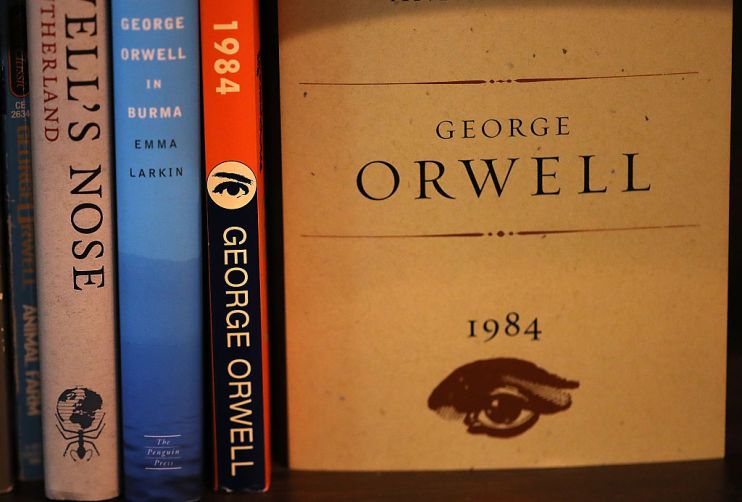
The very first rule for writing set out in George Orwell’s 1949 essay “Politics and the English Language” is: “Never use a metaphor, simile, or other figure of speech which you are used to seeing in print”.
It’s therefore amusing that “Orwellian” has become one of the most widely used figures of speech in English-language political writing, social criticism, and wider journalism. And to make matters worse for Orwell, it is often meant to describe something that he himself would have loathed, just as “Kafkaesque” describes something Kafka would have hated.
In his essay, Orwell was attacking political euphemism and vagueness, and its role in what he saw as the wider decline of language.
But the reasoning behind that first little rule of his is sound in all contexts: a word or phrase which once might have struck a reader as inventive and illuminating becomes less and less evocative with its every use until, finally, it retains only its simplest possible connotations — or none at all.
Orwell gives among his examples the phrase “swan song” — used often enough, but not (I imagine) putting many in mind of the
Ancient Greek idea that a swan sings a single beautiful song before its death.
Now the word “Orwellian” itself ensnares writers in a similar trap. It has, or rather should have, rather specific and depressing connotations. But — and I have asked around — it no longer makes anyone think of 1984’s Winston Smith, scribbling anxiously in his diary or scratching at his varicose ulcer, fearing always the all-seeing eye of Big Brother and the horrors of Room 101. Nor does it evoke the deliberate erosion of language for the purposes of the destruction of independent thought.
Rather, it has come to mean something like “a bit controlling”, and its chronic overuse means that it is unlikely to produce in the reader any stronger reaction than a raised eyebrow or a sigh. In Orwell’s time, the equivalent word was likely “fascist”, which he wrote had “no meaning except in so far as it signifies ‘something not desirable’”.
This is not to say that there is nothing going on in the world today that is intrusive, restrictive, or dehumanising. Far from it. But the architects of such situations, ideas and conditions get off lightly if all anyone can throw at them is the charge of “Orwellian”, rather than subject their thoughts and creations to the proper level of scrutiny.
Not only has the word “Orwellian” been mostly stripped of its meaning, but it has lost all its nuance.
The Washington Post reported a few years ago that the Centers for Disease Control and Prevention had struck words including “transgender” and “diversity” from the budget reports it made for the Trump administration. This year, it was revealed that facial recognition technology — which is both invasive and imprecise, especially so in the cases of women and people of colour — was to be rolled out across the UK. Then there is the continued existence of autocratic states like North Korea, which Christopher Hitchens once argued was worse than Orwell’s Airstrip One.
All of these examples might be — and, in fact, have been — called “Orwellian”. But they differ strikingly from one another. If you follow Orwell’s reasoning, each demands precise and clear descriptions if their faults are to be held up to the light, understood and, with any luck, addressed.
Lazy political language is harmful, as Orwell tells us, and vulnerable to manipulation. His own almost neurotic interest in clear prose as a prerequisite for clear thought and an instrument for its expression is plain to see throughout this work, which makes the overuse of his name as a nebulous synonym for “a bit disturbing” today especially ironic.
The New York Times pointed out some years ago that the word to which Orwell gives his name “even noses out the rival political reproach ‘Machiavellian’, which had a 500-year head start”.
It is, the report went on, “the most widely used adjective derived from the name of a modern writer”. Even the briefest Google search seems to bear this out. Only today, I learned that “Orwellian” has been applied to the music video for a new single by Coldplay, to the media’s reporting on the coronavirus outbreak, and to the banning of cash transactions over $10,000 in Australia.
Apparently, then, everything is now “Orwellian”. And that should make it plain to anyone who had any doubt that the word had been robbed of all meaning that it might just be time to come up with a suitable substitute.
Main image credit: Getty