Productivity is 16 percentage points below G7 average – the widest gap since 1993

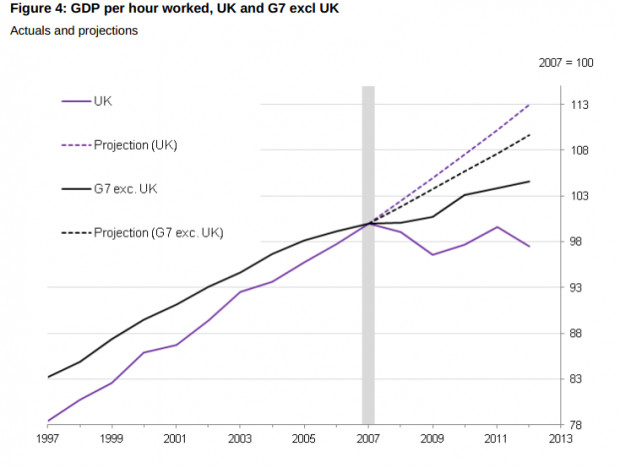
Compared with the other major industrialised economies, UK output per hour was 16 percentage points below average in 2012.
Output per worker basis came in at 19 percentage points lower than the average for the rest of G7 for 2012, according to latest figures from the Office of National Statistics (ONS).
Both output per hour and per worker fell in 2012 compared with 2011 in the UK. Across the G7, these measures both increased from 2011 to 2012.
(Office for National Statistics)
Howard Archer, chief UK and european economist at IHS Global Insight, comments on the productivity data:
The extent to which the weakness in the UK’s productivity has been structural rather than cyclical has vital implications for the economy’s growth potential and for policy. Particularly relevant at the moment, the Bank of England is assuming that productivity will pick up appreciably as UK recovers with the result that the unemployment rate will come down gradually. This is a key factor in the Bank of England’s view that the unemployment rate will not come down to 7.0% before mid-2016 with the result that it is unlikely to raise interest rates before then.
If much of the weakness of productivity is cyclical, then it clearly should improve markedly as the economy recovers.
An element of the UK’s poor productivity performance does appear to have been companies’ willingness to hold on to workers, particularly when the workers are skilled or experienced. There have also been reports that some companies employed more people, or at least retained workers, as they found winning and delivering work more resource intensive in an environment of persistently weak demand. For example, extended weak housing market activity clearly hit the productivity of estate agents as it is took them longer to sell a house.
There are other factors that could have hurt productivity on a more lasting basis. There is concern about the impact of “zombie” companies that are essentially being kept alive by low interest rates and banks’ reluctance to write off loans. Not only are these companies generally unproductive, but there is concern that they are preventing credit and resources being reallocated to newer companies and backing new products and processes.
There is particular concern that an extended inability to access capital has held back innovation and investment by smaller companies.
A marked overall decline in business investment during 2009-2012 may have significantly damaged UK productivity as a number of companies failed to invest to upgrade dated capacity or adapt latest technology and production techniques.
From the ONS:
Average productivity growth between 1997 and 2007 for the rest of the G7 was lower than in the UK (around 1.9%, compared with 2.5% for the UK), and productivity performance since 2007 has on average been somewhat stronger, implying a smaller productivity gap of around 5 percentage points on the same basis.

(Office for National Statistics)
From the ONS:
GDP per hour workedUK productivity in 2012 was:• Marginally below that of Canada and Italy• Below that of Germany and France by 24 percentage points• Below that of the US by 29 percentage pointsHowever, Japanese GDP per hour worked was 16 percentage points below that of the UK.

GDP per workerFirst estimates for 2012 show UK output per worker:• Below that of Canada and Germany by 5 percentage points• Below that of Italy and France by 10-11 percentage points• Below that of the US by 40 percentage pointsHowever, Japanese GDP per worker was 11 percentage points below that of the UK.

There are considerable differences in average hours worked across the G7, although the general long term trend is towards lower average hours. Differences between countries reflect cultural, legislative and compositional differences, for example between shares of full-time and part-time employment. Average hours in the UK are around the average of the G7, and have fallen less than in Japan, Germany and France. The difference in average hours in 2012 between the US (where average hours are highest among the G7) and Germany (lowest) is equivalent to a difference of around eight hours per week. (ONS)