Skip to content
Saturday 12 September 2026London --:--Frankfurt --:--Zurich --:--
NewslettersSearchEN · DE · FR
MorningWire

European business, markets and politics

FTSE 100
10,650.44
+0.39%
DAX
25,568.56
+0.82%
CAC 40
8,179.77
+0.78%
STOXX 50
6,325.13
+0.90%
  • Europe
  • Markets
  • Business
  • Economy
  • Regulation
  • Politics
  • Opinion
More
GermanyFranceEU InstitutionsCompetitionPublic AffairsBankingTechnologyEnergy
  • Germany
  • France
  • Europe
  • Markets
  • Business
  • Economy
  • Regulation
  • Politics
  • Opinion
  • DE
Thursday 31 October 2019 6:31 am  |  Updated:  Thursday 31 October 2019 9:26 am

Tax cuts could do for our economy today what the Reformation did 502 years ago

By: Ben Ramanauskas

Add as a preferred source on Google
Reformation
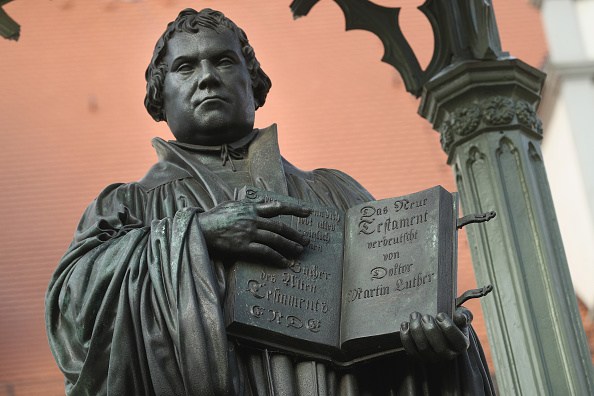
WITTENBERG, GERMANY - OCTOBER 20: A statue of 16th-century theologian Martin Luther stands on Marktplatz square on October 20, 2016 in Wittenberg, Germany. In 1517 Luther nailed his 95 theses to a door of the nearby Schlosskirche Church. Next year will mark the 500th anniversary of the Reformation that Luther set in motion and that led to the creation of successful Protestant movements in history's most significant challenge to the Catholic Church. Celebrations and events in Germany will begin later this month and continue globally through next year. Luther's translation of the Bible made it accessible to a much broader audience. He also spoke out against the practice of indulgences and the sale of relics, and also argued that a place in Heaven is possible not by good deeds but through faith. (Photo by Sean Gallup/Getty Images)

On this day in 1517, German monk Martin Luther nailed his 95 Theses to the door of All Saints’ church in Wittenberg.

In so doing, Luther set in motion a series of events which would have a dramatic impact on the political landscape of Europe, transform the economy, and alter the lives of ordinary people across the world.

Luther’s Theses contained a list of examples where he believed that the teaching and practices of the Catholic Church were contrary to the Bible. He argued that the Bible taught that forgiveness of sins and eternal life were obtained not by performing good works or at the say-so of a priest, but through faith in Jesus Christ.

The central tenet of the Reformation – that a person is justified by faith – produced an economic shift in sixteenth-century Europe. 

For example, a 2017 study found that the Reformation led to a drop in the number of people training to be priests and a move towards degrees in law and the arts. 

This makes perfect sense. If you believe that your soul will spend eternity in Hell if you don’t behave, it is wise to lock yourself away and devote yourself to prayer and good works. But if justification is a gift obtained through faith, you are freed up to do something more productive with your time.

This paradigm shift also impacted what ordinary people spent their money on. In Luther’s day it was common for people to buy indulgences from the Church. These “guaranteed” purchasers or their loved ones time off from Purgatory and a fast track to Heaven in exchange for money. 

Read more

The forgotten masterpiece that helped shape the modern English language

Woman with closed eyes praying over an open Book of Common Prayer on a bed

This was a good deal for the Church. Pope Leo X increased the use of indulgences in order to finance the rebuilding of St Peter’s Basilica, complete with the catchy marketing slogan: “as soon as a coin in the coffer rings, a soul from Purgatory springs”. But as a result of the Reformation, people’s beliefs evolved and they started spending their money on other things, such as food and drink (spurring the economy), or on educating their children (upskilling the workforce).

Liberated from external market distortions, people were free to earn and spend their money in the most productive ways. Economic growth boomed as a result.

This goes to show that what we believe matters – for politics, for the economy, and for society. It was true in the sixteenth century and, as our political parties gear up for an election campaign, it is true today. People work in order to provide for themselves and their families. When they are in control, they make more efficient decisions.

However, the high level of taxation in this country leads to the belief that people are working for the taxman, not for themselves. This results in people engaging in unproductive activity, such as working fewer hours or trying various methods to pay less tax. 

The UK has been suffering years of stagnant productivity, and the tax code is part of the problem. Allowing people to keep more of their own money and spend it on what they value will go some way to tackling this productivity puzzle.

Half a millennium on from the start of the Reformation, our beliefs still shape what we do for a living and how we spend our money. Whoever triumphs in this election, they would do well to remember this, and give us all a tax cut.

Main image credit: Getty

Read more

Exclusive: Rugby League monitoring Henry Pollock amid £1m Hearn wage demands

A young man with blonde hair and a dark shirt, clenching his fist and smiling, likely celebrating or cheering.

Share this article

  • Facebook
  • X
  • LinkedIn
  • WhatsApp
  • Email

Similarly tagged content:

Sections

  • Markets & Economics
  • News
  • Opinion

Categories

  • Economics
  • Opinion
  • Politics

Related Topics

  • General election 2019
  • Tax

Trending Articles

  • Serie A won’t catch the Premier League by selling its rights better

  • Last Night, a Star-studded Evening Celebrating Moncler’s Fifth Avenue Flagship Ushered in a New Chapter in the Brand’s Enduring Love Story With New York

  • Crystal Palace agree deal with HSBC that paves way for new training ground

  • Lotus, Porsche and Corvette: the best sports cars to buy in 2026

  • Claridge’s swings to £10m loss as luxury hotel warns on ‘adverse impact’ of tax hikes

More from Morning Wire

  • The forgotten masterpiece that helped shape the modern English language

    Life&Style
    Woman with closed eyes praying over an open Book of Common Prayer on a bed
  • Exclusive: Rugby League monitoring Henry Pollock amid £1m Hearn wage demands

    Sport Business
    A young man with blonde hair and a dark shirt, clenching his fist and smiling, likely celebrating or cheering.
  • The St Paul’s Cathedral Fabric outrage is a ridiculous moral panic

    Life&Style
    St Pauls Cathedral interior with an audience, grand architecture, chandeliers, and decorative fabric details
  • England stars back player-led calls for Fifa president Infantino to quit

    Sport Business
    Gianni Infantino speaking with a man in a chefs jacket at a formal event
  • War and tax: How the UK economy could get knocked off course

    Economics
    Andy Burnham speaking at a public event, emphasizing local governance and policy changes, wearing a suit and gesturing pas...
  • Healey revives ‘price-gouging’ threat as cost of living options narrow

    Politics
    Chancellor John Healey smiling, wearing a navy suit, white shirt, and red tie.
  • Holiday Inn owner suffers Middle East slowdown as Iran war hits tourism

    Hospitality
    IHG opened 17,500 rooms across 98 hotels throughout the quarter.
  • US bond market jitters spark UK economy recession warning

    Economics
    Donald Trump delivering a speech at a podium during a formal event, emphasizing key points to an attentive audience.
MorningWire

Independent European business, markets and political news for decision-makers.

Morning Briefing

Europe

  • Germany
  • France
  • EU Institutions
  • Europe

Business

  • Markets
  • Business
  • Economy
  • Regulation
  • Competition
  • Public Affairs

Editorial

  • Opinion
  • Editorial Policy
  • Corrections
  • Contact

Company

  • About Morning Wire
  • Privacy Policy
  • Terms of Use
  • Cookie Policy
© 2026 Morning Wire Ltd · Published by Morning Wire Media, Bahnhofstrasse 65, 8001 Zürich, Switzerland
Privacy · Terms · Cookies · Facebook