Sanae Takaichi rolled the dice and won – what next?

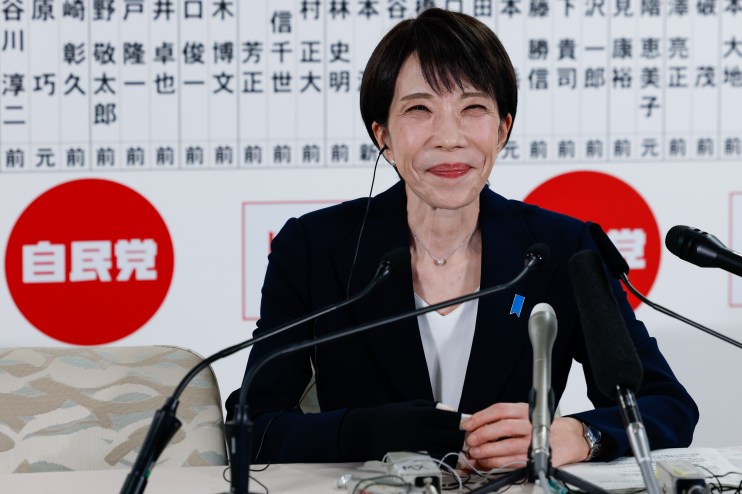
Japanese Prime Minister Sanae Takaichi secured a commanding victory in a snap general election, clinching a two-thirds supermajority that signals a new, more assertive phase in the country’s economic and foreign policy, says Helen Thomas
Japanese prime minister Sanae Takaichi’s decision to call a snap general election was a high-risk move. Just like investment theory would suggest, it has now delivered a high-reward outcome. Riding a wave of popularity that local media have dubbed sanakatsu (roughly translated as “Sanae mania”) Takaichi has secured a commanding victory, with her party and its coalition partner Ishin clinching a two-thirds supermajority in the lower house of the Diet.
For investors, policymakers and Japan’s allies alike, the result is more than a routine electoral win. It potentially marks the start of a new, more assertive phase in Japanese economic and foreign policy that blends reflationary economics, fiscal activism and a hawkish security stance.
Snap elections are always a roll of the dice. Call them too early and voters may see naked opportunism; call them too late and momentum can evaporate. Takaichi timed hers to capitalise on robust approval ratings and a fragmented opposition. Despite taking place in snowy wintry conditions for the first time in over 30 years, and with the shortest campaign period in post-war history, the strategy paid off handsomely.
The hastily assembled opposition bloc, the Centrist Reform Alliance, entered the race with hopes of consolidating anti-government votes. Instead, it emerged with its seat count roughly halved. Lacking a coherent message and struggling to match Takaichi’s media presence, the alliance failed to persuade voters that it was a credible alternative government.
The scale of the ruling coalition’s victory is significant. A two-thirds majority in the lower house gives the government the ability to override the upper house on legislation. Even if the government lacks a majority in the upper chamber, it can still push through bills rejected there. In practical terms, this removes a major legislative bottleneck and gives Takaichi unusual room to manoeuvre for a Japanese prime minister.
That room to manoeuvre is likely to be used quickly. Takaichi has signalled a revival of the reflationary playbook associated with the Abenomics era. Markets are already focusing on the prospect of a temporary cut to the consumption tax, a pre-election campaign measure that earlier rattled the Japanese government bond (JGB) market and put pressure on the yen.
With a strong mandate behind her, that tax cut now looks far more likely to materialise. The broader direction is clear: Japan is preparing to run its economy hotter. That implies tolerance for a weaker currency, higher nominal growth and, potentially, higher interest rates.
For years, Japan wrestled with deflationary psychology and anaemic demand. The new policy mix suggests a deliberate break from that mindset. The government appears willing to accept some market volatility in pursuit of sustained inflation and wage growth.
Attention is now turning to the Bank of Japan. Monetary policy coordination, or more likely tension, will be crucial. A scheduled speech on Friday by BOJ board member Tamura, known for his relatively hawkish leanings, will be parsed closely for clues about how comfortable the central bank is with a more reflationary fiscal stance. If fiscal and monetary policy move in the same general direction, the shift in Japan’s macro regime could be significant.
Hawkish
The election was not only about economics. Takaichi has taken a more hawkish line on defence and national security than many recent Japanese leaders. Her positions on military preparedness and regional deterrence were once viewed as potentially divisive. The election result suggests they are now firmly within the mainstream of Japanese politics.
This has regional implications. A stronger domestic mandate reduces the effectiveness of external pressure aimed at isolating or discouraging Tokyo from a firmer security posture. It also signals that Japanese voters are, at minimum, comfortable with a government that speaks more bluntly about geopolitical risks.
Washington’s reaction has been notably warm. US Treasury Secretary Scott Bessent publicly welcomed the result, calling Takaichi “a great ally” and confirming “when Japan is strong, the US is strong in Asia”. His remarks underline how closely financial and security considerations are intertwined in the US-Japan relationship.
Takaichi’s own response on social media was characteristically direct. Declaring that the potential of the US-Japan alliance is “LIMITLESS” (note the Trumpian capital letters), she framed the election outcome as not just a domestic endorsement but a platform for deeper cooperation with Washington.
For markets, that alignment matters. A Japan that is both fiscally expansionary at home and tightly aligned with the US abroad could play a larger role in regional economic and security architectures. That, in turn, influences capital flows, defence spending and currency dynamics.
Perhaps the most striking aspect of the result is how personal it is. Takaichi has managed to translate approval ratings into concrete electoral dominance. In a political system where leaders often cycle quickly and factions matter, that is no small feat.
A large mandate, however, brings large expectations. Delivering stronger growth, managing debt sustainability, navigating monetary normalisation and handling a complex security environment will test even a well-positioned government.
For now, though, the verdict from voters is clear. Takaichi took a gamble on the electorate. The electorate, in turn, handed her the numbers to try to reshape Japan’s economic and strategic trajectory. Whether this moment becomes a turning point for Japan’s long-term revival will depend on what she does with that rare political capital.
Helen Thomas is founder and CEO of Blonde Money