Scientists have found a way to create diamonds in a lab

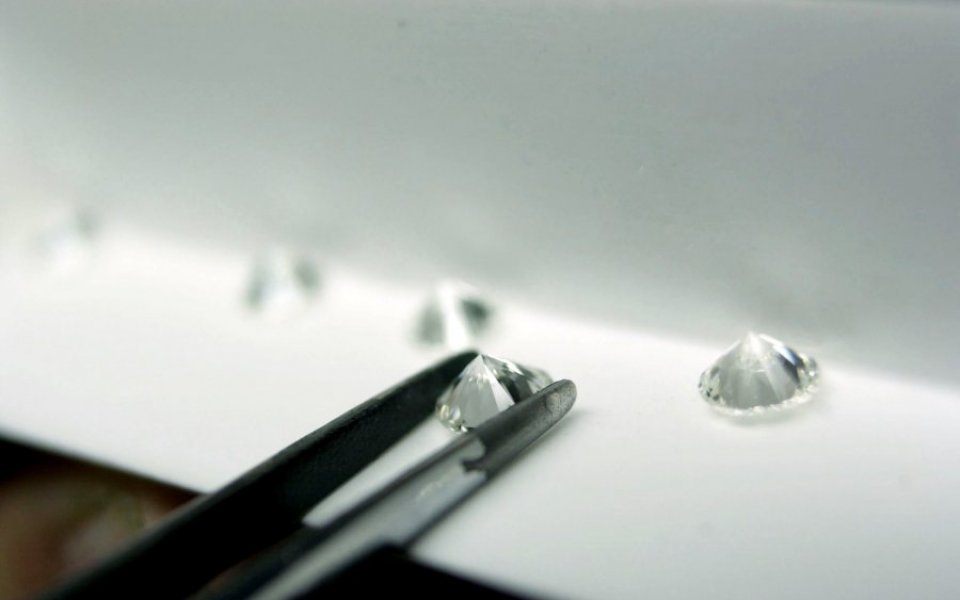
A discovery by scientists in the US could make it possible to create diamonds under simple lab conditions.
The team from North Carolina State University developed a new kind of carbon structure, called Q-carbon, which is fundamentally different from all other solid forms of the material. When Q-carbon is treated with laser pulses followed by rapid cooling, it can be transformed into a variety of single-crystal diamond objects.
This doesn't mean huge, glistening gems will suddenly be shipped from science laboratories around the world, but extremely strong materials could be produced for industrial purposes.
Read more: All that glitters: Should you buy diamonds as an investment?
"We can create diamond nanoneedles or microneedles, nanodots, or large-area diamond films, with applications for drug delivery, industrial processes and for creating high-temperature switches and power electronics," explained lead researcher Jay Narayan.
These diamond objects have a single-crystalline structure, making them stronger than polycrystalline materials. And it is all done at room temperature and at ambient atmosphere – we're basically using a laser like the ones used for laser eye surgery. So, not only does this allow us to develop new applications, but the process itself is relatively inexpensive.
Q-carbon is created by coating a substrate, such as a plastic polymer, with amorphous carbon – the material in its elemental form before it adopts a specific structure. This is then blasted with a single laser pulse that lasts around 200 nanoseconds. The temperature of the amorphous carbon is then raised extremely high and rapidly cooled to create Q-carbon.
"We've now created a third solid phase of carbon," said Narayan, referring to the fact graphite and diamond are the only natural solid carbon structures.
"The only place it may be found in the natural world would be possibly in the core of some planets."
Read more: Mixing diamonds and graphene could revolutionise engineering
So how do you go from Q-carbon to diamond? All you have to do, the researchers found, is interfere with the cooling process after the temperature has been raised extremely high – the cooling rate determines the way in which the carbon atoms are arranged relative to one another.
Because Q-carbon is harder than diamond, and is attracted to magnetic fields – a quality the researchers thought was impossible in a carbon material – the researchers think it could be used for other purposes beyond diamond manufacturing: "Q-carbon's strength and low work-function – its willingness to release electrons – make it very promising for developing new electronic display technologies," Narayan said.
For the time-being, however, Q-carbon's uses are likely to be limited, as very little is known about the new material. "We can make Q-carbon films, and we're learning its properties, but we are still in the early stages of understanding how to manipulate it," Narayan said.
We know a lot about diamond, so we can make diamond nanodots. We don't yet know how to make Q-carbon nanodots or microneedles. That's something we're working on.