Scottish independence is Sturgeon’s long game and a useful smokescreen

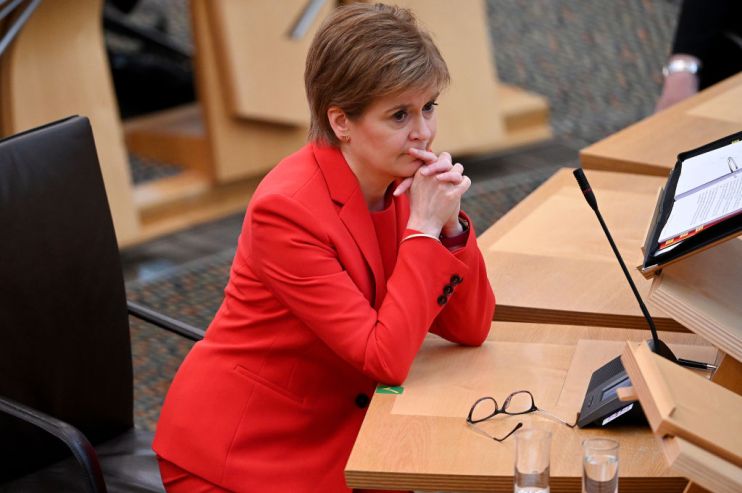
Last week, the first minister of Scotland, Nicola Sturgeon, laid out her plans for the latest attempt to separate the United Kingdom. In a statement to the Scottish Parliament which was long on wishful thinking and short on legal technicalities, she announced that the “proposed” date of another referendum on independence would be 19 October 2023.
Clearly, there are problems with this. The first is that the Scottish Parliament does not have the power to change constitutional matters, and therefore is not legally capable of organising and holding a referendum which has any effect. This is not a new argument: it was established before the last referendum in 2014 that the poll could only be authorised by the UK government using section 30 of the Scotland Act 1998 to expand the Scottish Parliament’s powers in this regard.
Boris Johnson has made it clear that he has no intention of using section 30 to authorise a new referendum. One can see his point: the SNP made much in 2014 that the vote was a “once-in-a-generation” opportunity, and by no one’s estimation is nine years a generation. There has been little evidence of a significant shift in public opinion; although the polls are close, it still seems that, by a small majority, the Scottish people would vote to retain the Union.
Why, one might ask, is this the first minister’s preoccupation? There are two answers. To be generous, the SNP is founded on the principle of separating from England, so one can hardly blame the party for wanting another opportunity to make that real. More cynically, the SNP government’s record—on health, on education, on public procurement—is pretty dismal, and blowing the horn of separation will rally its supporters and distract from everyday concerns.
Sturgeon is already playing a long game. She has asked the chief law officer, the lord advocate, to refer the issue of a consultative referendum to the UK Supreme Court. She hopes, she says, that the court will rule that such a referendum is legal and within the competence of the Scottish Parliament. Most commentators agree that it will not. This too is built into her strategy. If the court rules against her, she says, “what it will clarify is this: any notion of the UK as a voluntary union of nations is a fiction. Any suggestion that the UK is a partnership of equals is false.”
Having weaponised the legal system, she has gone further. Denied the power to hold a referendum, the SNP will regard the next general election as a “de facto” judgement on separation, and—one must infer—authorisation to move forward outside the legal system. Sharp-eyed readers will notice that Sturgeon is setting herself and her party up in a win-win situation: if the court authorises a referendum, she has won, and if it doesn’t, it is proof that Scotland must have its freedom.
The “de facto” argument was taken further by her deputy, John Swinney, who suggested that even winning 30 of Scotland’s 59 seats at the next general election would be regarded as a mandate for independence. This is two-faced: it is overwhelmingly likely that the SNP will take more than 30 seats, as they have done in 2019, and 2017, and 2015, but no general election is a single-issue poll. Let us be clear: what the SNP are saying is that winning a bare majority of parliamentary seats effectively gives them carte blanche, whatever the law may say. This is dangerous; indeed, it is not far from sedition.
It also puts the Labour Party in an awkward position. In 2015, the Conservatives painted Ed Miliband, then leader of the Opposition, as the puppet of the SNP, suggesting that he would authorise a second referendum on independence in return for their support in a hung parliament. Mutatis mutandis, that campaign can be dusted off anew: if you vote Labour, the government will say, you are tacitly allowing the SNP to break up the United Kingdom.
The government has a stronger position perhaps than they want to admit. Refuse a section 30 order, because there is no slam-dunk argument for a second referendum, and hope that the SNP is unable to organise an unofficial poll. But Sturgeon is no fool, and has a track record of banging the separatist drum to drown out any criticism. Boris Johnson is, you may have forgotten, Minister for the Union among his other titles. He needs to start pulling his weight.