Tasmania holiday ideas: Beaches, mountains, wildlife and food

A poster catches my eye while I’m waiting to catch my connecting flight from Sydney Airport. It shows four hikers – a family, perhaps, or maybe just a close group of friends – standing on the summit of a small mountain draped in moss. Warmed by the orange glow of an early sunrise, the hikers stand, arm-in-arm, looking out over a silver alpine lake shrouded with mist. It’s a scene from the wild, wind-sculpted island of Tasmania, Australia’s southernmost state, and the final destination on my 11,000-mile journey from London. On the poster, a simple message is written: “Come down for air”.
Coming from busy, polluted London, the sentiment reads less like an invitation and more like doctor’s orders. It’s a prescription backed up by science too: Tasmanian air is genuinely the cleanest in all the world, courtesy of the strong westerly winds that sweep across the Southern Ocean from pristine Antarctica. What’s more, approximately one-quarter of the island is designated as a World Heritage Site, an area spanning 1.58 million hectares of pristine wilderness. If our carefree cousins Down Under really did write the playbook for a work-life balance, they’d have a whole chapter on why Tassie is where you’d come to truly unwind.
I get my first taste of Tasmania in the picturesque port city of Hobart, the state’s charming capital. With its population of less than 200,000, its traffic-free roadways, and a slower pace of life than elsewhere in Aus (yes, really) Hobart’s sleepy fishing town charm masks a burgeoning cultural scene epitomised by avant-garde galleries like the Museum of Old and New Art (MONA). The main attraction, though? That famously fresh air.
Be warned: invigorating though it may be, Tasmania’s air can stir up some unexpected impulses. For starters, it has me digging out my trainers from the bottom of my suitcase and setting off on a jog. Forget that I’m in the vice-like grip of jetlag, that my legs are still stiff from the flight, and that I don’t actually run. The urge to crack open my lungs and imbibe more of that sweet, cool air has me heading for the hills on my first morning in Tasmania. Following signs for the Royal Tasmanian Botanical Gardens, I reach a viewpoint with vistas across the River Derwent. To the west looms Mount Wellington – Kuanyi, in the language of Tasmania’s indigenous Palawa people – whose dolerite peaks are dusted with snow in the winter months. All this, and I’ve run barely two kilometres from the front door of my hotel.
Back to the hotel for breakfast, flooded with the feel-good effects of early morning exercise. I’m staying at MACq 01, a sleek hotel on Hobart’s wharf that wears Tasmania’s history on its sleeve. Daily tours of its corridors share the stories of a cast of characters that have shaped Tasmania’s present and past.
Some 200 years ago, Tasmania – Van Diemen’s Land as it was then known –would have been one of the last places in the world a Brit like me would have wanted to end up. Nearly half of all convicts shipped to Australia from Britain and its overseas colonies found themselves here, banished to the ends of the Earth for offences that might have ranged from armed robbery to pinching a handkerchief.
The toughest and unruliest cons ended up at Port Arthur, possibly Britain’s most notorious overseas penitentiary. It lies 60 miles southeast of Hobart on a rugged stretch of coastline surrounded by supposedly shark-infested waters. Today, the prison is one of Tasmania’s most-visited tourist attractions, but I have something else planned. I’m bound for a taste of life behind bars in a different sense, on a whistle-stop whisky tasting tour from Hobart.
Tasmania’s reputation for producing high-quality wines is world-renowned, but there’s a growing whisky scene that’s putting the island state’s single malts on the map, too. On my tour with Drink Tasmania, my driver and guide steers me around four independent craft distilleries, starting in the Tasmanian Highlands, where two friends grow and malt their own barley, finishing at a beachside industrial estate. Each distillery is different in its own way, but they all share one thing in common: they make bloody good whisky.
So, what’s the secret? The enterprising spirit (pun intended) of Tasmania’s craft distillers plays its part, but it’s also down to those fresh westerly winds. The island’s pure air – that gift that keeps on giving – is said to enhance the whisky’s quality by preserving the spirit’s purity, allowing it to mature in the cask under optimal conditions and absorb rich, full flavours from the wood.
The climate helps with winemaking, too. Here, cool-climate grape varieties ripen slowly on the vine, resulting in flavourful wines like the award-winning chardonnay my partner is enjoying while we stop for lunch at Devil’s Corner, Tasmania’s largest vineyard. I’m the designated driver for our Tassie road trip, which means wine tasting responsibilities today have fallen to her. She dutifully assures me it’s creamy and delicious.
Devil’s Corner is just one of several vineyards along Tasmania’s Great Eastern Drive, a scenic coastal route that’s more than just a feast for the eyes. Fresh fish and juicy oysters plucked straight from the ocean are the order of the day every day here: that afternoon, I forage for my own dinner on an oyster tasting experience at Freycinet Marine Farm, with shucking consequences.
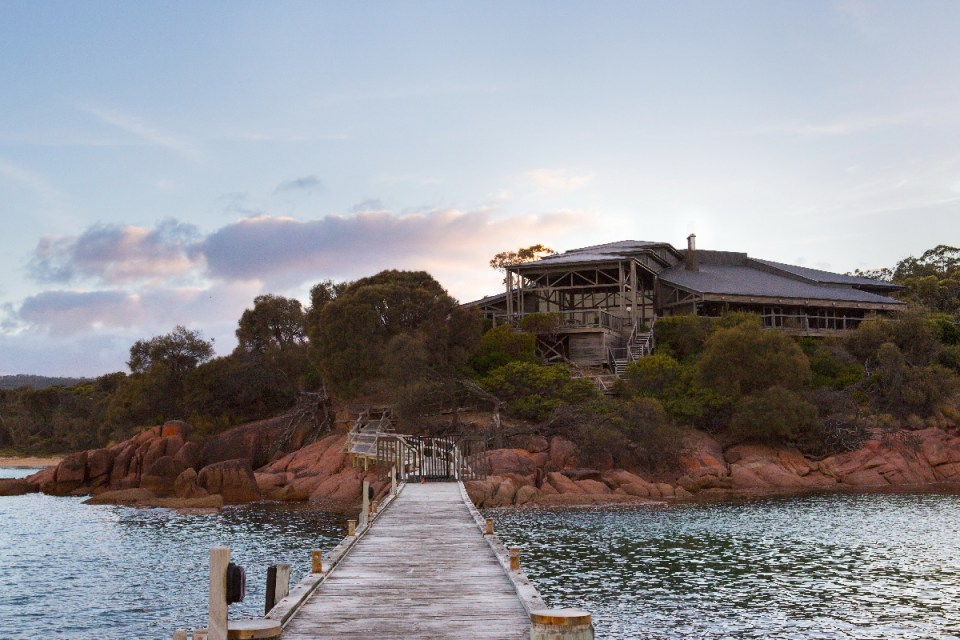
We cruise along the Great Oyster Bay until we arrive at tonight’s accommodation, Freycinet Lodge, in time for a spectacular sunset. Freycinet National Park is Tasmania’s oldest (and, on current evidence, most photogenic) national park, with powder-white beaches, forested hills, and a towering mountain range – the Hazards – that glow in a palette of pinks and purples with the setting of the sun.
It’s a view that’s even better from above. The next morning, we take to the skies on a breathtaking helicopter tour of the Peninsula with Freycinet Air. We glide above the Hazards mountains’ pink granite peaks and trace the golden crescent of Wineglass Bay, which was named in the nineteenth century not just for its shape, but for the shade of red that the water would turn when there were whaling stations here.
Thankfully, the signs are promising that Australia’s whale populations have recovered since whaling was outlawed in 1978. A burst of white foam out at sea catches our pilot’s eye and we bank left to investigate. Suddenly, a humpback breaches, and then another. The water is so clear that even at this height we can track their shapes under the surface: it’s a pod of maybe a dozen whales, migrating south towards their summer feeding grounds in Antarctica. Spellbound, we provide their convoy with an aerial escort for twenty minutes that feel more like two, before waving them off on their long journey home.
More wildlife encounters are in store at our next destination, way up in the Tasmanian Highlands. We’ve booked a cabin at Cradle Mountain Lodge: an alpine retreat where resident wallabies and teddy-bear-like wombats wander freely. Next door, Tasmanian devils showcase the spine-tingling scream that earned them their chilling name at a conservation sanctuary that’s working hard to protect their species from a facial tumour disease that’s devastated their numbers. These devils are loud, but the call of the wild echoing down from Cradle Mountain is even louder.
If Tasmania’s main draw is its pristine wilderness and dramatic scenery, then Cradle Mountain-Lake St Clair National Park might be the state’s crowning glory. The park is part of the Tasmanian Wilderness World Heritage Area – one of only two places on Earth to meet as many as seven out of UNESCO’s ten criteria – and at its heart is Cradle Mountain itself, its serrated summit carving a jagged line across the sky. This is Tasmania at its wildest, at its most raw.
The best views are from Marion’s Lookout, a two-hour hike with a rocky scramble to finish. On the way up, I spot a spiny echidna probing the button grass moors for snacks with its Pinocchio nose. From here, Cradle Mountain towers over the glittering Dove Lake, whose shores are bordered by ancient forests of beech and pencil pine. Each breath of that fresh mountain air is as crisp as a sip of premium champagne, or perhaps a Tasmanian chardonnay. Suddenly it all makes perfect sense. Tasmania. Come down under for air.