Skip to content
Wednesday 19 August 2026London --:--Frankfurt --:--Zurich --:--
NewslettersSearchEN · DE · FR
MorningWire

European business, markets and politics

FTSE 100
10,728.04
+0.07%
DAX
26,128.36
0.00%
CAC 40
8,509.36
0.00%
STOXX 50
6,468.17
0.00%
  • Europe
  • Markets
  • Business
  • Economy
  • Regulation
  • Politics
  • Opinion
More
GermanyFranceEU InstitutionsCompetitionPublic AffairsBankingTechnologyEnergy
  • Germany
  • France
  • Europe
  • Markets
  • Business
  • Economy
  • Regulation
  • Politics
  • Opinion
  • DE
Wednesday 30 October 2024 3:52 pm  |  Updated:  Wednesday 30 October 2024 4:07 pm

Tax burden to rise to historic highs after Labour’s first Budget, OBR says

By: Chris Dorrell

Add as a preferred source on Google
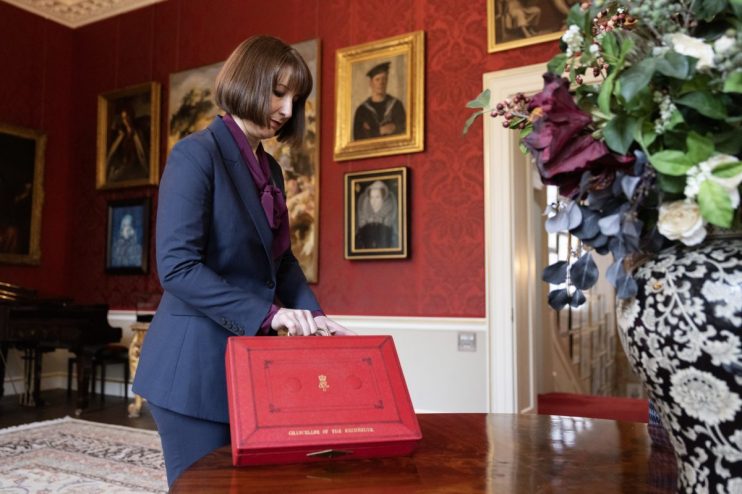
London, United Kingdom. Chancellor of the Exchequer Rachel Reeves delivers the Autumn Budget 2024. Picture by Simon Dawson / No 10 Downing Street

The new government’s first Budget will see the tax take rise to its highest ever level, the Office for Budget Responsibility (OBR) said today.

Rachel Reeves unveiled tax rises worth £40bn in Labour’s first Budget, helping to fund a big increase in public spending, while the Chancellor also raised borrowing significantly.

“This budget delivers one of the largest increases in spending, tax and borrowing of any fiscal event in history,” Richard Hughes, chair of the OBR said following the Budget.

Play Video

In its latest economic forecasts, published alongside the Budget, the independent fiscal watchdog forecast that the state would expand to 44 per cent of GDP, almost five percentage points bigger than it was before the pandemic.
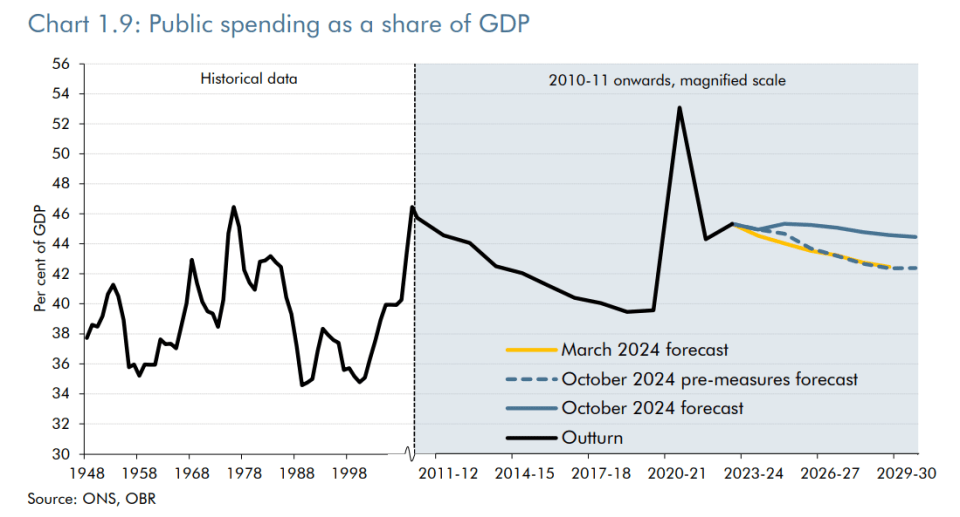
About half of the planned increase in public spending will be funded by higher taxes, most notably the big increase in employers’ national insurance.

This will push the tax intake to 38 per cent of GDP by the end of the decade, its highest level on record.

The rest of the increase in public spending will be financed by higher borrowing. Budget policies will mean borrowing increases by an average of £32bn over the next five years, the OBR said.

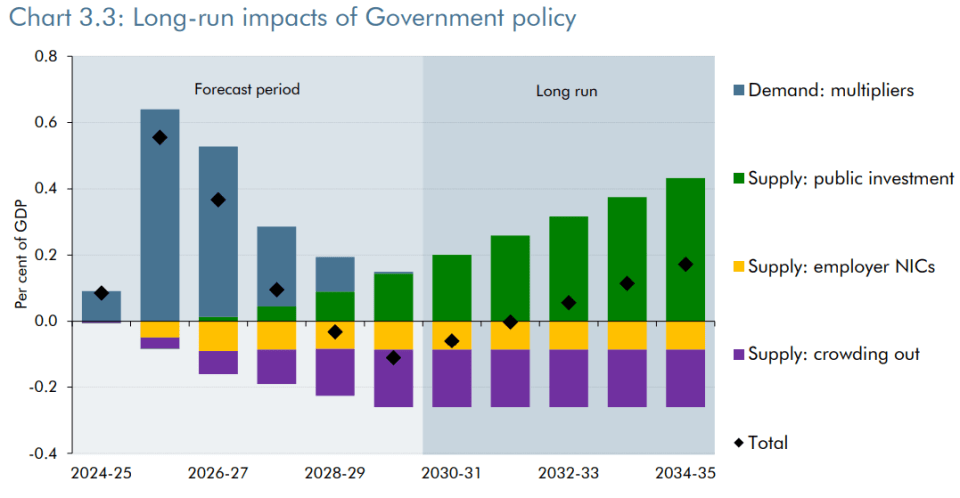
Growth would see a “temporary boost” as a result of policies announced in the Budget, although this would fade in the medium term due to crowding-out.

Crowding-out describes when increased government spending leads to a decrease in private sector activity.

Read more

OBR misery makes tax rises inevitable

Treasury Department building with government bonds signage, representing financial management and bond issuance responsibi...

“The increase in the public sector’s use of resources in an economy close to its potential level of output leads to the crowding-out of some business investment,” Hughes said.

“The net effect of all these changes is to leave the level of GDP higher in the near term, but broadly unchanged at the medium term,” he added.
Source: OBR

Looking at the long term, the OBR suggested that a “sustained” increase in public investment beyond the five-year forecast period would help improve the UK’s growth outlook.

Hughes said that the net effect of the government’s policies would “turn positive in the early 2030s as the lagged impact of a larger public capital stock feeds through into potential output”.

However, inflation will also be higher than it otherwise would have been as a result of the Budget, which may force the Bank of England to hold interest rates higher for longer.

The OBR’s March forecasts suggested inflation would fall below two per cent next year, remaining below the Bank’s target for the duration of the forecast period.

Its latest forecasts suggest inflation will remain above two per cent until 2029.

David Miles, a member of the OBR’s Budget Responsibility Committee, said the spending increases “push the economy…a little into the territory of demand running a bit ahead of supply capacity”.

Read more

Government debt repayment ‘could rise to half’ of total taxes

OBR chiefs told the Treasury Select Committee that a higher tax burden could stifle growth.

Share this article

  • Facebook
  • X
  • LinkedIn
  • WhatsApp
  • Email

Similarly tagged content:

Sections

  • News

Categories

  • Economics

People & Organisations

  • Autumn Budget 2024
  • Chancellor Rachel Reeves
  • Keir Starmer
  • Labour Party
  • OBR
  • Rachel Reeves
  • tax burden
  • UK economy
  • UK Government

Related Topics

  • office for budget responsibility

Trending Articles

  • As it happened: FTSE 100 drops as oil prices rise after Trump makes Hormuz threat

  • Jobless Banquet: Youth unemployment surge ‘sends Neets to KFC’

  • US bond market jitters spark UK economy recession warning

  • Monzo chair makes early exit after boardroom rift

  • New Premier League rules could see £11bn invested into new stadiums

More from Morning Wire

  • OBR misery makes tax rises inevitable

    Opinion
    Treasury Department building with government bonds signage, representing financial management and bond issuance responsibi...
  • Government debt repayment ‘could rise to half’ of total taxes

    Economics
    OBR chiefs told the Treasury Select Committee that a higher tax burden could stifle growth.
  • Warning for John Healey as key fiscal target missed

    Economics
    Labour MP John Healey in a professional headshot, likely for news or political profile.
  • Pension pressure to help swell UK debt to three times size of economy

    Economics
    Two older women exercising at an outdoor gym in sunshine
  • Tax rises ‘guaranteed’ as Healey faces £22bn black hole from Burnham spending plans

    Economics
    Chancellor John Healey smiling, wearing a navy suit, white shirt, and red tie.
  • Investors ‘may be less than impressed’ by John Healey’s £9bn borrowing plans 

    Economics
    Man in suit and red tie speaking at a podium to an audience in a modern building.
  • Healey announces early Budget

    Politics
    Man in suit and red tie speaking at a podium to an audience in a modern building.
  • Andy Burnham pledges ‘cost £63bn’ – and tax ideas could backfire

    Politics
    Andy Burnham smiling in a bus drivers seat, wearing glasses and a suit, addressing transport pledges.
MorningWire

Independent European business, markets and political news for decision-makers.

Morning Briefing

Europe

  • Germany
  • France
  • EU Institutions
  • Europe

Business

  • Markets
  • Business
  • Economy
  • Regulation
  • Competition
  • Public Affairs

Editorial

  • Opinion
  • Editorial Policy
  • Corrections
  • Contact

Company

  • About Morning Wire
  • Privacy Policy
  • Terms of Use
  • Cookie Policy
© 2026 Morning Wire Ltd · Published by Morning Wire Media, Bahnhofstrasse 65, 8001 Zürich, Switzerland
Privacy · Terms · Cookies · Facebook