The Extinction Rebels seem to care more about capitalism than climate

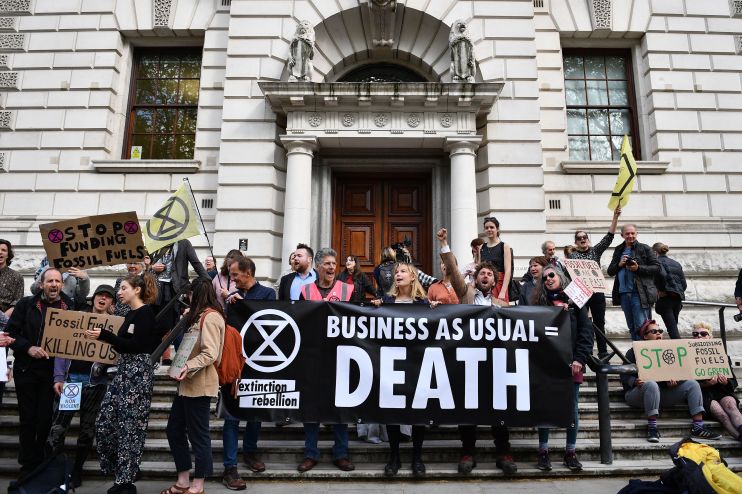
If your commute to work this week has been blocked by a giant colourful boat, you have Extinction Rebellion (XR) to thank.
The self-defined “non-violent civil disobedience activist movement” has begun its summer of disruption, shutting down traffic in five UK cities to protest against climate change “inaction”.
A worthy and vital attempt to safeguard the planet for future generations? Or an extremist group with a subversive anti-capitalist agenda?
The latter accusation comes from a new report from the Policy Exchange think tank, written by two counter-terrorism experts. They trace XR’s roots back to the anti-globalist Occupy movement, and argue that its law-breaking tactics are a threat to civil society as we know it.
“Extinction Rebellion”, the authors claim, “rejects both our representative democracy and the liberal free market economy and explicitly seeks to overturn both”.
The risk of an authoritarian coup may be somewhat over-the-top, but there can be no doubt that XR’s leaders see anti-capitalism as crucial to the cause of environmentalism. Signs reading “planet before profit” and “capitalism is costing the Earth” abound at these protests.
And on Wednesday’s Today Programme, XR’s spokesperson dodged a question on whether the movement wanted a “permanent state of recession”, replying instead “it’s not remotely extreme, it’s just common sense”. The “de-growth” agenda is central to their demands.
This is not only disingenuous, given that many of the people protesting this week are doing so in an attempt to protect the planet, not as an attack on free-market liberalism; it is counter-productive.
First, jamming up cities and causing misery for millions of workers does nothing for the environment except increase traffic pollution, while alienating people who might otherwise be sympathetic.
As Policy Exchange noted: “the impact of the first week of their protests during April 2019 was estimated to have cost shops £12m in lost takings and to have delayed 500,000 commuters”. XR has also threatened to shut down airports – disruption that would primarily impact families on their summer holidays, not to mention exporters.
YouGov’s “top issue” tracker shows that the environment is one of the key priorities for voters, topped only by Brexit and health. Britain is both aware of the threat and supportive of the cause. Radical tactics that make everyday city life unbearable risk doing more harm than good.
More fundamentally, though, the pernicious argument that dismantling western capitalism is the only way to save the planet is demonstrably false. The kind of big-state socialism that XR’s leaders (albeit not the majority of its supporters) seem to espouse has an abysmal environmental track record.
From the catastrophic pollution of the centrally-planned Soviet Union to the biodiversity annihilation of Mao’s China, socialist regimes have historically been far more ecologically damaging than their capitalist counterparts.
Nor is economic growth incompatible with environmentalism. In fact, the richer a country’s citizens are, the more they tend to care about the environment (you are, after all, less likely to worry about an endangered species if you can’t afford to feed your family).
Today, the greatest impact on our environment comes not from the British businesses targeted by the protests this week, or even the cars on UK roads, but from developing nations like China and India that are currently undergoing their own industrial revolutions.
These emerging economies are not going to witness a reduction in consumption or production until they reach a standard of living they consider adequate, and it is naive for developed nations to ask them to.
That is not to suggest that we resign ourselves to environmental armageddon.
No one aside from a few crackpot conspiracy theorists genuinely believes that we do not face an ecological challenge of gargantuan proportions.
From oceans full of plastic, to the increase in pollution-related health issues and deaths, to the threat to civilisation if temperatures and sea levels rise in line with scientists’ predictions, this is the greatest challenge of our age, and concerns that we are not acting fast or effectively enough are entirely legitimate.
But the solutions lie not in eliminating economic growth and trying to force everyone to go back to a subsistence-farming standard of living, but in the technologies of the future that can avert the climate crisis – from geoengineering to nuclear fusion to plastic-eating microbes.
And while governments have a major role to play in investing in this research, such technological breakthroughs are only possible in market economies that champion enterprise and innovation – the very kind of economies that XR’s de-growth agenda aims to dismantle.
In Anglo Saxon England, the unit of land necessary to support a single household was 120 acres. If that were still true today, the UK would have to be 54 times bigger to support our 27m households. It is only technology that has made it possible for so many people to live more comfortably than ever before with comparatively few resources.
So if XR’s leaders really want to reverse environmental damage, they should consider going back to university to study chemical engineering and life sciences – or working for the firms that are leading the cutting-edge research in these fields (like BP and Shell), not to mention those investing in electric vehicles, lab-grown meat, and advanced manufacturing.
The fact that they are instead fixating on destroying capitalism reveals that their priorities lie elsewhere.
Main image credit: Getty