The ‘innovation economy’ and why AI won’t steal your job

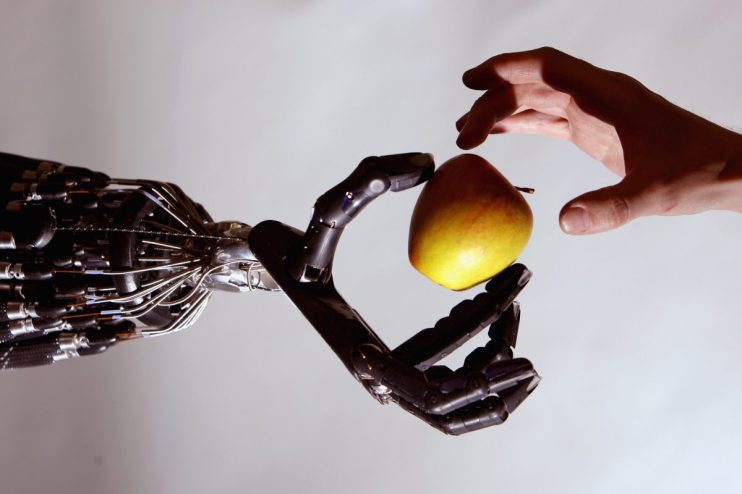
Historically, economic progress has been driven by seismic shifts in how we value things.
From the agrarian economies that once sustained early civilisations, to the industrial revolutions that mechanised production – each era reshaped society’s priorities.
In the late twentieth century, the rise of the ‘knowledge economy’, placed information and cognitive thinking at the heart of progress.
But today, as the implementation of artificial intelligence (AI) accelerates, we find ourselves at another crossroad.
“The ‘knowledge’ based economy is on its way out”, said Aneesh Raman, chief economic opportunity officer at LinkedIn, “and an innovation economy, is on its way in”.
A shifting economy
For decades, the knowledge economy reigned supreme. It thrived on the ability to process, store, and distribute information. But since then, AI has fundamentally changed the game.
Machines can now analyse vast amounts of data, identify patterns or generate human-like text in the matter of seconds – tasks that once required years of expertise. Yet, as AI takes over knowledge-based work, information alone is no longer enough.
It falls short in defining the problems worth solving, or imagining a future that does not yet exist.
In response, a new economy is taking shape – one built on human capabilities that AI cannot replicate.
The real breakthrough lies in understanding where AI’s capabilities end, and when human strengths take over.
Human creativity has started taking precedent over the rote accumulation of knowledge, as the operative question pivots from ‘what is left for humans after AI?’, to ‘what is possible when they work together?’
Business leaders have already recognised this shift. LinkedIn data revealed that 90 per cent of C-suite executives reportedly consider AI as a top priority, with businesses pouring billions into AI-driven automation and decision making.
According to Accenture, 73 per cent of companies are channeling their digital investments into AI, recognising its potential to boost productivity and unlock entirely new markets.
AI and the workforce myth
Despite fears of AI replacing jobs, the reality is more nuanced.
By 2030, nearly 70 per cent of the jobs that will exist have yet to be invented. This presents a paradox where AI will replace certain tasks, but it will also create entirely new industries and career paths.
The AI market is projected to surpass $800bn (£618.19bn) in 2030, with AI agents handling a growing share of business functions.
Chinese startup DeepSeek proved to global tech players just how affordable AI-powered systems can be, launching an advanced chat bot at a fraction of the cost of similar, US developed models.
The real challenge, however, won’t be job losses – or the idea of being ‘replaced’. Rather, it will be whether organisations or individuals are prepared to redefine their roles.
“We are moving from an era of humans supporting technology, to one where technology supports human potential”, added Raman.
As Jensen Huang, chief executive of chip giant Nvidia, said: “You’re not going to lose your jobs to AI, but rather to someone who uses it.”
In the UK, the anaemic growth of IT skills among Brits has widened the AI skills gap – meaning we don’t have the level of expertise across the country to accommodate this shift.
IT and AI positions were reportedly the hardest recruit for in 2025, with 43 per cent of business leaders considering hiring talent internationally instead.
The lost Einsteins
While leaning towards innovation promises a new frontier of economic growth, systemic barriers continue to hold back potential pioneers.
A sobering reality remains that economic privilege still plays a significant role in determining who can innovate successfully.
Research from MIT reveals that children from high-income families are 10 times more likely to become inventors than their lower income peers.
Economists have coined this phenomenon the “Lost Einsteins” problem – a term that encapsulates the vast potential squandered due to socio-economic disparities.
If the innovation economy is to thrive, businesses and policymakers must commit to breaking down those barriers, by prioritising diverse hiring and creating pathways for underrepresented talent to enter the workforce.
Governments should rethink education systems to prepare students for a world where adaptability will be more important than memorising facts, or risk leaving millions behind in the AI boom.
The synergy of humans and AI
The conversation around AI has too often been framed in extremes – either as a dystopian, job-thieving technology, or an over-hyped trend with limited impact.
This is now giving way to a more balanced perspective, where fostering effective collaboration between humans and AI, will unlock human potential on an unprecedented scale.
Organisations should therefore develop roles that integrate this collaboration, which necessitates a cultural shift towards cross-functional approaches.
People using AI will drive personalised learning and development, fostering a culture of continuous adaptability.
There will be drawbacks, like increased pressure on workers and ethical concerns, but ultimately, those who leverage AI will set themselves apart.
While AI might just be the most powerful tool of our time, at the end of the day, it is just that: a tool. It doesn’t stand without human interaction.