The Power of Capitalism: The myth of Swedish socialism


Dr Rainer Zitelmann is a German historian, sociologist and author. His latest book is The Power of Capitalism. In our exclusive series, Zitelmann reveals a compelling body of evidence that capitalism and market economies have lifted billions out of poverty. Today he writes on Sweden.
According to the 2023 Index of Economic Freedom, Sweden is among the most market-oriented economies worldwide. Overall, it ranks in 10th place, far ahead of the United States (25th) and the UK (28st). But public spending is still high, and while income tax rates have come down considerably from their peak in the 1970s and 1980s, they are still higher than almost anywhere else in the world.
In other words, despite the ascendance of capitalist elements, Sweden is not entirely free of socialist influences. However, the image of Sweden and other Scandinavian countries as strongholds of socialism harks back to the 1970s and 1980s. During the period of socialist welfare-state expansion from 1970 to 1991, Sweden dropped far behind many of its European competitors. From fourth place in the OECD per-capita GDP ranking in 1970, socialist-era Sweden had dropped to 16th place by 1995.
The socialist agenda damaged the Swedish economy and resulted in prominent entrepreneurs leaving the country in frustration. Ikea founder Ingvar Kamprad was one of them. The marginal income tax rate of 85 per cent was supplemented by a wealth tax on his personal assets, which forced him to borrow money from his own company in order to pay his taxes. To pay back his debt to Ikea, Kamprad wanted to sell one of the small companies he owned to Ikea at a profit. As he was preparing the sale, the government made retroactive changes to tax legislation. In 1974, he moved to Denmark and later to Switzerland, where he spent the next few decades – for a time as the wealthiest man in Europe.
These socialist policies alienated even those who were sympathetic to the Social Democrats’ project. Astrid Lindgren, the world-famous author of a raft of children’s classics including the Pippi Longstocking series, is just one example.
Her long-standing commitment to the social democratic beliefs espoused by the likeable newspaper editor with a strong sense of justice who is a central character in her Madicken series didn’t stop her from feeling outraged by the 102 per cent marginal tax rate levied on her earnings in 1976. Lindgren vented her anger in a satire on the Swedish tax system titled “Pomperipossa i Monismanien” and published in a leading newspaper. The public was on Lindgren’s side. Eventually, Swedish prime minister Olof Palme took care of the matter himself and admitted on television that Lindgren was right.
Many excesses of the welfare state were equally absurd, including the generous sick pay. As well as statutory payments, most employees in Sweden received additional sickness benefits under both company agreements and collective agreements, which meant that those who took sick leave ended up with a larger paycheck than a healthy person who came to work every day. Unsurprisingly, Sweden held on to the OECD record for the highest rate of non-working adults in the labour force for several decades.
Pushback against the proponents of socialist ideas increasingly gathered momentum, and by the 1990s there was a comprehensive counter-movement. A major tax reform in 1990/91 introduced a dual tax system which slashed corporate taxes from 57 per cent (including payments into workers’ funds) to 30 per cent. Some incomes from shares were exempted from taxation, and capital gains from shares were also taxed at a lower rate.
The reforms continued over the following years: in 2004, estate and accession taxes of up to 30 per cent were scrapped. The abolition of the wealth tax, which had already been cut, came into effect retroactively as of 1 January 2007. The corporate tax rate of 30 per cent was cut to 26.3 per cent in 2009, today it is 20.4 per cent. Property tax rates were also cut substantially. Subsequent reforms in 2005 gave business owners and self-employed professionals the option to significantly reduce their tax burden by declaring part of their earnings as capital gains rather than income.
Ever since these reforms were introduced, many successful Swedish entrepreneurs have stayed in Sweden and reinvested capital in new ventures, creating businesses such as Spotify and Klarna. And following the abolition of inheritance and wealth tax, the proportion of billionaires in relation to the population is now 60 per cent higher in Sweden than in the United States.
Although contemporary Sweden remains a traditional welfare state in some respects, successive governments since the early 1990s have consistently chosen more freedom over more equality, more market over more state. Following the obvious failure of the socialist experiment, the balance between capitalism and socialism has shifted towards capitalism.
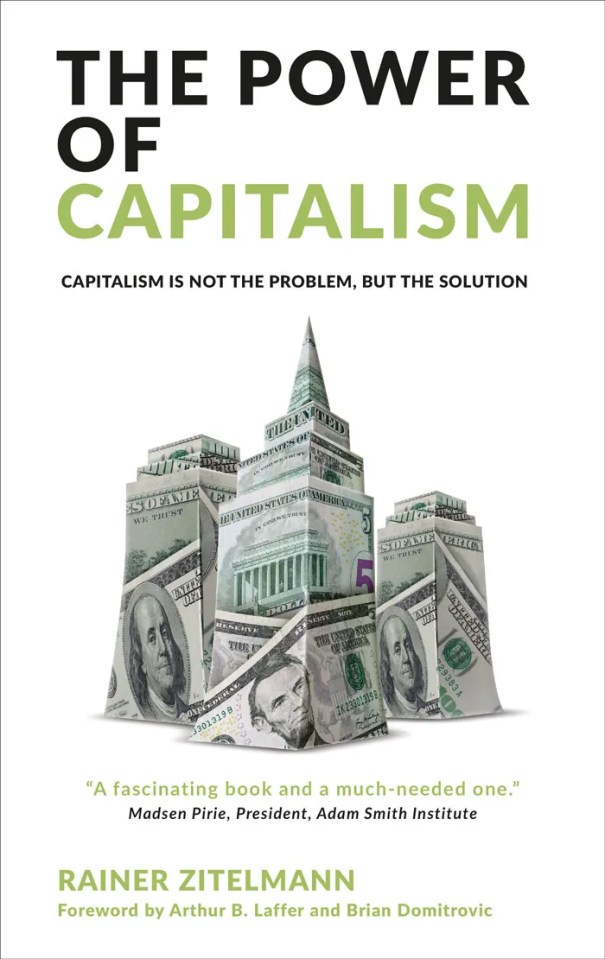
Rainer Zitelmann’s book is available on the book’s website