The US-China trade spat is a proxy war in a much bigger battle

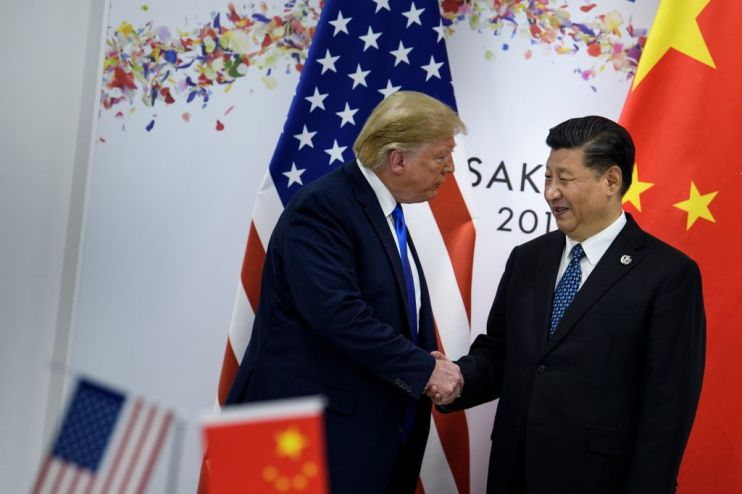
Make no mistake, the trade war is real.
But it is being used as a proxy by China and the US to fight a bigger battle: one that transcends orthodox definitions of hard and soft power to incorporate “sharp” power – influence over finance, information, ideas, even thought and behaviours.
It is a fight for control of the new digital paradigm. But right now, it risks being influenced by domestic considerations – with potentially disastrous consequences for the rest of the world.
Take last week. President Donald Trump asked China to investigate the Biden family’s business dealings, but Beijing’s foreign policy principles, insofar as they are transparent, explicitly state that it will not interfere in the affairs of another country.
The demand clearly provides the strategic context for the ongoing discussions. With trade talks resuming today, China’s vice president Liu He and the US trade representative Robert Lighthizer will be attempting to avoid any further escalation of tensions.
If they fail, the US will increase the tariffs imposed on $250bn of Chinese goods from 25 per cent to 30 per cent. For the last 18 months, the two countries have escalated the crisis by embroiling themselves in the tit-for-tat attritional tactics that are endemic to this type of conflict. On the face of it, neither side is winning, and the knock-on effects on the global economy are potentially catastrophic.
Last week’s move, however, suggests that Trump’s current strategic game is to use rhetorical dominance over foreign policy as a show of strength to a domestic audience, at a time when impeachment proceedings against him require both a strong rebuttal and a win against China.
Trade has always been Trump’s preferred tool in the zero-sum game that he plays at home and abroad. So it may seem unsubtle, but he would think nothing of embroiling his chief trade adversary into his domestic challenges and offering them a concession on the tariffs in return.
China, by contrast, is likely to see this for what it is: a move with a short-term domestic political objective rather than a longer-term globally economic one. However, China’s “socialism with Chinese characteristics” can allow conflict and peace to exist at the same time: it can be at war with the US for control of the digital paradigm while simultaneously expanding its reach peacefully across the Belt and Road Initiative sphere of influence.
So China’s strategy this week is likely to be equally clear. It will engage in the talks, but will maintain its firm position on the key sticking points: cyber security, intellectual property theft, access to Chinese markets, and dispute resolution mechanisms outside of WTO frameworks. It does not need to shift its position on tariffs: if China’s growth slows, so does that of the rest of the world. China can afford to risk a breakdown of talks as a result.
What is interesting here is that both sides are in similar positions. While the problems that Trump’s administration faces may seem to be centred around the man himself, the long-term concern for the US is the threat posed to American hegemony from China’s control of the digital space.
Equally, President Xi Jinping is all-powerful, but has to acknowledge the personal challenges his leadership faces from the protests in Hong Kong.
So while both countries face similar long-term challenges to their global power, their leaders have more immediate domestic concerns, which may influence how they act.
Expect Trump to play more trade games in the coming months. While he is under the threat of impeachment and also looking to the 2020 election, the trade war will be the best way of diverting attention away from his own actions domestically. China, meanwhile, will see the current noise in the discussions as a facade hiding the intrinsic weakness of the US position.
Crucially, trade is not the real issue for either side – for both, short-term control of the domestic agenda and long-term control of the digital paradigm are far more important.
Trade is a proxy war and, given the size and power of their economies, both sides can afford it to be attritional. The rest of us, however, cannot. We ignore it at our peril.
Main image credit: Getty