The Windrush scandal carries lessons that are all too familiar in today’s Britain

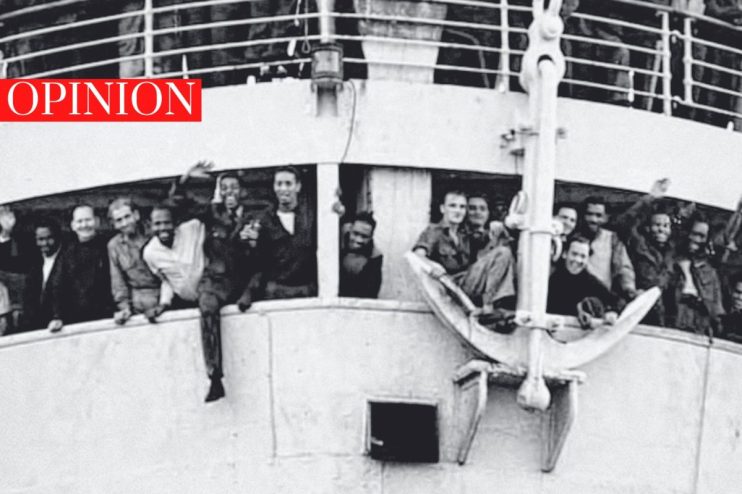
Seventy-five years today 802 people arrived in London from the Caribbean and began Britain’s journey towards becoming a multi-racial society. On Windrush Day, Will Cooling explains what we still have to learn from what happened afterwards
As a young child I was enthralled by the Victorians and the two World Wars, learning all about the politicians who shaped Britain, and the armed forces that fought to defend it.
Such history was extremely focused on white men. Even in the 1990s this was recognised as a problem, with teachers trying to make sure what we learnt was less a boys’ only adventure.
They made time to talk about things such as women’s rights and Florence Nightingale. They wanted girls to see themselves in the history they learnt as much as we boys did. They realised that a broader curriculum would interest a broader range of people. That insight however rarely extends beyond the classroom. Whether it’s documentaries on TV or statues on the streets, the history that is celebrated is still primarily one dominated by men whose heroics were in a battle, at the despatch box or from a throne.
The problem extends beyond girls being less interested during history lessons. What we choose to celebrate about the past is the same as what we value about the present. That my history lessons were touched by the spirit of second-wave feminism was a symptom of broader changes in society, as the sexist taboo against women working or holding senior roles was broken.
Of course, today’s Britain is a more diverse one than the one I grew up in and is becoming more diverse with every passing year. The same way my teachers knew thirty years ago that it was important to broaden history to include women, today we need to broaden history to better include Black and Asian people. And that doesn’t mean copying American resources about Martin Luther King Jr or Barack Obama, in the same way British girls aren’t taught about Eleanor Roosevelt or Ruth Bader Ginsburg. It means celebrating moments in British history that demonstrate the role Black and Asian people have played in our society and celebrate their contribution.
Which brings us to today, June 22nd. Seventy-five years ago, 802 people from the Caribbean disembarked HMT Windrush after arriving in Great Britain overnight. Their arrival from Jamaica was greeted with open racism by members of both political parties. In an eery echo of contemporary debates about immigration, politicians’ desire to appease constituents by restricting new arrivals was defeated by the country’s urgent need to address chronic worker shortages. Therefore, despite these initial protests, Britain continued to encourage people from across the Commonwealth to come and work here throughout the 1950s.
There is a story that we can tell our children about how Black and Asian people came to Britain to help a country devastated by war rebuild itself. Indeed, maybe if this message was more commonly known by White Britons, we wouldn’t have tolerated the manifold abuses the Home Office so recently perpetuated against elderly Black or Asian Britons in the service of Theresa May’s hostile environment policy.
This contemporary discrimination is an echo of the hostile reception many Black and Asian people encountered as they made Briton their home in the 1950s. Often separated from their immediate family, they would be exposed to racist abuse, and racist discrimination from key institutions such as employers, trade unions and local councils. The government was unwilling or unable to ensure they received the support they needed to be safe and comfortable in their new home. While overt racism is less tolerated today, we still see too many recently arrived immigrants being left to struggle in the face of indifference from their neighbours, co-workers and public services. Maybe, if we had fully learnt the lessons of the past, we wouldn’t be repeating similar mistakes today.
So on Windrush Day, we should celebrate the contribution of the Windrush Generation but also learn the lessons from their mistreatment, so that we can fully include Black and Asian Britons, and provide a better welcome for people immigrating to Britain today.