Skip to content
Wednesday 26 August 2026London --:--Frankfurt --:--Zurich --:--
NewslettersSearchEN · DE · FR
MorningWire

European business, markets and politics

FTSE 100
10,886.16
+0.29%
DAX
26,266.14
+0.61%
CAC 40
8,439.20
0.00%
STOXX 50
6,455.63
+0.12%
  • Europe
  • Markets
  • Business
  • Economy
  • Regulation
  • Politics
  • Opinion
More
GermanyFranceEU InstitutionsCompetitionPublic AffairsBankingTechnologyEnergy
  • Germany
  • France
  • Europe
  • Markets
  • Business
  • Economy
  • Regulation
  • Politics
  • Opinion
  • DE
Wednesday 29 July 2015 10:31 am

Three charts showig how working in London differs to other cities

By: Jessica Morris

Add as a preferred source on Google

A London working week is typically associated with long hours, heavy workloads as well as demanding clients, but a report released this week by Centre for Cities has shown there are some perks to working in the big smoke.

Londoners are more likely to be in employment than their counterparts in large, medium and small city centres. At the same time, they're much more reliant on public transport such as tubes and buses, which gets tricky when they're super crowded or plagued by strikes.

Londoners are more likely to be in employment:
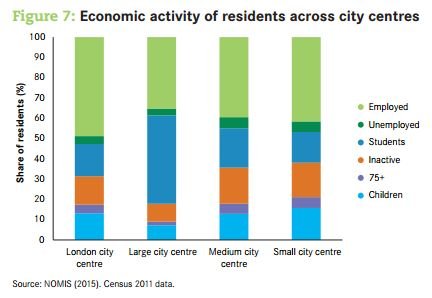

(Source: Centre for Cities)

With finance and technology hiring set to create 145,000 new jobs in central London over the next decade and firms fighting for more office space, it's no surprise that the capital city offers good employment prospects.

"In medium and small city centres there are bigger shares of people who are economically inactive: 18 per cent in medium city centres and 17 per cent in small city centres, compared to just nine per cent in large city centres," the report said.

Occupations across city centres


(Source: Centre for Cities)

And the jobs that Londoners do are pretty good, too.

"London in particular has the highest share of residents who are managers or senior officials, professionals or associate professionals (66 per cent)," the report said.

"City centres of small cities, on the other hand, have the highest share of residents working in lower skilled occupations – sales and customer service, process, plant and machine operatives, and elementary occupations (38 per cent)."

This might have something to do with the fact people who live in central London are a particularly brainy bunch with half holding degrees, compared to 37 per cent in large city centres, and 25 per cent in medium sized cities.

Methods of travel to work


(Source: Centre for Cities)

There's no prizes for guessing this one – Londoners are more likely to use the underground, light rail or a bus. However, they're less likely to take a car or van, probably due to the long traffic queues and the high costs associated with running a vehicle in the capital.

"In city centres, less than a quarter commute by car or van, compared to just over a half in suburbs and two thirds in hinterlands," the report said.

"This reflects the fact that city centre residents live closer to their workplace. 56 per cent travel less than 5km to work – while just 30 per cent of residents in the rural hinterlands travel less than 5km."

"But these travel patterns are not uniform across all city centres. In London, just under a quarter of all journeys are made by underground, and eight percent are made by car."

Share this article

  • Facebook
  • X
  • LinkedIn
  • WhatsApp
  • Email

Similarly tagged content:

Sections

  • Markets & Economics
  • News

Categories

  • Business
  • Economics

Related Topics

  • employment and wages
  • UK jobs

Trending Articles

  • Andy Burnham hints at tax rises in Autumn Budget

  • Budget 2026: Which taxes will Burnham and Healey hike?

  • Can debt-ridden Morrisons become a Big Four supermarket again?

  • Burnham shelves Thames Water administration plans over costs

  • As it happened: Stocks rally; US to unveil ‘economic D-Day’ Iran sanctions

More from Morning Wire

  • Top court ‘opens the floodgates’ for part-time workers’ claims

    Lawsuit
    Supreme Court building under clear sky, symbolizing justice and authority, relevant to recent judicial news coverage
  • Ten bold ideas to fire up the British economy

    Economics
    Morning Wire
  • Britain needs to start designing for drought

    Opinion
    London cityscape from Primrose Hill showing dry, brown grass during drought with River Thames and skyscrapers
  • Britain needs a new Richard Branson

    Opinion
    Richard Branson in a suit, holding an umbrella and bowler hat, smiling in a swimming pool
  • City leaders weigh employment policy alternatives to non-competes

    Law
    LONDON, ENGLAND - OCTOBER 15: Commuters cross London Bridge on October 15, 2024 in London, England. Estimates for the September 2024 payroll indicate that the number of employees rose by 0.4% compared with September 2023, a rise of 113,000 employees. (Photo by Dan Kitwood/Getty Images)
  • Burnham’s devolution drive could ‘push 90,000 jobs out of London’

    Economics
    In 2022, rolling Tube strikes led to massive queues for crowded buses. (Photo by Chris J Ratcliffe/Getty Images)
  • Labour’s ‘chaotic’ zero-hour crackdown could cost firms £3bn per year

    Economics
    Andy Burnham, Mayor of Greater Manchester, in a suit and glasses, looking serious against a bright sky.
  • The decline of Harvey Nichols is a tale of London’s decline too

    Opinion
    Harvey Nichols department store at night, illuminated with neon signs and colorful window displays.
MorningWire

Independent European business, markets and political news for decision-makers.

Morning Briefing

Europe

  • Germany
  • France
  • EU Institutions
  • Europe

Business

  • Markets
  • Business
  • Economy
  • Regulation
  • Competition
  • Public Affairs

Editorial

  • Opinion
  • Editorial Policy
  • Corrections
  • Contact

Company

  • About Morning Wire
  • Privacy Policy
  • Terms of Use
  • Cookie Policy
© 2026 Morning Wire Ltd · Published by Morning Wire Media, Bahnhofstrasse 65, 8001 Zürich, Switzerland
Privacy · Terms · Cookies · Facebook