Skip to content
Saturday 12 September 2026London --:--Frankfurt --:--Zurich --:--
NewslettersSearchEN · DE · FR
MorningWire

European business, markets and politics

FTSE 100
10,650.44
+0.39%
DAX
25,568.56
+0.82%
CAC 40
8,179.77
+0.78%
STOXX 50
6,325.13
+0.90%
  • Europe
  • Markets
  • Business
  • Economy
  • Regulation
  • Politics
  • Opinion
More
GermanyFranceEU InstitutionsCompetitionPublic AffairsBankingTechnologyEnergy
  • Germany
  • France
  • Europe
  • Markets
  • Business
  • Economy
  • Regulation
  • Politics
  • Opinion
  • DE
Wednesday 16 October 2019 4:11 am  |  Updated:  Tuesday 15 October 2019 5:31 pm

This year’s Nobel economics laureates have made the world a better place

By: Paul Ormerod

Add as a preferred source on Google
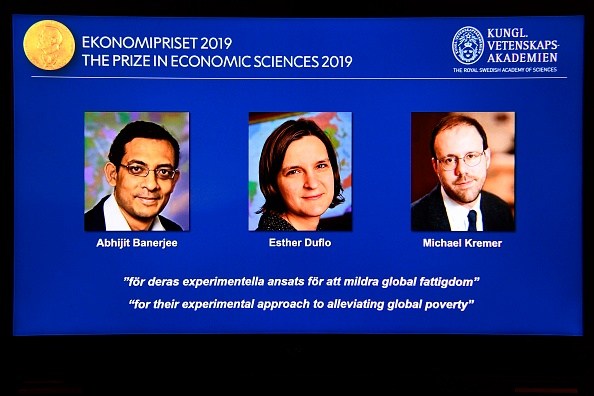
A computer screen displays the co-winners of the 2019 Sveriges Riksbank Prize in Economic Sciences in Memory of Alfred Nobel (L-R) Abhijit Banerjee, Esther Duflo and Michael Kremer during a press conference at the Royal Swedish Academy of Sciences in Stockholm, Sweden, on October 14, 2019. - Indian-born Abhijit Banerjee of the US, French-American Esther Duflo and Michael Kremer of the US won the Nobel Economics Prize for their "experimental approach to alleviating global poverty", the Royal Swedish Academy of Sciences said. (Photo by Jonathan NACKSTRAND / AFP) (Photo by JONATHAN NACKSTRAND/AFP via Getty Images)

This year’s Nobel Prize in economics, announced on Monday, was a ray of sunshine amid the prevailing media gloom.  

The Prize was awarded for the work the new laureates had done on the alleviation of global poverty. This is one reason to be cheerful about it. Another is that Esther Duflo became only the second ever  woman to win the prize, along with her close collaborators Abhijit Banerjee and Michael Kremer.

In addition, the winners have made important developments in how economists go about solving problems. These individuals are a key part of the drive to move economics on from an obsession with pure theory towards making it much more empirically-based.

At first sight, the award is very conventional. The laureates retain the basic view of economists: poor people are essentially rational agents, trying to take decisions which are in their own interests. 

They may have much more difficulty in accessing relevant information than others, and  face many more constraints on their ability to make the best decision. But they are just as rational as everyone else.

The similarity with tradition ends there. For the laureates’ main innovation is to introduce the use of randomised controlled trials (RCTs) into economics.

One hundred years ago, the British statistician Ronald Fisher was revolutionising the principles of statistical analysis. The maths that he developed enabled the testing of new medicines to become much more scientific.

Read more

Lord O’Neill declines job in Burnham government

Jim ONeill, economist and former Goldman Sachs chairman, sitting on a yellow sofa in front of large windows.

The basic idea is to have a group of people who take the new drug and a group who do not.  The key thing is to assign them into the groups purely at random. This way, any difference in the outcomes of the group which was treated and the group which was not can reasonably be thought to be due to the impact of the drug.

Duflo and her colleagues, along with others they have inspired, have addressed a wide range of real-life policy problems in the developing world using the same approach, with hugely successful results.

Examples include discovering how best to get farmers to use more effective fertilisers, how to increase the uptake of safe water filters, how to improve patient safety in hospitals, how to spread advice most effectively about tuberculosis using community-based counsellors, and how to improve safety in public service vehicles.

The technique of RCT has even been applied in developed world settings. For example, experiments have been carried out with job applications, sending them out with names which strongly imply the ethnic background of the applicant and seeing if the response differs across groups. (It does.)

The approach of RCT is not without critics in economics, even now.  An important issue, for example, is that experiments are typically on a small scale, and there may be issues when they are scaled up.

But Duflo and colleagues, unlike some past economics laureates, have definitely helped to make the world a better place.

Main image credit: Getty

Read more

Treasury ‘tells Healey’ to consider tax on banks and oil

Chancellor John Healey smiling, wearing a navy suit, white shirt, and red tie.

Share this article

  • Facebook
  • X
  • LinkedIn
  • WhatsApp
  • Email

Similarly tagged content:

Sections

  • Markets & Economics
  • News
  • Opinion

Categories

  • Business
  • Economics
  • Opinion

Trending Articles

  • Serie A won’t catch the Premier League by selling its rights better

  • Last Night, a Star-studded Evening Celebrating Moncler’s Fifth Avenue Flagship Ushered in a New Chapter in the Brand’s Enduring Love Story With New York

  • Crystal Palace agree deal with HSBC that paves way for new training ground

  • Lotus, Porsche and Corvette: the best sports cars to buy in 2026

  • Claridge’s swings to £10m loss as luxury hotel warns on ‘adverse impact’ of tax hikes

More from Morning Wire

  • Lord O’Neill declines job in Burnham government

    Economics
    Jim ONeill, economist and former Goldman Sachs chairman, sitting on a yellow sofa in front of large windows.
  • Treasury ‘tells Healey’ to consider tax on banks and oil

    Politics
    Chancellor John Healey smiling, wearing a navy suit, white shirt, and red tie.
  • Top economists shun Burnham over wealth taxes

    Politics
    Andy Burnham speaking at a press conference, expressing confidence despite challenges, highlighting leadership and resilie...
  • ‘Large tax hikes on the way’: How the global bond rout is boxing in Healey

    Economics
    John Healey smiling, holding two ice cream cones, standing in front of an ice cream van.
  • ‘Calm before the storm’: City warns Healey growth spurt won’t last

    Economics
    Patrick Healey in a suit with a red tie, looking contemplatively to the left, with an American flag behind him.
  • Burnham predicted to raise taxes for ‘fundamental’ cost of living support

    Economics
    Andy Burnham, Mayor of Greater Manchester, in a dark jacket and glasses, standing before a large pile of waste.
  • JP Morgan boss issues bank tax warning to John Healey

    Banking
    JPMorgan Chase CEO Jamie Dimon
  • JP Morgan boss Jamie Dimon to meet Chancellor John Healey ahead of Budget

    Banking
    Jamie Dimon in a dark suit, serious expression, business setting, highlighting leadership in the financial industry
MorningWire

Independent European business, markets and political news for decision-makers.

Morning Briefing

Europe

  • Germany
  • France
  • EU Institutions
  • Europe

Business

  • Markets
  • Business
  • Economy
  • Regulation
  • Competition
  • Public Affairs

Editorial

  • Opinion
  • Editorial Policy
  • Corrections
  • Contact

Company

  • About Morning Wire
  • Privacy Policy
  • Terms of Use
  • Cookie Policy
© 2026 Morning Wire Ltd · Published by Morning Wire Media, Bahnhofstrasse 65, 8001 Zürich, Switzerland
Privacy · Terms · Cookies · Facebook