To rebuild Britain we should start with Hammersmith Bridge

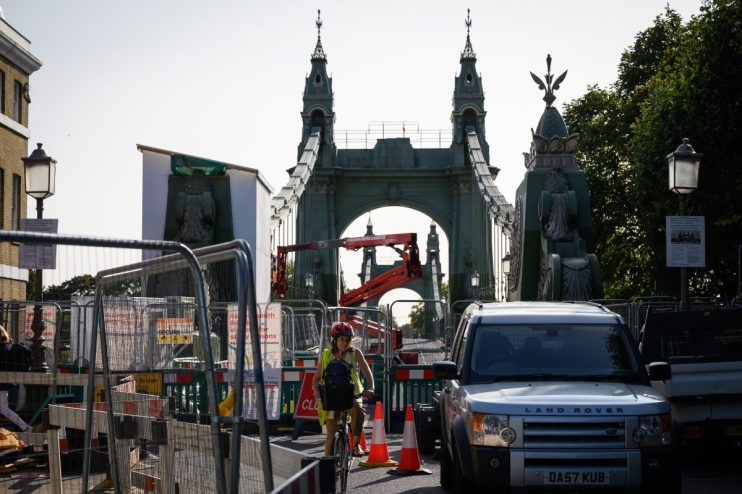
Handsome, historic but functionally broken, Hammersmith Bridge has come to symbolise Britain’s problems, writes Felix Pivcevic
There are countries that build. There are countries that talk. Modern Britain has chosen to specialise in a third way: the working group. Hammersmith Bridge – the Harrods‑green suspension stranded between Hammersmith and Barnes – has become our totem. Handsome, historic, but functionally broken.
For nearly seven years, it has been closed to vehicles. Bus routes cancelled, journeys lengthened, and neighbourhoods cut off. That an arterial road in our capital city remaining shut no longer shocks us is itself a warning sign. The dysfunction has become normalised, absorbed into a white noise of decline.
The proximate causes are well known. In April 2019, micro‑fractures were discovered in the bridge’s cast‑iron pedestals. Bollards and railings followed, and a crossing that had hummed with life for over 130 years fell silent. Sticking-plaster stabilisation works, completed in 2025 after six years of stasis, allowed for a partial reopening to pedestrians and cyclists, but a funded, timetabled plan to restore vehicle access has never materialised.
The deeper cause is more instructive. As with so much in Britain, responsibility for fixing Hammersmith Bridge is fragmented. Formal ownership sits with Hammersmith & Fulham Council. TfL has historically funded most repairs, but is now in chronic financial distress. The ultimate purse strings are held by a central government that has problems of its own.
In theory, a three‑way funding settlement agreed in 2021 should have solved the problem. In practice, it has dissolved into a slow‑motion accounting dispute over who has paid what so far, which costs count, and who will blink first.
As the arguments have dragged on, cost estimates have crept into the hundreds of millions. Politicians now suggest a full reopening could stretch well into the 2030s, meaning close to two decades of a largely defunct river crossing in one of the world’s richest cities.
The vacuum of decision‑making initially produced a strange burst of creativity. The ironically named Hammersmith Bridge Taskforce considered a carousel of options: a hugely costly “double‑deck” structure allowing traffic to run overhead while the existing frame is repaired; a partial bus‑only reopening; permanently banning cars; and even preserving the bridge as a static monument. Each option has been analysed, and analysed again. None has been chosen.
Indecision is costly
Meanwhile businesses look on. Indecision is not neutral. Disrupted transport constrains labour mobility. Entrepreneurs price in uncertainty, and investors quietly note that if a modest infrastructure problem can’t be solved, larger ambitions sound hollow.
The Hammersmith Bridge debacle reinforces a growing realisation that Britain’s economic problems are less about skills and capital, and more about competent decision making. British engineering is world class. The cost of total restoration would amount to a rounding error in the annual welfare budget. Yet the city has endured seven years of paralysis over fixing a problem that is well understood and whose economic value is plain to see.
So what would a serious response look like?
Something distinctly Victorian. When Hammersmith Bridge last failed, they did not convene a dithering taskforce. Instead, they legislated quickly. In 1883, Parliament passed a bespoke Act empowering a single body, the Metropolitan Board of Works, to build a brand new bridge, and construct a temporary crossing alongside so traffic could continue to flow. Responsibility and funding were fixed in law. In four years, it was complete.
This is the model we could revive. Heidi Alexander, the transport secretary, should own the problem and work cross‑party to do these same things: assign ownership unequivocally to a single delivery authority, with a statutory duty to restore the bridge. Last year’s Budget set aside £15.6bn for urban infrastructure in England. A tiny fraction of that money would be enough to unblock this issue immediately.
What we should abandon is the costly “double deck” Foster‑Cowi plan. Regardless of relative costs, spending nearly £300m to fix a low‑slung crossing over a narrow stretch of the Thames is farcical. The original bridge cost £11.5m in today’s money and plans already exist for a temporary bridge that costs little more and can restore partial connectivity within a matter of months: a plan which will also make repairing the original structure cheaper and faster.
This is not nostalgia. It is reviving common sense. The Victorians built quickly, beautifully and durably not because life was simpler, but because they made it so. They streamlined decisions and made it clear who was responsible.
Restoration therefore does not narrow the options: it makes future choices possible. That includes making enhancements so that walking and cycling are even safer and more attractive than before. But as a matter of principle, fixing things that break should be the default pursuit of any functioning society.
It is not ideas that Britain lacks. It is conclusions. Hammersmith Bridge stands as a quiet lesson in what happens when a country over‑invests in process and forever outsources decisions. If we want to be a nation that builds again, we could start by crossing the river.
Felix Pivcevic is the Putney Chapter Lead of Looking for Growth