Skip to content
Tuesday 25 August 2026London --:--Frankfurt --:--Zurich --:--
NewslettersSearchEN · DE · FR
MorningWire

European business, markets and politics

FTSE 100
10,886.16
+0.29%
DAX
26,266.14
+0.61%
CAC 40
8,439.20
-0.16%
STOXX 50
6,455.63
+0.12%
  • Europe
  • Markets
  • Business
  • Economy
  • Regulation
  • Politics
  • Opinion
More
GermanyFranceEU InstitutionsCompetitionPublic AffairsBankingTechnologyEnergy
  • Germany
  • France
  • Europe
  • Markets
  • Business
  • Economy
  • Regulation
  • Politics
  • Opinion
  • DE
Friday 30 August 2019 6:59 am  |  Updated:  Thursday 29 August 2019 6:06 pm

Trade is being weaponised – and it’s driving the G7 apart when we need the alliance most

By: Rebecca Harding

Add as a preferred source on Google
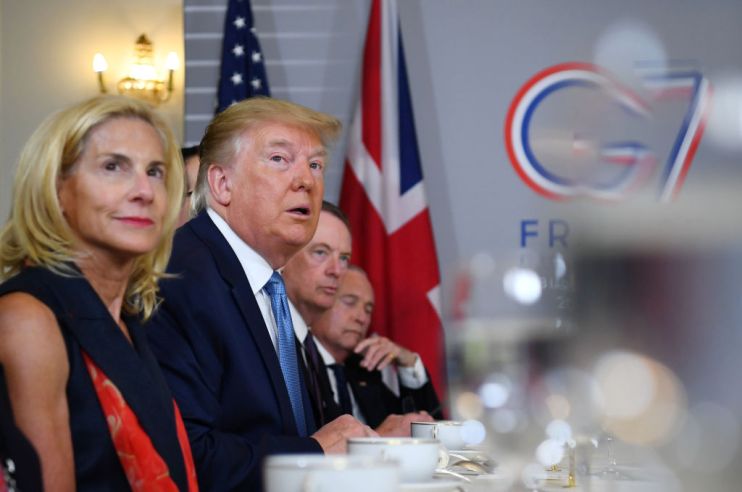
BIARRITZ, FRANCE - AUGUST 25: U.S. President Donald Trump attends a bilateral meeting with Britain's Prime Minister Boris Johnson during the G7 summit on August 25, 2019 in Biarritz, France. The French southwestern seaside resort of Biarritz is hosting the 45th G7 summit from August 24 to 26. High on the agenda will be the climate emergency, the US-China trade war, Britain's departure from the EU, and emergency talks on the Amazon wildfire crisis. (Photo by Dylan Martinez - Pool/Getty Images)

In the recent past, the G7 has largely been a talking shop for the leaders of the world’s biggest economies, who gather for a couple of days before sending out a communique generally agreeing that the western consensus should be maintained, and that globalisation is a good thing.

Last year, all that changed. 

Who can forget the picture of Angela Merkel – surrounded by the leaders of Japan, Canada, the UK, France, and Italy – standing behind a table, with both hands forcefully supporting her, as she leans over accusingly to a seated Donald Trump opposite? 

Remember the outrage at Trump’s subsequent tweet accusing Canada’s President Trudeau of being “weak” and “dishonest” because of his stance on iron and steel tariffs? 

At a point where the G7 should have been responding to the perceived threats to western values from fake news, cyber threats, intellectual property theft, and terrorism, the leaders of the world were arguing among themselves.

This breakdown in trust between the G7’s members has become even more evident. 

Donald Trump has become yet more bilateral in his negotiating stance, stepping further outside of the frameworks of the rules-based international order. Meanwhile, China and the US have become embroiled in something of a trade war of attrition, as each side seeks to wear the other down, while circumventing the usual dispute settlement systems of the World Trade Organisation.

Members of the G7, particularly Germany, Italy and France and Japan, are the target of US ire because of the size of their trade surpluses with the US, and in the EU’s case, its failure to contribute fully to the Nato budget.

Read more

Healey oversees unexpected rise in borrowing in first month as Chancellor 

Man in suit and red tie speaking at a podium to an audience in a modern building.

Into this tension steps Boris Johnson, who is not noted for his consensus approach to politics and negotiations. While the Prime Minister takes care to call them “our EU friends and partners”, he has nevertheless made it clear that he blames their lack of willingness to withdraw the Irish backstop from the existing EU withdrawal agreement for the failure to negotiate terms that would prevent a no-deal Brexit. 

To aggravate matters from an EU perspective, the US has talked up the prospects of a trade deal with the UK as soon as we are able to negotiate one.

The G7 is driven apart by trade at the moment – and the UK’s ambivalence towards the EU will hardly make for comfortable dinner-table conversations. 

The logic of the UK seems to be this: the US is our largest trading partner with exports that were some $16bn more than the next largest partner, Germany. There has been a decline over the last five years at an annualised rate of one per cent in our exports to the US, and a trade deal has the potential to stem this apparently ebbing tide. More than this, by aligning with the US at a G7 meeting, we can demonstrate the power of our own position.

Of course, there is an alternative view. The UK exported $477bn of goods to the world last year, while export trade with the G7 as a whole in 2018 was worth 35 per cent of that, at $166bn. The US accounts for nearly 13 per cent of all the UK’s exports. But added together, Germany, France and Italy account for just over 19 per cent, while the EU as a whole accounts for nearly 43 per cent. As an export destination, the EU is more important than the whole of the G7 put together.

Last year, Merkel spoke of the need for a European army to protect Europe from the increasing likelihood that the US would become an “unreliable ally”. 

In doing so, she reinforced the fact that trade had become weaponised – rhetorically, and increasingly literally, a tool for nations to coerce and influence others to achieve their strategic objectives. 

A year on, trade, economics and finance have become yet more weaponised, and the solid western alliance represented by the G7 countries can no longer be taken for granted. Within this context, the UK may well also be seen as an “unreliable ally”, but it is also worth remembering that by ourselves, our power to influence and coerce is weak.

Read more

Iranian hackers behind UK energy plant attack

UK industrial electricity prices are the highest in the G7 and 46 per cent above the average of the International Energy Agency.

Share this article

  • Facebook
  • X
  • LinkedIn
  • WhatsApp
  • Email

Similarly tagged content:

Sections

  • Markets & Economics
  • News
  • Opinion

Categories

  • Economics
  • Opinion
  • Politics

Trending Articles

  • Andy Burnham hints at tax rises in Autumn Budget

  • Can debt-ridden Morrisons become a Big Four supermarket again?

  • Budget 2026: Which taxes will Burnham and Healey hike?

  • As it happened: Stocks rally; US to unveil ‘economic D-Day’ Iran sanctions

  • Burnham shelves Thames Water administration plans over costs

More from Morning Wire

  • Healey oversees unexpected rise in borrowing in first month as Chancellor 

    Economics
    Man in suit and red tie speaking at a podium to an audience in a modern building.
  • Iranian hackers behind UK energy plant attack

    Energy
    UK industrial electricity prices are the highest in the G7 and 46 per cent above the average of the International Energy Agency.
  • UK economy weathers Iran war shocks but slowdown incoming

    Economics
    Chancellor John Healey smiling, wearing a navy suit, white shirt, and red tie.
  • Britain’s problem isn’t too much Thatcherism, but too little

    Opinion
    Margaret Thatcher smiling outside 10 Downing Street during her tenure as UKs longest-serving Prime Minister in the 20th ce...
  • War and tax: How the UK economy could get knocked off course

    Economics
    Andy Burnham speaking at a public event, emphasizing local governance and policy changes, wearing a suit and gesturing pas...
  • City leaders weigh employment policy alternatives to non-competes

    Law
    LONDON, ENGLAND - OCTOBER 15: Commuters cross London Bridge on October 15, 2024 in London, England. Estimates for the September 2024 payroll indicate that the number of employees rose by 0.4% compared with September 2023, a rise of 113,000 employees. (Photo by Dan Kitwood/Getty Images)
  • Devolution should mean regions competing for investment

    Opinion
    Manchester skyline with iconic landmarks during a Belfast speech event, highlighting urban landscape and architectural bea...
  • Can John Healey deliver Burnham’s make-or-break devolution agenda?

    Economics
    John Healey, in a red tie, speaking with Andy Burnham, wearing glasses and a dark blue jacket, outdoors.
MorningWire

Independent European business, markets and political news for decision-makers.

Morning Briefing

Europe

  • Germany
  • France
  • EU Institutions
  • Europe

Business

  • Markets
  • Business
  • Economy
  • Regulation
  • Competition
  • Public Affairs

Editorial

  • Opinion
  • Editorial Policy
  • Corrections
  • Contact

Company

  • About Morning Wire
  • Privacy Policy
  • Terms of Use
  • Cookie Policy
© 2026 Morning Wire Ltd · Published by Morning Wire Media, Bahnhofstrasse 65, 8001 Zürich, Switzerland
Privacy · Terms · Cookies · Facebook