Tupperware of Ashes at the Dorfman: Bleak but vital play on how we treat our elderly

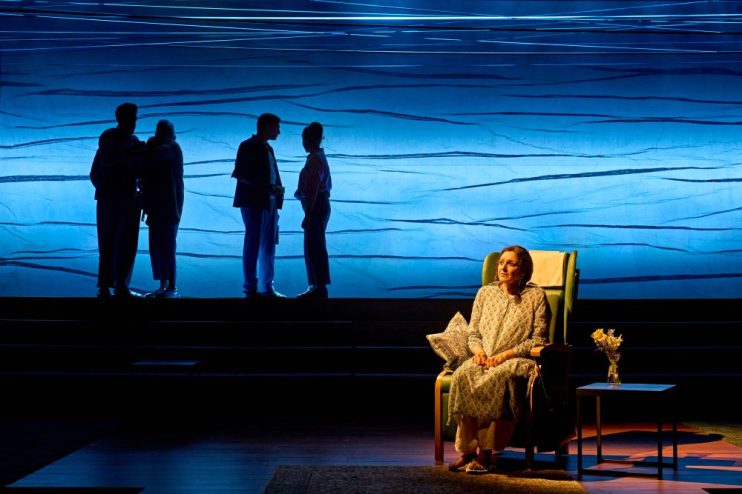
A Tupperware of Ashes isn’t just an excellent work of fiction, but a bleak, vital conversation about how we treat our elderly
Imagine being presented with the blank outline of a clock, and being asked to fill the hours in, one to 12. Imagine the horror when you realise you can’t do it. Until then you believed you were compos mentis, you ran a restaurant, cooked, argued with your three adult children and gossiped with friends. You forgot things from time to time, but ultimately you had believed yourself to be well.
This is the moment in new play A Tupperware of Ashes that the protagonist, Queenie (superbly played by Meera Syel), is confronted with the fact that she has a terminal illness. The shame and horror that wipes across her face is affecting in the extreme, compounded by the fact that there is no cure.
Written by Tanika Gupta and directed by Pooja Ghai (who created the acclaimed The Empress), Tupperware of Ashes starts out as a bang-average family comedy replete with jokes mocking British-Bengali matriarch-child dynamics. One mother, a chef and restaurant owner in her late 60s who came to the UK from India as a young adult, and three children (an English teacher, a lawyer and a doctor). The family gathers, bickers, laughs. Humour is juxtaposed with tragedy throughout, although in the second half it is tragedy that comes to the fore.
Inspired by King Lear, Queenie is a difficult parent. When Raj, her firstborn, protests his mother’s dislike of his “life partner”, Krishna, she replies: “I gave you life! I’m your life partner!” Some of this feels a little cliche, though the stereotypes about Bengali family culture are somewhat eased towards the play’s end when the children visit the Ganges and learn more about their mother’s relationship with her own parents. The clash of cultures allows for a broader conversation about how to address an ageing population increasingly afflicted by mental decline.
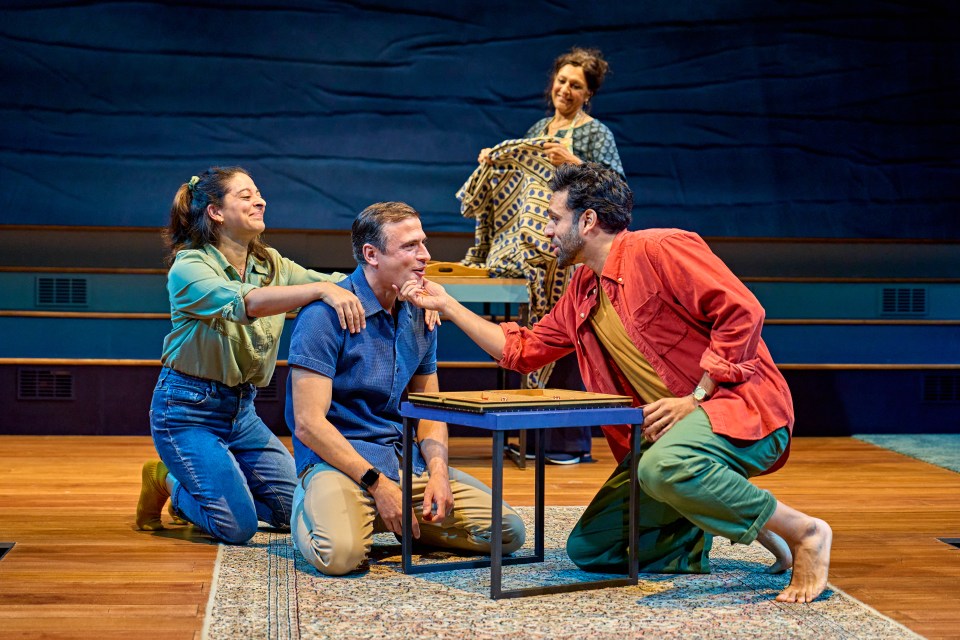
Generational cohabitation is far more common outside of the UK, where we are increasingly reliant on a flailing care sector. Queenie’s best friend Indira is horrified at the thought of putting Queenie into care: “In our culture, we look after our parents!” she says, whereas in Britain “they treat their pets better than their parents”. Stereotypes about parent-child relationships in India versus the UK are made a little more complicated when it is revealed that Queenie did not look after her own parents in their old age. As her disease escalates she becomes paranoid, reduced to the role of a child in her refusal of food, aggressive in her (seemingly one-sided) conflict with her first son’s wife.
“They treat their pets better than their parents”
After accepting her prognosis with immediate pragmatism, Queenie marches back to her three children to tell them she is dividing her estate between all three equally – a good shout, you might think (and they don’t even have to flatter her vanity first). Her plan to orchestrate a rotating residency whereby she hangs out at each child’s spare room for four months goes a little less smoothly.
Inevitably, Queenie does end up in a home – just like an increasing number of us will. With my grandpa, that was our worst fear: him being funnelled into a care facility during the pandemic, necessarily but cruelly alone. The only time I have seen my father break down was when he realised my grandpa, the person he respected most in the world, was no longer really himself, unable to enjoy Beethoven’s symphonies or read books about Einstein’s theory of gravity, now condemned to watch daytime TV.
In the home, she is confronted with “an old person’s chair” – “How will Omit and I have sex in there?!” she asks as her deceased husband circles her, goading her on. Omit’s presence is a clever device, often engulfing the audience, and thus allowing us to engage in the battle between reality and fantasy in Queenie’s mind. Their relationship is charming and youthful and silly – both are excellently acted.
Gupta uses the first half to question binaries in legal and medical definitions. The diagnosis and legal steps are explained in great detail – all to pose the questions: at what point should someone be defined as ‘ill’? At what point should someone lose the ability to make irreversible legal decisions? These are not clear-cut lines.
Queenie is a complicated and convincing character. She wields her agency with gusto until the disease silences her. It takes a lot to convince her that she is ill. Even as she deteriorates, the audience is never quite sure whether it’s the Alzheimer’s talking or her.
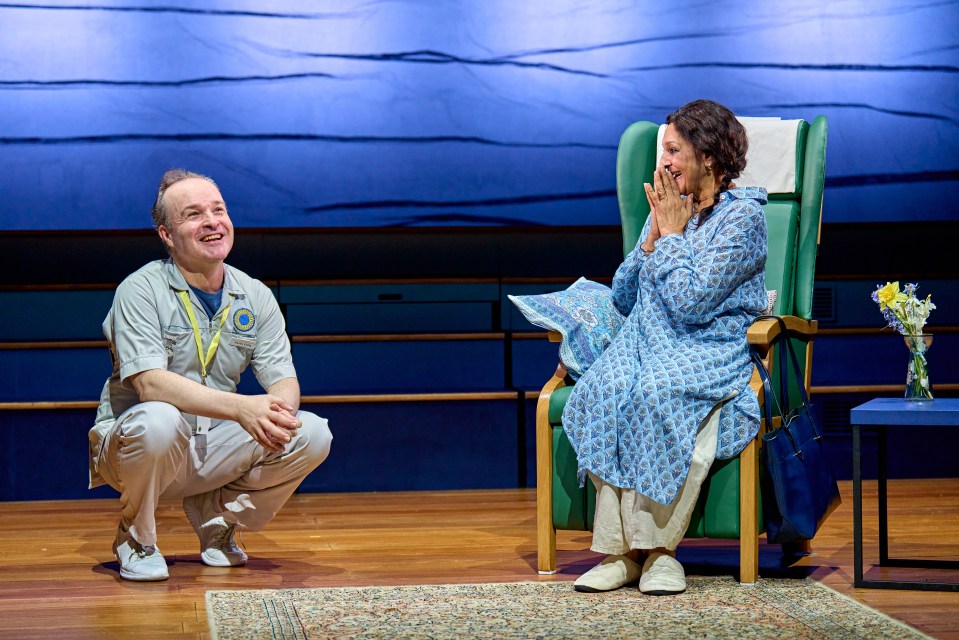
The Polish care worker Pavel, who tends to Queenie in the home, is verging on being a two-dimensional hero worthy of a patronising street-wide clap – but ultimately plays an affecting role. Unlike her children, who cannot accept that their mother lives in a different world, Pavel – with apparent ease – indulges in, for example, her little fantasy of going to Rome to buy a mango gelato. “Let’s drive there!” she cries. Yes, he agrees, the complexities of such a suggestion swept under the non-existent rug. When Pavel enters in a face-mask and visor, the cruelty and pain of Queenie’s loneliness is hard to watch. Syel excels in showing the cumulative impact of age and illness.
This is not really a realist production; indeed, everything is hammed up. At one point Queenie nearly commits suicide by jumping out of a window, then suddenly the lighting, music and choreography conspires to make her appear as if a Power Ranger, looming at the top of the stage armed with what looks like a machete. A dramatic cut kills the music and brings up the lights as Queenie is coerced back into reality by two paramedics. It’s a neat way of showing how those with Alzheimer’s can suffer delusions and find themselves saying or doing things they wouldn’t otherwise.
Up to 1.7m people could be living with dementia in England and Wales by 2040. The chances are your life will be disrupted by the disease soon in some capacity, if it hasn’t been already. In that light A Tupperware of Ashes isn’t just an excellent work of fiction, but a bleak, vital conversation about how we treat our elderly.