Skip to content
Sunday 23 August 2026London --:--Frankfurt --:--Zurich --:--
NewslettersSearchEN · DE · FR
MorningWire

European business, markets and politics

FTSE 100
10,816.56
+0.64%
DAX
26,136.56
+0.59%
CAC 40
8,484.43
+0.37%
STOXX 50
6,462.22
+0.63%
  • Europe
  • Markets
  • Business
  • Economy
  • Regulation
  • Politics
  • Opinion
More
GermanyFranceEU InstitutionsCompetitionPublic AffairsBankingTechnologyEnergy
  • Germany
  • France
  • Europe
  • Markets
  • Business
  • Economy
  • Regulation
  • Politics
  • Opinion
  • DE
Tuesday 19 May 2015 6:31 am

UK house prices: Scotland’s growth at its highest since 2007 as prices accelerate

By: Billy Ehrenberg

Add as a preferred source on Google

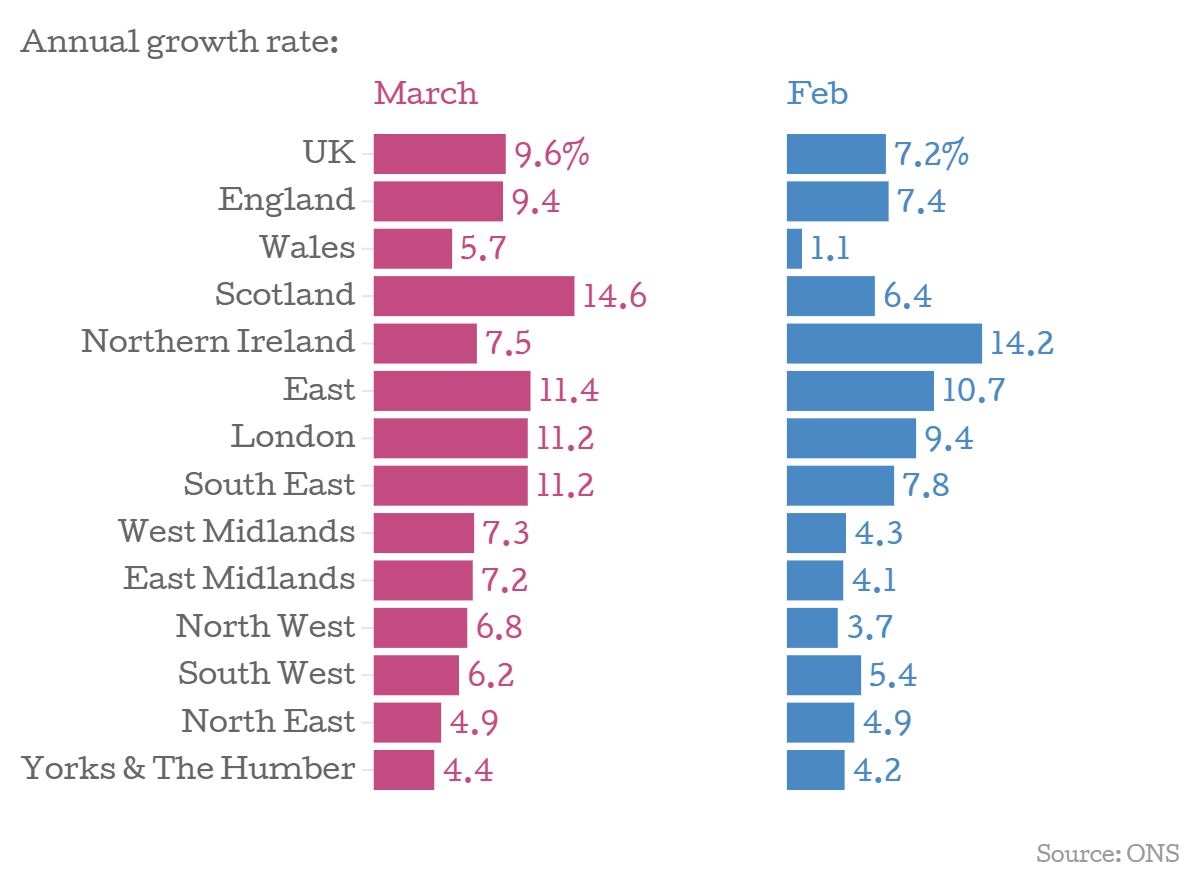
The UK’s house price growth rose to 9.6 per cent for the year to March, with Scotland the east of England and London driving the rise.

The figures

The 9.6 per cent rise in the UK for the year to March was 1.2 percentage points higher than the 7.4 per cent recorded in February.

The growth wasn’t evenly spread across regions: Scotland had the fastest growth at 14.6 per cent, while England’s prices grew at 9.4 per cent. Scotland’s stellar performance meant its prices grew at the fastest rate since July 2007.
On a monthly (seasonally adjusted) basis, prices in the UK grew 1.1 per cent between February and March.

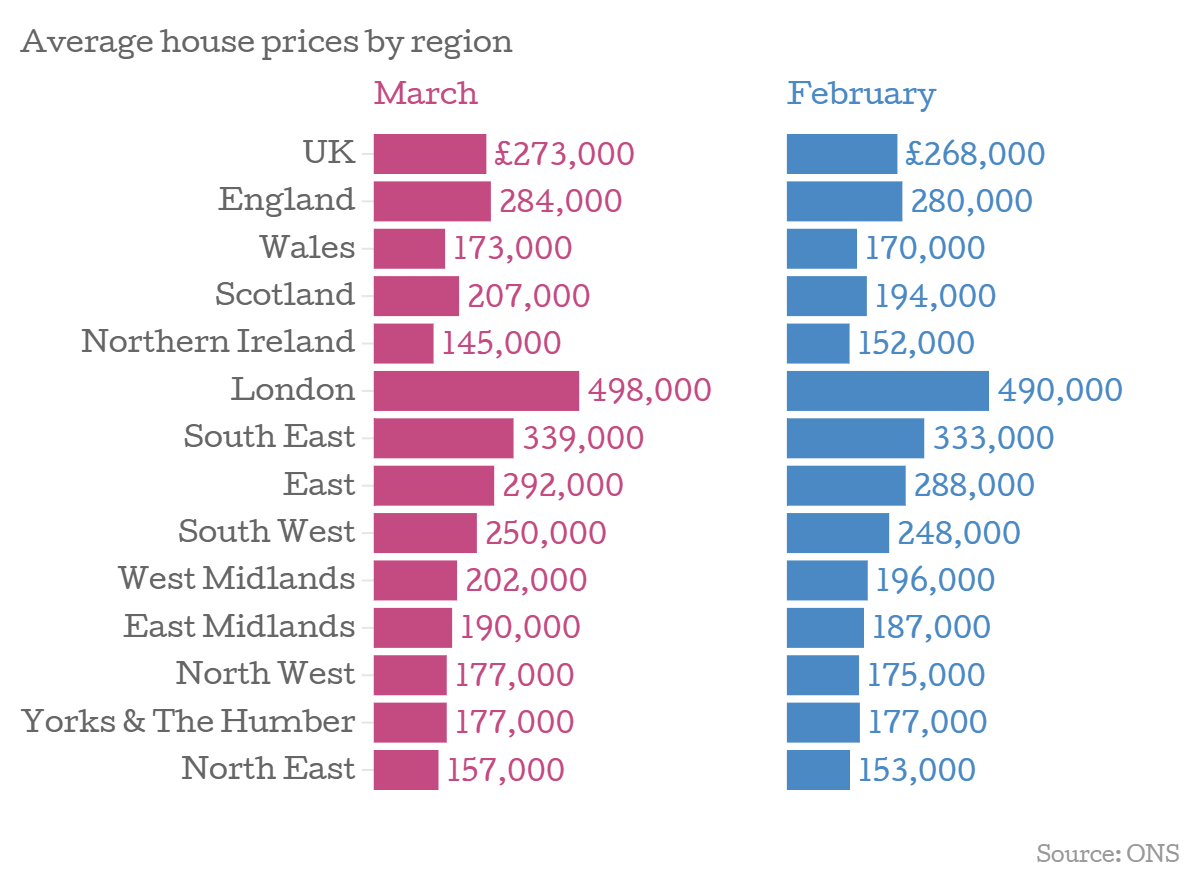
Average prices are far higher in London, but growth in the capital has fallen behind the east, south east and Scotland. This isn't peculiar to the ONS data, other measures have shown similar trends.
Why it’s interesting

The ONS releases data based on mortgage completion, and it lags behind other indexes such as nationwide and Halifax, who have released data for April. Both showed higher monthly increases in April than in March – Nationwide’s one per cent in April beating 0.1 in March, while Halifax’s 1.5 per cent in April was more than double the 0.6 per cent growth it recorded in March (although the three-monthly growth rate slowed). 

This means that the ONS’s data isn’t cutting edge, but it shows there is steady momentum growing in the market. This momentum could be due to a shortage of houses coming on to the market – a factor sure to increase demand.

This demand may wane later in the year as downward pressure comes into play. Stretched price to earnings ratios are one candidate for moderating growth – data from Halifax shows that the average price to earnings ratio rose to 5.2 in April, the highest since April 2008.

What the analyst said

Howard Archer of HIS Global Insight said:

We are lifting our forecast house price increase in 2015 to 6 per cent from 5 per cent, partly due to the increased upward impact on prices coming from a lack of properties on the market. We also suspect that the housing market will benefit from reduced uncertainty following the decisive general election result.

In short

Although house price growth is robust, it may well moderate going through the year as interest rate rises continue to hang over the market (even if they may not come until 2016) and tighter borrowing restrictions. 

Share this article

  • Facebook
  • X
  • LinkedIn
  • WhatsApp
  • Email

Similarly tagged content:

Sections

  • Markets & Economics
  • News

Categories

  • Business
  • Economics

Related Topics

  • UK house prices

Trending Articles

  • Can debt-ridden Morrisons become a Big Four supermarket again?

  • Ratcliffe’s Ineos saves Runcorn plant

  • Mike Ashley’s Frasers offers to pay personal shoppers in Harvey Nichols takeover

  • Burnham predicted to raise taxes for ‘fundamental’ cost of living support

  • Amazon says it buys books in bulk to ‘improve products’

More from Morning Wire

  • House prices in wealthy London boroughs fall by up to £300,000

    Property
    Waverton Investment Management and London & Capital combined into W1M.
  • UK economy weathers Iran war shocks but slowdown incoming

    Economics
    Chancellor John Healey smiling, wearing a navy suit, white shirt, and red tie.
  • UK economy’s rebound fails to stem two years of mass job losses 

    Economics
    LONDON, UNITED KINGDOM - JANUARY 31: The Shard is seen on the horizon as commuters cross London Bridge during the morning rush hour on January 31, 2023 in London, United Kingdom. The IMF reports that the UK economy will contract by 0.6% in 2023, as opposed to the previous prediction it might grow, and will perform worse than many other advanced economies, including Russia.The cost of living continues to hit households with grocery inflation for the first four weeks of 2023 rising to 16.7% which would add a further £788 per year to family food bills. (Photo by Leon Neal/Getty Images)
  • House prices suffer biggest August slump in eight years 

    Property
    Aerial view of colorful residential houses built on a hillside, nestled among green trees, representing housing markets
  • As it happened: FTSE 100 drops as Antofagasta prompts miner sell-off; oil prices cool

    FTSE 100 Live
    Glencore floated on the London Stock Exchange in 2011 and is one of the largest members of the FTSE 100.
  • Aviva profits jump following Direct Line acquisition

    Insurance
    Aviva's deal to buy Direct Line was agreed in March
  • Inflation leaps to 2.9 per cent in blow to Burnham 

    Economics
    Burnham cityscape showcasing modern architecture, bustling streets, and vibrant community life in a thriving urban setting
  • Wizz Air profit wiped out by rising fuel prices

    Markets
    The CEO of Wizz Air received a huge bonus in 2024.
MorningWire

Independent European business, markets and political news for decision-makers.

Morning Briefing

Europe

  • Germany
  • France
  • EU Institutions
  • Europe

Business

  • Markets
  • Business
  • Economy
  • Regulation
  • Competition
  • Public Affairs

Editorial

  • Opinion
  • Editorial Policy
  • Corrections
  • Contact

Company

  • About Morning Wire
  • Privacy Policy
  • Terms of Use
  • Cookie Policy
© 2026 Morning Wire Ltd · Published by Morning Wire Media, Bahnhofstrasse 65, 8001 Zürich, Switzerland
Privacy · Terms · Cookies · Facebook