
University unveils humanoid to help NASA on missions to Mars

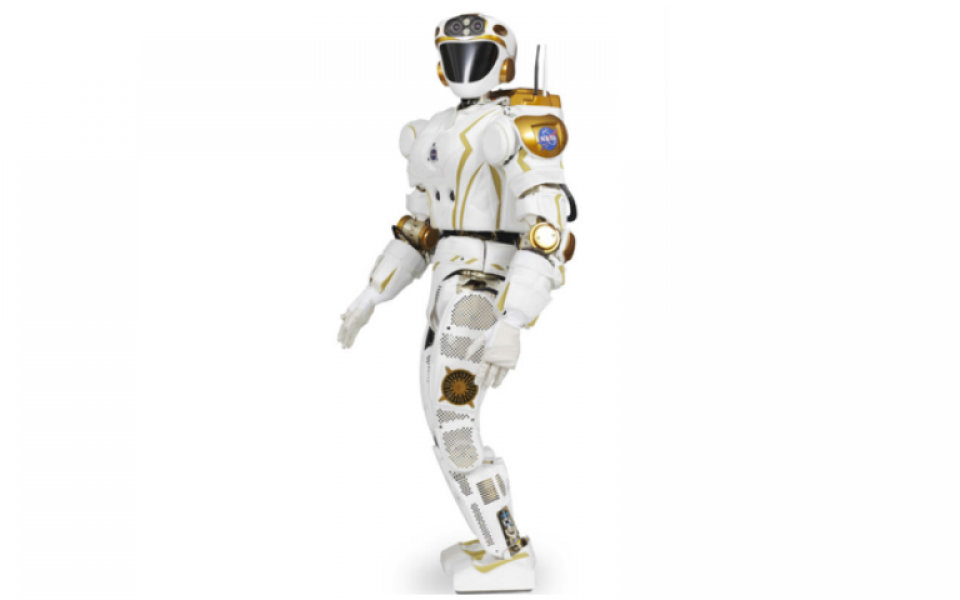
Scientists at The University of Edinburgh have recently unveiled a £2m humanoid robot that will help NASA on un-manned missions to Mars.
The Valkyrie project is a result of collaboration between NASA and The University of Edinburgh on a very ambitious futuristic idea.
Valkyrie is the most advanced humanoid robot in the world and only three exist – one in Edinburgh and two in the US. This is a long-term loan under the NASA Space Act Agreement, requiring detailed, year-long negotiations to get around NASA's very strict rules on loaning-out the hardware outside the US.
The University of Edinburgh is very fortunate to be one of the few groups to get to work on this amazing project, with the real possibility that NASA is planning to use these humanoid robots to send un-manned robotic missions to Mars.
Sethu Vijayakumar, professor of robotics, at the University of Edinburgh's School of Informatics:
“This is massive recognition for…Edinburgh that NASA has chosen us one of the key partners…Over the past ten years, we have significantly strengthened our worldwide standing in the field of robotics.”
Pre-deployment capabilities
The concept is that it would make manned missions much cheaper, safer and efficient if humanoid robots could be used to pre-deploy essential capabilities on the surface of Mars – ahead of the manned mission.
Other space related goals also include robots co-working in the space station and taking over repetitive as well as high risk tasks (e.g. space walks) from astronauts.
The project has brought together four principal investigators and around ten to twelve PhD students and postdocs involved in development of various aspects at Edinburgh, whilst the project also collaborates closely with teams at Massachusetts Institute of Technology and the Institute for Human & Machine Cognition in Florida.
International collaboration
This is a truly collaborative and international project and brings with it massive recognition for the research team, the School of Informatics and the University of Edinburgh that NASA has chosen it as one of the key partners in this project.
Over the past ten years, a great deal of hard work has gone into significantly strengthening their worldwide standing in the field of robotics by building on the existing strengths in machine learning to lead the research in data driven control of complex, anthropomorphic robotic platforms.
This has been recognised by the establishment of the Edinburgh Centre for Robotics, an Engineering and Physical Sciences Research Council-funded centre of excellence in robotics, in partnership with Heriot-Watt University – with cutting edge infrastructure, world class robotic platforms (of which the NASA Valkyrie is one of the highlights) and funding to train the next generation of world leaders in the field through the EPSRC Doctoral Training Program in Robotics and Autonomous Systems.
The key aim, and the direction the research team at Edinburgh is taking, is to provide dexterous capabilities to this extremely powerful, agile and complicated robotic hardware — so that it realises its true potential.
‘Shared Autonomy’
Over the next four to five years, the robot will be tasked to do several challenging tasks that require dense sensing, manipulation capabilities and close human robot interaction. The scientific challenge is to make such behaviours as robust as possible.
Vijayakumar adds “We have to deal with real-time control and develop new techniques and algorithms to build walking, grasping, manipulation and balance control – things that we take for granted as a human being.”
“I believe that the next scientific frontier in robotics is in the area of 'Shared Autonomy' where the robot and humans will seamlessly be able to collaborate and control the level of autonomy for optimal and safe execution of a task.”