US military won’t invade Greenland, but Wall Street Warriors might

A US military invasion of Greenland would be self-defeating, but both sides have a great deal to gain from harmonious financial and industrial relations, writes James Gray
There has been some fairly hysterical coverage of Trump’s remarks about Greenland. Will it mean the end of NATO? Will it lead to war with Denmark? But despite Trump’s notorious unpredictability, there seems to me vanishingly little likelihood of any kind of military aggression by the United States against Greenland. Why so?
His off-hand remarks cite Greenland’s strategic and commercial importance to America. And of that there can be no doubt. As the Greenland ice shelf melts – at a rate of 270bn tonnes per year – several strategic sea routes open up. Greenland controls the top end of the Greenland-Iceland-UK Gap, crucial to NATO submarine surveillance and vital in resupplying Europe.
The increasingly ice-free Northwest Passage skirts Greenland’s shores. There’s even talk of a deep-sea port to serve the emerging Northern Sea Route or Northeast passage, either in Iceland or – just possibly – in East Greenland. Mike Pompeo once called Arctic sea lanes the “21st-century Suez and Panama Canals”. So Greenland’s strategic importance to the US is abundantly clear.
Yet there are three powerful reasons why a military invasion of any sort would be foolish and self-defeating.
Why the US military won’t invade Greenland
First, Greenland already hosts a huge American military base, and congress have recently approved a $4bn programme of upgrading for it. Indeed America is already the only effective military presence in the entire island. The Pituffik Space Base is an essential part of US air defence and missile early warning systems which would detect any nuclear missile launched in Russia’s Kola Peninsula or nearby (which houses the bulk of Russia’s nuclear capabilities). Pituffik’s 10,000 ft runway (about the same size as Gatwick) handles more than 3,000 flights a year. And it has the northernmost deepwater port in the world. There are 150 military personnel there. That’s down from 6,000 in the Cold War, but could be regrown easily without any kind of ‘invasion’.
So what would be gained by any kind of American military action elsewhere on the island? Not only would it be pointless, but under the 1951 Treaty which allows it, the US presence in Greenland can only continue as long as both Denmark and the United States remain NATO members.
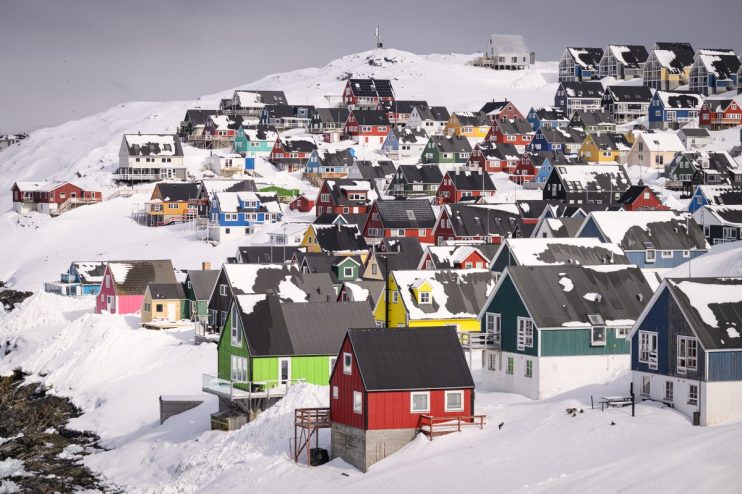
Second, there really is nothing in Greenland which invites invasion. 80 per cent of the island is covered by an ice sheet which averages 1 mile in thickness. The weather is extremely cold for eight months of the year (down to minus 50 degrees), with spikes of heat in the summer (recently up to 35 degrees). It is largely dark, or at least very gloomy from September until March, and most of the island is uninhabitable. Aside from the capital, Nuuk (20,000 population), there are no towns or cities of any size. There is only one road, 100 miles in length, so all travel is by air or sea. There is very limited industry of any kind aside from fishing and a little tourism.
And third, while America has nothing at all to gain from any invasion, and a great deal to lose, they have a great deal to gain from harmonious financial and industrial relations with Greenland. It is all about natural resources. Trump’s unashamed lust for Greenland’s rare earths is but one element of a global race to control the production of the strategic minerals which are essential components of batteries, phones, electric vehicles and all modern computing devices. It’s about silicon, germanium, phosphorus, boron, indium phosphide, gallium, graphite, uranium, copper, lithium, cobalt and nickel, among others, and he who controls their production holds the key to the digital globe.
US is trying to outmanoeuvre China
Taiwan manufactures over 60 per cent of the world’s semiconductors and more than 90 per cent of its most advanced chips. So if China were ever to carry out its threat to invade Taiwan (which some observers think may be imminent, perhaps encouraged by Trump’s daring action in Venezuela), it would gain near-total control of the global microchip supply. Do we really want to be dependent on China for every phone, computer and electric vehicle produced in the West?
That means that the US needs to develop chip-making capabilities comparable to Taiwan’s, to achieve which it needs reliable sources for the 50 or so critical minerals required. And Greenland’s Ilimaussaq Intrusion mine at Kvanefjeld, alongside several others, holds concentrated quantities of 30 of them, amounting to 10 per cent of the world’s total rare earth reserves.
However, the practical reality is that with a population of just 57,000 – many of them Inuit fishermen and hunters – Greenland currently lacks the industrial infrastructure to extract these minerals and both China and the US would be keen to fill that gap.
China in particular has shown intense interest, at one point proposing a $2.5bn investment in a Greenlandic mine (more than the island’s entire GDP), which would have brought in 5,000 Chinese workers. Then they proposed massive infrastructure investments including a deep-sea port and two international airports. These would require capital which would leave Greenland beholden for all time. Denmark and the US, unsurprisingly, blocked these plans.
The final umbilical cord linking Greenland to Denmark is the annual block grant of 3.9bn kroner (roughly $560m), making up about 19 per cent of Greenland’s GDP. But to put that in perspective, it is less than the amount annually spent by the US on the city of El Paso, Texas. And it is minuscule compared to the mineral wealth Greenland could one day command in partnership with a deep-pocketed ally like America.
The deal that would benefit Greenland and US
So military invasion would be wholly self-defeating and pointless. But massive infrastructure and mineral extraction investment makes a huge amount of geostrategic good sense. In October 2024, the US and Greenland issued a joint statement pledging deeper cooperation on many of these issues. While an outright purchase may be politically impossible, other options exist – such as a Compact of Free Association, similar to agreements the US has with other strategically placed Pacific nations. These can deliver economic and security benefits to both parties. Trillions of dollars of Wall street investment in mineral extraction would without doubt follow.
Trump’s 2025 call to “buy”, far less invade, Greenland sounds outlandish – even offensive – as with so much of his rhetoric. But beneath the bombast may lie the bones of a deal: one that could benefit the predominantly Inuit population, while delivering enormous strategic and commercial gains to the United States.
It was the Viking, Eric the Red, who, in AD 986, first saw Greenland’s potential. He wanted to colonise his newly discovered island, and in a blatant piece of 10th century spin-doctoring hit on a wizard wheeze to encourage other Norse people to come to this bleak, icy and remote corner of the unknown world.
“In the summer, Erik left to settle in the country he had found, which he called Greenland, as he said people would be attracted there if it had a favourable name.” (Erik the Red’s Saga)
Greenland must now find a way to harness its vast resource wealth while preserving its fragile culture and ecology. Greenland cannot be sacrificed to short-term capitalism – but it can, and must, find a way to benefit from it. If managed with wisdom and care, the coming years could bring not only prosperity to Greenlanders, but a global model of sustainable extraction and indigenous self-determination.
America, China and Russia may want Greenland. But perhaps Greenlanders need them just as much?
James Gray is a former Conservative MP and the author of newly published The Arctic: What next? Available (£20 inc P and P) from [email protected]