US tech giants face trouble if Obama fails to shut down internet snooping

THIS Friday, Barack Obama will decide what he intends to do about the US National Security Agency’s (NSA) covert surveillance activities on the phone and internet records of the American people. He will do so having received a coruscating report from his own review panel, recommending that he shut it down. A bunch of hard-headed intelligence specialists, they concluded that the programme was ineffective at stopping terrorism, expensive, and made excessive inroads into the privacy of ordinary, innocent Americans.
But Obama’s decision will probably rest far more on a cold calculation of commercial interest. Although the US people and politicians of all parties are furious about the intrusion on their privacy, the loudest roar in the past few months has come from Silicon Valley.
The apparent compliance of Google, Yahoo, Facebook and Microsoft with the PRISM programme – fiercely denied by these companies – followed by the hacking of the servers of Google and others by a gleeful GCHQ, has shattered the trust that customers of those companies had in them. In an industry in which assets can flee at the speed of light, where the customer base is notoriously fickle, and where today’s leviathan is tomorrow’s fossil, the main players are feeling real fear and anger.
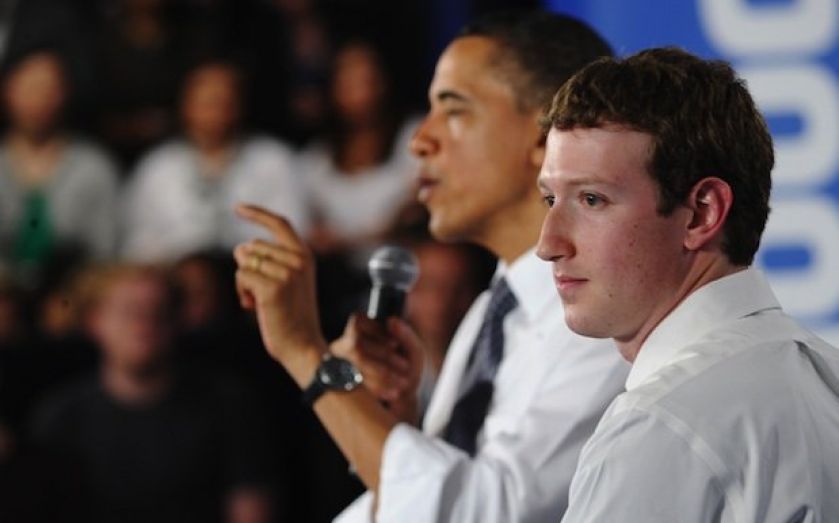
Most vocal has been Facebook’s Mark Zuckerberg, who exploded with fury at the US intelligence community’s casual dismissal of the tech giants’ worries. The former initially (and untruthfully) claimed that their activities did not affect American citizens. Yet fully 80 per cent of Zuckerberg’s customer base is outside the US, and he is already facing a younger potential clientele who view Facebook as old fashioned. An intelligence initiative that makes his company look like it is the patsy of a distrusted establishment is extremely harmful, and he is already feeling the financial pain.
This is all compounded by a strategy that includes a deliberate attempt by American and British intelligence agencies to undermine the encryption standards that underpin the security of the internet. All this is done not so much by breaking the law, as by getting government lawyers to render interpretations of the law that do violence to the normal understanding of the English language.
Inevitably, this is going to drive customers to countries like Germany, whose Basic Law and constitutional court renders such behaviour strictly illegal. Some German internet companies are already looking at how to capitalise on this.
The Washington, DC-based think tank the Information Technology and Innovation Foundation has assessed that the US tech industry could lose up to $35bn (£21.2bn) by 2016 as a result of NSA surveillance concerns. The situation, however, could get worse.
A few days after Obama offers his view, the European Parliament’s LIBE Committee will issue its own report on the matter. Early drafts suggest that it is going to recommend suspension of the Safe Harbour Treaty, the streamlined process that enables US companies to comply with EU data protection directives. If it does that, it will create serious competitive problems for any American data-based company.
There are even bigger issues in play. It is not yet clear whether fracturing internet security and encryption standards will harm financial centres, but it seems likely. Furthermore, in today’s global economy, data flows are as important as capital flows. The Balkanisation of the web, as countries like Brazil seek to protect their citizens’ privacy from Western assault, will undoubtedly harm growth in the global economy.
So the issue is enormous, which is no doubt why Obama spent so much of his time last week seeing all the protagonists in the American debate. But Obama will not have the last word on the issue. Congressman Jim Sensenbrenner, the man who wrote the Patriot Act, made it plain to me last week that, if the President did not act on this, he had the votes in the House of Representatives to push through an Act to shut down the offending programmes, and that he fully intended to do so.
This will leave Britain in a difficult position. Our agencies have been hand in glove with the Americans in these covert operations. There is a real risk that we will be seen as the dirty laundry centre for the Western intelligence community. We face exactly the same challenges as the US, with a big internet-based sector, and a big financial sector. Our pre-eminence in these areas depends in very large part on our reputation for upholding the rule of law and for the integrity of our approach to business. If, therefore, the Americans clean their house, we will have to do the same – or face dire consequences.
David Davis is Conservative MP for Haltemprice and Howden.