We need more new towns like Brent Cross – but we need them in the right places

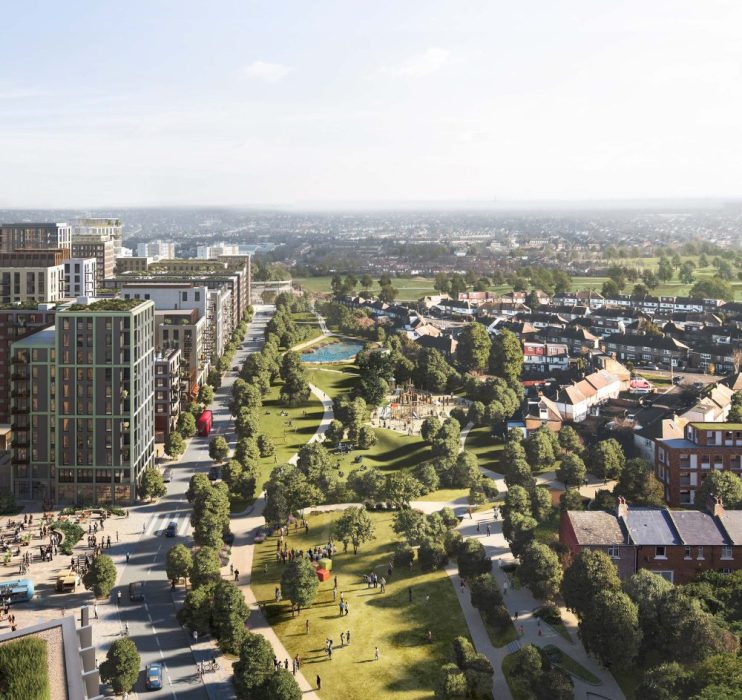
Brent Cross is London’s newest park town. Its proximity to London has been crucial to making it a success, writes Tom Goodall
Although the concept is coming to define the new government – in housing policy at least –the definition of a new town is not totally clear. Indeed, so nebulous is the phrase as it stands that the government itself has assigned the act of defining them to an assembled taskforce, which held its first meeting last week in Milton Keynes (the archetypal postwar New Town).
Questions abound. Where will the new towns be built? Brownfield land will be prioritised first, we are told, but whether we expand existing communities on the so-called grey belt or build brand new towns from scratch has not yet been determined.
Important to remember is that a successful town is more than a mere collection of homes. It is the heartbeat of a community – a place where people feel a deep sense of belonging, pride and ownership. This belief is what inspired us at Related Argent to name Brent Cross South – a 180-acre park town for London, designed for people to live, work and thrive, minutes from Zone 1 – as Brent Cross Town.
New towns will not only solve the housing emergency, but will also deliver growth. Every new home built is associated with 1.2 direct jobs, according to analysis by the Greater London Authority using the National Housing Federation’s local economic impact calculator. Labour’s target of 1.5m homes would therefore generate an estimated 1.8m jobs, significantly boosting the economy.
Yet new communities that focus solely on the delivery of homes – using every spare penny to lay bricks and mortar whilst disregarding social infrastructure – oftentimes don’t succeed in becoming living, breathing places where people actually want to be.
Crucial to this debate is an understanding of just how long it takes to build what we would consider a fully-fledged town. Milton Keynes was created in 1967, and the Milton Keynes Development Corporation oversaw its construction up until 1992. That’s 25 years in the making.
The target set out in the 2024 Labour manifesto is for 1.5m new homes over the next parliament. That’s 300,000 a year, which, if realised, would be a monumental and unprecedented achievement. Many believe it impossible without urgent intervention from the government, with a coalition of housing providers in July urging Angela Rayner to deliver the “biggest boost to social housing in a generation” and plug a £2.2bn black hole in their budgets threatening the next four years of development.
London’s new ‘park town’
London can play a critical role in speeding up the delivery of new towns. If we build new communities with connections to the capital, these areas can benefit from much of the necessary existing infrastructure allowing developers to go from zilch to swinging open a brand new front door in 10 to 15 years, rather than 25. It has taken just eight years to get to opening the first front door at Brent Cross Town – albeit with significant upgrades to transport through the creation of a new mainline train station Brent Cross West and the delivery of the first phase of our net zero energy network.
Two problems: time and affordability
However, the full construction process for even the simplest of new housing is often longer than the average parliament, which begs the question of whether the new towns target is a solution for this parliament alone or subsequent ones too.
Time and affordable housing are two major areas where the government may struggle. The “gold standard” 40 per cent affordable housing target has the potential to destroy a scheme’s viability without significant grant funding from public bodies like Homes England or the GLA.
At King’s Cross we achieved 40 per cent affordable housing, enabled through access to significant grant funding which no longer exists. In 2024, we face a far different outlook. Very few parties will fund infrastructure or affordable housing, meaning that market-facing products all too often take priority over critical elements like public realm, schools and social housing.
In today’s climate, very few parties will fund infrastructure or affordable housing, meaning that market-facing products all too often take priority over critical elements like public realm, schools and social housing.
At Brent Cross Town, one of the first things we brought forward was Claremont Park – a 1.8-hectare public green space delivered for the community and the first new homes will be social rented housing. At King’s Cross, we prioritised Central Saint Martins and the iconic Granary Square. Neither of these would be possible in today’s market without significant government subsidy. This funding outlook paired with the gold standard targets has the potential to create a dangerously adversarial dynamic between industry and the government – stalling delivery even further.
If we stand a chance of reaching a fraction of this target, the government should prioritise London and its surrounding areas, along with other regional urban centres and places where people already want to live. In our post-Covid, hybrid working world, London has continued to expand. As the commuter belt thickens and widens to the likes of Brighton, Cambridge and beyond it forges ripe terrain for new towns. Those sites must be identified and demarcated quickly to generate the momentum needed to carry this government into their next parliament.