Skip to content
Saturday 12 September 2026London --:--Frankfurt --:--Zurich --:--
NewslettersSearchEN · DE · FR
MorningWire

European business, markets and politics

FTSE 100
10,650.44
+0.39%
DAX
25,568.56
+0.82%
CAC 40
8,179.77
+0.78%
STOXX 50
6,325.13
+0.90%
  • Europe
  • Markets
  • Business
  • Economy
  • Regulation
  • Politics
  • Opinion
More
GermanyFranceEU InstitutionsCompetitionPublic AffairsBankingTechnologyEnergy
  • Germany
  • France
  • Europe
  • Markets
  • Business
  • Economy
  • Regulation
  • Politics
  • Opinion
  • DE
Wednesday 27 April 2022 6:15 am  |  Updated:  Tuesday 26 April 2022 5:29 pm

We need to stop comforting ourselves with the myth of the all-powerful central bank

By: Paul Ormerod

Add as a preferred source on Google
Last-Minute Lobbying Ahead Of UK Budget Debut
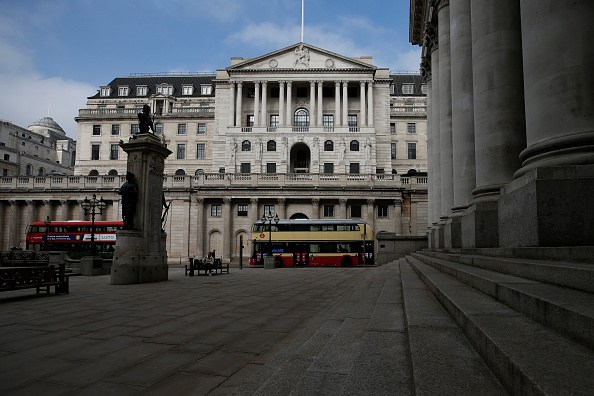
The Bank of England has come under fierce criticism for its sloppy response to the rise of inflation. (Photo by Hollie Adams/Getty Images)

Inflation continues to be a major problem for policy makers. The annual rate of price increases hit 7 per cent last month and could be in double figures later this year.  This projection is far from being a fantasy.  On some measures, annual inflation in America is already over 10 per cent.

Rather bizarrely, the Governor of the Bank of England, Andrew Bailey, claimed last week that the Bank was not behind the curve on inflation. This is despite the fact the Bank had a target to keep inflation at around 2 per cent. According to Bailey, there had not been a policy failure.

The specific policy lever in the hands of the Bank’s Monetary Policy Committee (MPC) is of course the short-term interest rate. After sitting on its hands for months as inflationary pressures mounted, the MPC did eventually raise rates in March – to the dizzy height of 0.25 per cent.

But the idea that the economy can be fine-tuned by technocrats is a long standing delusion. Gordon Brown’s decision to give the Bank of England its independence 25 years ago was simply a manifestation of this technocratic fantasy.

Freed from the meddlings of politicians, rational experts, drawing on the very latest economic models, would calmly steer the economy and deliver low inflation.

Bailey drew on this fantasy when he pointed out that inflation had in fact averaged around the 2 per cent target since the financial crisis of the late 2000s. Inflation has been very low – until very recently – not just in the UK but throughout the West for much longer, indeed since the mid-1990s.  

There is a common factor in the disappearance of inflation across advanced economies.

One possibility is that it was the genius of central banks across the world which enabled them to anticipate every twist and turn which inflation might take, and take measures in good time to offset them. But the change in inflation from year-to-year- is often very similar to a purely random series. Effective short-term prediction is near impossible. So central banks, no matter how clever those controlling the levers, could not systematically anticipate the potential changes and take appropriate action to control them.

Still, many economists continue to believe low inflation has been due to the perspicacity of central banks. When they are challenged with the randomness of these changes, they will blindly insist it is precisely because central banks are so brilliant that they are able to smooth out any trends in inflation, so the actual data will indeed look random.

It is a seductive argument. Its credibility is undermined by the fact that central banks failed to anticipate the major economic event of recent decades – the 2008 financial crisis.

When China and India started to engage with the world economy during the late 1980s onwards, the effective world supply of labour rose massively. This made it hard for workers in the West, particularly the less skilled, to demand wage increases. And this kept inflation low. But all this has ended across the West as a whole. The evidence has been mounting for some time.  

Inflationary pressures were already building. The massive increases in world energy and food prices during the past year have been the trigger which released them. The evidence was already there. Central bankers have been asleep on the job.

Read more

How patient can the Bank of England be?

Historic Royal Exchange building in London with modern skyscrapers behind, clear blue sky.

Share this article

  • Facebook
  • X
  • LinkedIn
  • WhatsApp
  • Email

Similarly tagged content:

Sections

  • Opinion

Categories

  • Opinion

Trending Articles

  • Wetherspoon boss: ‘Not up to Burnham’ to choose who is on the high street 

  • Primark sales slip as owner dresses up retailer for demerger

  • Badger Beer maker Hall & Woodhouse doubles profit ahead of tie-up with James May

  • Crystal Palace owner Blitzer part of £1bn mega stadium redevelopment

  • Barclays faces legal scrutiny over role in £90m ‘Ponzi scheme within a Ponzi scheme’

More from Morning Wire

  • How patient can the Bank of England be?

    AD
    Historic Royal Exchange building in London with modern skyscrapers behind, clear blue sky.
  • Bailey warns on inflation risks as Iran war roils UK economy

    Economics
    Bank of England Governor Andrew Bailey addressing financial stability concerns at a press conference
  • Four interest rate hikes loom despite surprise economic growth

    Economics
    Andrew Bailey, Governor of the Bank of England, speaking at a press conference with the logo in background.
  • Bank of England’s Pill warns against ‘wait and see’ interest rates approach

    Economics
    Huw Pill, Bank of England Chief Economist, smiling in a suit and tie against a blue NABE banner.
  • Inflation expectations softer than predicted ahead of interest rate decision

    Economics
    The Bank of England is expected to hold interest rates at four per cent due to stubbornly high inflation.
  • Mortgage nightmare as investors price in three interest rate hikes 

    Economics
    Bank of England building on Threadneedle Street, London, showcasing its historic architecture and financial significance
  • As it happened: Vodafone leads FTSE 100 rally after TV launch; oil jumps again

    FTSE 100 Live
    Vodafone and Three company logos on a red and white sign outside a modern glass building
  • El Nino heatwaves to ‘fuel inflation next year’

    Economics
    Firefighter in helmet and uniform watching a blazing forest fire at night, red glow in the sky
MorningWire

Independent European business, markets and political news for decision-makers.

Morning Briefing

Europe

  • Germany
  • France
  • EU Institutions
  • Europe

Business

  • Markets
  • Business
  • Economy
  • Regulation
  • Competition
  • Public Affairs

Editorial

  • Opinion
  • Editorial Policy
  • Corrections
  • Contact

Company

  • About Morning Wire
  • Privacy Policy
  • Terms of Use
  • Cookie Policy
© 2026 Morning Wire Ltd · Published by Morning Wire Media, Bahnhofstrasse 65, 8001 Zürich, Switzerland
Privacy · Terms · Cookies · Facebook