What do Brits think of capitalism? Not much, it seems


One of the most surprising findings of an international survey conducted on attitudes towards capitalism for the book In Defence of Capitalism is that the British – in the motherland of capitalism – are far more critical of capitalism than might be expected. Only in 12 countries are attitudes towards capitalism more negative than in Great Britain.
The poll was conducted between June 2021 and November 2022 in a total of 33 countries. The survey was conducted in the United States and in small, medium and large countries in Europe, South America, Asia and Africa. Representative samples of around 1,000 respondents were surveyed in each country. In total, 33,452 respondents took part in the survey.
In Britain, Ipsos MORI surveyed a representative sample of 1,096 people between the ages of 16 and 75 from July 30 to August 9, 2021 to find out how they feel about capitalism.
Attitudes to economic freedom in Great Britain
British respondents have an ambivalent attitude toward economic freedom. In total, respondents were presented with six statements on economic freedom. Three of these statements had a clear pro-market tendency, e.g.: “I think private business alone should decide what products to manufacture and what prices to charge for them; the state should not be involved in that”. Three statements had a clear pro-government intervention tendency, e.g., “We need a lot more state intervention in the economy, since the market fails time and again”. Agreement with the three pro-market statements averaged 17.3 per cent, while agreement with the pro-government intervention statements averaged 19.7 per cent (Figure 1).
Figure 1
UK: Six statements on a good economic system
Question: “Below is a list of various things that people have said they consider to be a good economic system. Which of the statements would you say too?”

Note: All data are in percentage of respondents
- Source: Zitelmann, IN DEFENCE OF CAPITALISM, Ipsos MORI survey 20-091774-30
What do the British associate with ‘capitalism’?
People in the UK tend to associate the term capitalism with negative rather than positive things. All of our British respondents were presented with 10 items – five positive and five negative – and asked which they associated with the word ‘capitalism’. An average of 53 per cent selected the 5 positive associations. In contrast, negative terms were chosen by an average of 65 per cent (Figure 2).
Figure 2
UK: Associations with ‘capitalism’
Question: “Please now think about the word capitalism. For each of the following statements, select whether that is something you associate with capitalism”.

Note: All data are in percentage of respondents
- Source: Zitelmann, IN DEFENCE OF CAPITALISM, Ipsos MORI survey 20-091774-30
18 Positive and negative statements about capitalism
Respondents were presented with a total of 18 statements about capitalism, 10 of which were negative and 8 of which were positive. Agreement with the positive statements about capitalism (averaging 14.0 per cent) is much lower than agreement with the negative statements (averaging 29 per cent). Dividing the percentage for the positive statements by the percentage for the negative statements gives us a coefficient of 0.49. This is remarkable, since the 18 statements covered a wide range of topics. In Great Britain, support for the negative statements about capitalism clearly dominates.
The most frequently selected negative statements about capitalism included, for example, that capitalism is dominated by the rich, they set the political agenda. Many Britons also blame capitalism for promoting selfishness and greed. (Figure 3).
The pro-capitalism statement that elicited the strongest support (albeit only 20 per cent!), is also the most defensive: “Capitalism may not be ideal, but it is still better than all other economic systems”.
Even the statement “Capitalism has improved conditions for ordinary people in many countries” received only 14 per cent support. The British should know better from their own history – and a look at global developments over the past 200 years shows that this statement is actually indisputable. Before capitalism emerged, most people in the world were living in extreme poverty. In 1820, around 90 per cent of the global population was living in absolute poverty. Today, the figure is less than 10 per cent. And most remarkably: In recent decades the decline in poverty has accelerated at a pace unmatched in any previous period of human history. In 1981, the absolute poverty rate was 42.7 per cent; by 2000, it had fallen to 27.8 per cent, and in 2021 it was below 10 per cent (Figure 4).
Figure 3
UK: Statements about capitalism – 10 negative statements
Question: “Which of the following statements about capitalism, if any, would you agree with?”
“Capitalism…”

Note: All data are in percentage of respondents
Source: Zitelmann, IN DEFENCE OF CAPITALISM, Ipsos MORI survey 20-091774-30
Figure 4
UK: Statements about capitalism – 8 positive statements
Question: “Which of the following statements about capitalism, if any, would you agree with?“
“Capitalism…”
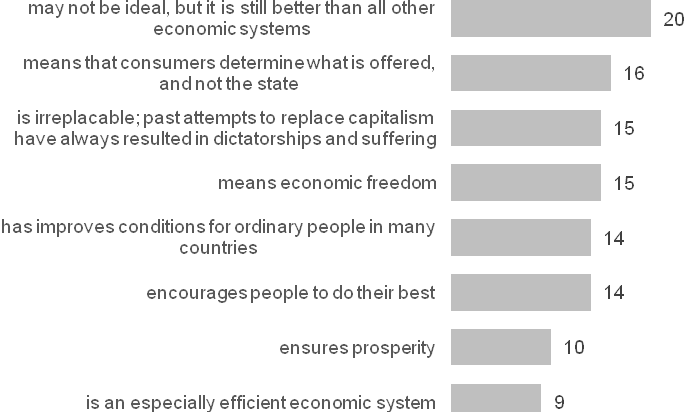
Note: All data are in percentage of respondents
- Source: Zitelmann, IN DEFENCE OF CAPITALISM, Ipsos MORI survey 20-091774-30
Conspiracy theories and attitudes toward capitalism
Conspiracy theorists are people who believe that an event or situation – such as a crisis or pandemic – is the result of a secret plan hatched by powerful people.
Among the survey questions, Ipsos MORI presented respondents with two items that are designed to identify individuals who are prone to conspiracy thinking. The first of these is: “Do you agree, or disagree, with the following statement: ‘In reality, politicians don’t decide anything. They are puppets controlled by powerful forces in the background’”. The second is: “Do you agree, or disagree, with the following statement: ‘A lot of things in politics can only be properly understood if you know that there is a larger plan behind them, something that most people, however, do not know’”. Individuals who agreed with these statements were identified as having a conspiracy mentality. In Britain – as in all other countries with the exception of Albania – anti-capitalists tend to be more conspiracy-minded than pro-capitalists (as confirmed by a comparison of the dark and lighter bars in Figure 5).
Figure 5
Anti-capitalism and the tendency to conspiracy thinking
The Conspiracy Theory Coefficient: Average proportion of respondents who agree with the following two statements:
“In reality, politicians don’t decide anything. They are puppets controlled by powerful forces in the background.”
and
“A lot of things in politics can only be properly understood if you know that there is a larger plan behind them, something that most people, however, do not know.”
divided by the average proportion of respondents who explicitly disagree with the two theses.

- Sources: Allensbach Institute survey 12038, Sant Maral Foundation, Ipsos MORI surveys 20-091774-30, 21-087515-07, 22-014242-04-03 and 22-087515-44 Indochina Research, FACTS Research & Analytics Pvt. Ltd. and Research World International Ltd.
How do attitudes to capitalism in Britain compare to attitudes in other countries?
When the figures for economic freedom and the two capitalism questions are combined, the result is a coefficient of 0.73. This coefficient is decisive for comparison with other countries. In our survey, there are 20 countries that exhibit more pro-capitalist (or less anti-capitalist) tendencies than in Britain, in contrast to 12 countries in which anti-capitalist tendencies are even more dominant (Figure 6).
Figure 6
Overall coefficient on attitudes toward capitalism in 33 countries

Note: The lower the coefficient, the stronger the anti-capitalist attitude
Sources: Allensbach Institute survey 12038, Sant Maral Foundation, Ipsos MORI surveys 20-091774-30, 21-087515-07, 22-014242-04-03 and 22-087515-44, Indochina Research, FACTS Research & Analytics Pvt. Ltd. and Research World International Ltd.