What is art in the age of AI?

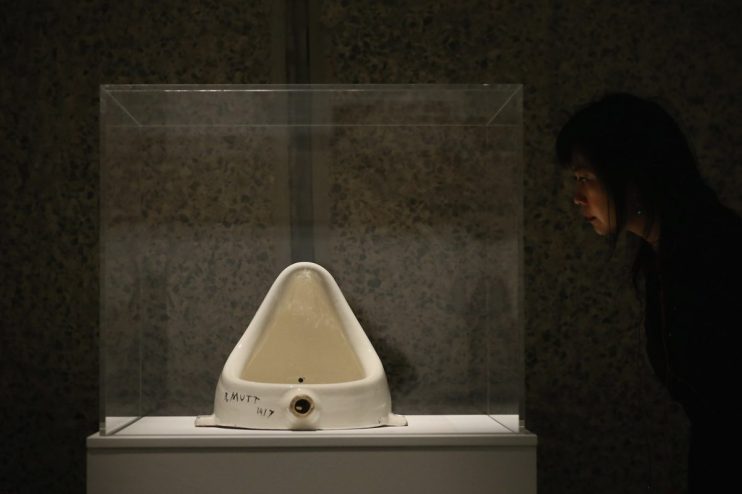
Ever since Marcel Duchamp redefined art over 100 years ago, human creativity has been adapting to new technology and the AI era is no different, says Lewis Liu
I almost became a professional artist instead of an AI entrepreneur; a painter to be exact. As an undergraduate art student, double majoring in Fine Arts and Physics and trying to combine the two disciplines, I struggled tremendously with Marcel Duchamp. Duchamp, the famous French artist who submitted a urinal as ‘art’ titled ‘Fountain’ in 1917, changed art forever. It signalled to the art world that art is merely a social construct, and that pre-fabricated machine objects, such as a urinal, can be construed as art just as much as a Rembrandt painting.
I remember getting into massive arguments about this with my various professors. See, I was classically trained in oil painting as a kid, and I was keenly proud of my ability to execute with brush on canvas. And while I understood the theoretical implications of modern art, it deeply bothered me for most of my undergraduate life, and much of my art involved trying to understand this: how is this art if there is no ‘skill’ involved? I ultimately let go of the notion that art must be brilliant ‘brush on canvas’ and embraced letting the physical laws of the universe directly impact my paintings and installations, combining art and physics.
In fact, this notion has been described by Walter Benjamin in what is arguably the single most important art historical essay in the last 100 years, ‘The Work of Art in the Age of Mechanical Reproduction,’ published in 1935. This was a response in part to photography and industrial replication, arguing that in a world of ‘mechanical reproduction,’ the concept of art must change as well. Take photography as an example. In the past, only a brilliant painter could paint the likeness of the world. Photography rendered the skill of image replication obsolete – in fact, it does it much better. However, photography as we understand it today is itself an artistic endeavour: in subject choice, framing, technical adjustments, and selection of photographs. These skills are distinct and separate from ‘brush on canvas’. This ties back to Duchamp’s view that art, ultimately, is defined by its social norms.
An evolution in creativity
As such, the notion of human creation and art is undergoing another revolution with AI, creating an uncanny parallel to the one Benjamin described as photography and film became widely accepted as art. When photography first emerged, there was a genuine question as to whether it was art if a human hand did not touch it, given it was produced through mechanical means. Similarly, AI-generated content raises similar questions – humans do not draw out individual components, but rather prompt these artifacts into being. If the art of photography centers on subject choice, framing etc, then perhaps the art of AI centers on prompting, system variables, choice of models, and so forth. These are all valid parallels. Similar to both Duchamp’s and Benjamin’s century old views, we should expand our definition of human creation to include AI-generated art.
Redefining art and human creation is relatively straightforward, as AI art represents a natural progression of established artistic thinking. The intellectual property questions, however, are far more challenging. The IP issues surrounding authorship of AI-generated art are more complex than those photography faced when it was first introduced. Photography encountered legal challenges regarding whether a photograph itself could be considered creative work given its mechanical generation. This was resolved in 1884 when the US Supreme Court deemed photography copyrightable in Burrow-Giles Lithographic Co. v. Sarony.
With AI, the situation is more complicated, especially since LLMs and image diffusion models are trained on other copyrighted works. I’m not here to litigate the exploding number of IP lawsuits currently in play, ranging from the recent Meta Llama Books case to The New York Times vs. OpenAI to the Stability AI/Midjourney cases. Rather, I aim to consider how AI-generated art fits within the framework of artistic creation and how it relates to various IP considerations.
Let me illustrate this through a different context. Last year, my wife and I attended a charity gala in Sarasota, Florida, where Steve Aoki, the DJ, performed. It was my first time at a DJ-specific live musical event, as I had never previously considered DJing an art form in itself. Despite enjoying and dancing to familiar tunes, the overall experience constructed by Steve Aoki was profoundly different from each individual song he incorporated. As such, in my own mind, DJing itself became an art form, despite being a mix of other artists’ work.
I later learned, as someone obsessed by AI IP issues, that DJs must obtain commercial licenses from the artists whose work appears in their commercial mixes. This demonstrates that two things can be true simultaneously: mixing content from other artists requires IP permission from those ‘precursor’ artists, but the mixing itself is also an independent art form. In my view, AI art follows the same principle: AI-generated content can and should be considered art, but there are clear IP issues when the generative model ‘mixes’ a universe of different ‘precursor’ creators.
We are experiencing a revolution in creative expression that echoes the upheavals sparked by Duchamp’s readymades and Benjamin’s observations on mechanical reproduction. As someone who travelled from classical artistic training to embracing physics in my art, I see AI as the next natural evolution. The artistic value lies not in whether a human hand directly created each element, but in the vision, curation, intention and ultimately social context behind the work. AI art is undeniably art. The challenge now is creating an ecosystem where this new art form can thrive while ensuring that the countless creators who made it possible are properly recognised and compensated. This balance, while complex, is essential to maintaining the ethical foundation upon which all meaningful art ultimately rests.
Dr Lewis Z Liu is co-founder and CEO of Eigen Technologies