What will this election be about? Security, security, security
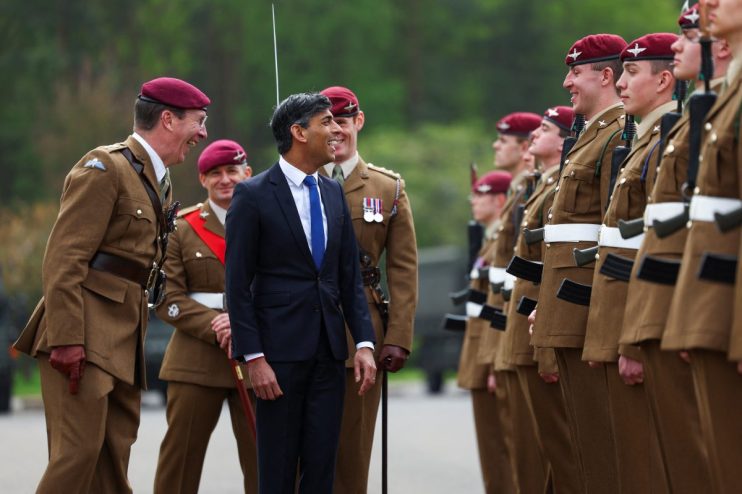
Both Labour and the Conservatives have already drawn in firm dividing lines over what this election will be about, but it is security that unites both campaigns, writes Emma Revell
Well, there we have it. After months of speculation, the Prime Minister bit the bullet and announced he would be sending the nation to the polls on 4 July.
There’s been a lot of discussion in the days since about whether he made the right decision. But at this point, it doesn’t matter. What’s much more interesting than whether Rishi Sunak was right to call the election is what the election will actually be about. And both parties have already drawn in firm dividing lines.
For the Conservative Party, as was made clear by their headline-grabbing election pledge over the weekend to reintroduce national service, security will be a major focus of their campaign. In a speech just a week before the election was called, the Prime Minister emphasised the need to prepare for the “storms ahead”, highlighting the government’s commitment to increasing defence spending to 2.5 per cent of GDP by 2030 in the face of threats from Russia, China, Iran and North Korea, which he labelled the “axis of authoritarian states”. So expect the Tories to mention frequently that Keir Starmer sat in the shadow cabinet of a man who repeatedly finds himself photographed alongside terrorist sympathisers, and said he would never use our nuclear deterrents.
Along with defence, a huge part of their focus will be on tax and the economy. A speech by the Chancellor less than a week before the election was called focused on pushing the narrative that a Labour government would cost taxpayers money – in fact, he was so determined to push that message that he took the unusual step of speaking at a podium which had the opposition’s name on it: “Labour’s Tax rises”.
Of course, Jeremy Hunt has himself put up taxes in several different ways over the last 18 months. But that, he claimed, was necessary to pay for the pandemic and fight inflation as a result of Russia’s invasion of Ukraine. Our tax rises are essential and temporary. Labour’s tax rises will be more painful, and more permanent.
The Tories also – somewhat riskily, given their record – want to fight the election on immigration. Playing on the Labour Party’s less than firm stance on border control, they hope voters will focus on the need to get numbers down and the fact that they are finally starting to move in the right direction.
Unusually, the Labour Party also wants to fight this election on security, which Keir Starmer called the “bedrock” of the party’s manifesto in his first major speech of the election yesterday. This includes national security, where they too say they aim to increase defence spending to 2.5 per cent of GDP – but with the weaselly caveat that this will only happen when circumstances allow.
But they will also extend the theme to energy security, with the creation of Great British Energy, a publicly-owned, clean power company which they claim will cut bills for good and boost energy security by taxing oil and gas companies and investing in renewables in the UK, reducing reliance on imports. And then again on economic security, asking voters plainly “Do you feel better off than you did five years ago?” and “Are you confident about paying your bills?”.
It is of course possible to pick enormous holes in this argument. Labour’s plan to decarbonise the grid by 2030 is viewed by most experts as impossible. Their claim that they can do this without spending the £27bn a year they initially promised, but now can’t afford, is even more extraordinary.
The challenge for the Conservative Party is, while they can point to this data or that saying the economy has turned a corner, voters don’t feel it. The weekly trip to the supermarket still costs more and brings home less. Energy bills are still higher than they were three years ago, even if they’re now coming down. Rents and mortgage repayments have shot up as a result of high interest rates.
The Labour manifesto, when it comes, is also likely to offer what Keir Starmer hopes are positive policies which will appeal to voters; ones which tell a story of hope for the future, not simply a rebuke to the Conservatives.
On housing, Labour have some promising policies on the green belt. But their announcement on new towns last week was much weaker than many had hoped for.
The party will also want to make headlines with its New Deal for Working People, including the “right to switch off”, a strengthening of rules around zero hours contracts and a whole range of employment rights being available from day one. It will be tricky for Starmer and Rachel Reeves to balance the party’s newfound friendship with business and the demands of its traditional trade union backers and a potentially large cohort of backbench MPs. Still, the voters seem all in favour, even if business owners aren’t.
If previous elections have taught us anything though, it is that the defining moment of a campaign isn’t always one which any political party plans or promotes. As much as parties may like to think they set the agenda with their campaign stops, stump speeches and policy launches, general elections are just as likely to be defined by a hot-mic incident, a hot-tempered deputy Prime Minister or a set of pledges carved on a limestone slab. It won’t be long before we find out what will come to define this one.