What Wimbledon taught me about winning in business

Tennis’s unique scoring system mirrors the nonlinear, probabilistic nature of start-ups and life, where success hinges not on winning every point, but on succeeding when it really matters, says Lewis Liu
I am obsessed with tennis. I try to play every day. My wife says I’m grumpy if I miss a day.
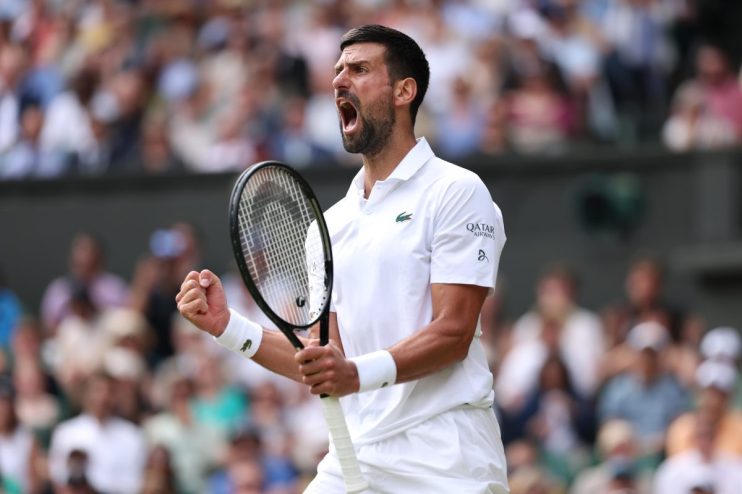
During Wimbledon, it’s always playing somewhere in the background as I try to make sense of the post-Federer/Nadal world. I’ve always disliked Djokovic (too good in a boring way was my sense), but now I find myself rooting for him. Perhaps I feel some kind of deep respect and camaraderie with a middle-aged millennial dad playing what is perceived to be a younger man’s game. Him, tennis; me, building AI companies.
This week, as I was chasing my boys around the house trying to get them to wear the required tennis whites for their summer tennis camp (they wanted much more colorful clothing), my older son asked me a deep question: “Baba, why do tennis scores have points, then games, then sets? Why not just go point by point like football? Why is it Love-15-30-40-game instead of Love-15-30-45-game?”
The second question about the peculiar Love-15-30-40 progression has been written about extensively. But the first question – why break it down into larger and larger discrete groupings – that’s much deeper and more interesting. It’s a mathematical structure that affords tennis its drama and serves as a fantastic metaphor for competitive life and business.
The mathematics of never being quite over
Tennis has this extremely peculiar scoring system where you need to win four points (and win by two) to win a game. Then you need to win six games to win a set (and win by two or go to tiebreak). Then you need to win two or three sets to win the match. Essentially, at every level, there’s this vibe of “it’s not over until it’s over.” You can be up 40-0 and still lose the game. You can be up 5-1 in a set and still lose it. You can be up two sets and still lose the match.
Because of this mathematical grouping and the “reset” after each game or set, it’s possible to win more points but still lose the match. Just a few weeks ago at the Roland Garros final, Carlos Alcaraz defeated Jannik Sinner despite Sinner winning more total points: 193 to 192. Moreover, Alcaraz won this after losing the first two sets and saving three championship points.
Roger Federer shared a shocking statistic in his famous Dartmouth graduation speech: even though he won 80 per cent of his matches, he only won 54 per cent of all points played. One of the greatest tennis players who ever lived won just barely over half the points he played.
This is the fundamental mathematical nature of tennis, and competitive life: it is both probabilistic (winning more points will significantly increase your chances of winning the match) and highly bifurcative (winning key points creates huge swings in outcome).
Why this matters for business (and life)
This mathematical structure resembles exactly how I think about building companies in the tech and AI world. The winner in a software category is almost never the product with the most features, but rather the product that wins at the pivotal ones.
A great example is Zoom. When it launched, Skype was the dominant player and Webex had far more enterprise features. But Zoom edged out its competitors on two crucial things: latency and ease of use. Zoom may not have won more “points” versus Webex, but it certainly won the match.
As an early-stage tech investor, this framework is particularly relevant. Every start-up I work with must hit key milestones (win those games or sets) to progress to the next funding round. Not every start-up will hit those milestones; that’s the reality of probability, and we must do everything to increase those odds. But my job is to push the ones that can progress over the line.
There’s no prize for an unfinished milestone, no matter how close you get to the finish line. It’s mathematically far more important for my portfolio that a certain number of start-ups cross the next milestone than all startups getting close. This is something extremely important for founders to understand about VC dynamics. But it’s not just VC dynamics; it’s almost everything in competitive business: the highly nonlinear, probabilistic, and bifurcative nature of the world, where half-finished work means death.
The reset and the wisdom
In the life of a start-up, there are so many “50-50” things. The best teams flip that to maybe a Federer-level 54-46. There’s still a huge element of luck involved, but if you flip enough weighted coins and truly show up for the things that really matter: key client pitches, fundraising meetings, product launches: you win those pivotal points.
When I was younger, I was a much more aggressive, technically astute, and athletic tennis player than I am today. Despite a 20-year hiatus, I’m confident I can beat my 18-year-old self. This is perhaps the wisdom that comes from experience in competitive worlds. I know each point is just a point. Even if I lose that point, as Federer says, “it is just a point.” A game or set allows me to reset to 0-0 and start again; a younger Lewis would not have managed that.
The same applies to building companies. You want to maximize your probability of winning each point: shipping features, landing clients, hiring talent. But you also need to recognise which are the game, set, or championship points and show up emotionally for those moments. Experience teaches you the difference.
As I write this, Djokovic has advanced to the Wimbledon semifinals. Given his experience, even against much younger players, the mathematics of tennis will be on his side. In startups, as in tennis, it’s not about winning every point; it’s about understanding the game’s deeper structure and showing up when it matters most.