Skip to content
Friday 7 August 2026London --:--Frankfurt --:--Zurich --:--
NewslettersSearchEN · DE
MorningWire

European business, markets and politics

FTSE 100
10,948.70
+0.74%
DAX
26,425.88
+1.09%
CAC 40
8,744.57
+0.52%
STOXX 50
6,557.19
+0.84%
  • Europe
  • Markets
  • Business
  • Economy
  • Technology
  • Politics
  • Opinion
More
GermanyFranceBankingAIEnergyFintechPropertyCapital Markets
  • Germany
  • France
  • Europe
  • Markets
  • Business
  • Economy
  • Technology
  • Politics
  • Opinion
  • DE
Thursday 16 April 2026 5:11 am  |  Updated:  Thursday 16 April 2026 10:04 am

Why Britain is the sick man of the global oil shock

By: Mykola Kuzmin

Add as a preferred source on Google
View of the Strait of Hormuz, showcasing bustling maritime traffic under clear skies, highlighting its strategic significa...
Iran has accused the US of breaching the spirit of the ceasefire

Britain’s indecisiveness leaves us dangerously exposed to further price shocks, writes Mykola Kuzmin

The idea that Britain will glide through 2026 with falling inflation, easing rates and stable energy prices is already unravelling. With oil now surging towards $200 a barrel, the Chancellor faces a far more dangerous reality.

The British economy’s “Goldilocks” scenario was destroyed somewhere between Kharg Island and Ust-Luga, a burning Baltic terminal. Last week, Dated Brent, the benchmark that reflects physical oil prices paid by refiners, reached $141 – the highest level since 2008.

Russian seaborne exports have decreased by 43 per cent weekly as a result of repeated strikes on Primorsk and Ust-Luga, with an additional 17 per cent of refining capacity down. Looking at the Middle East, things don’t look too hopeful in terms of capacity, with Saudi Arabia’s East-West Pipeline now operating at a maximum capacity.

The 2026 disruption has impacted more crude from open trade than any of the major oil shocks that have occurred since 1973, including the Gulf War and the invasion of Ukraine. The embargo of the 1970s tripled prices and removed 4.5 mb/d from the market; at its peak, this removed something closer to 17 mb/d.

The effects are already hitting home. Average UK diesel has hit 185p a litre, up 30 per cent since 28 February, with motorway sites clearing 200p and a forecourt on Sloane Avenue charging £3 a litre. Haulage costs will add 0.5 per cent onto food inflation by June, and headline CPI is set to jump 1.2 per cent this quarter.

With UK consumers absorbing the hit, the Treasury cannot afford a blunt response. A universal fuel duty cut would risk reigniting inflation and unsettling bond markets, however, the indecisiveness leaves Britain dangerously exposed to further price shocks.

Rachel Reeves should act decisively. The most sensible policy action taken by the Treasury is a surgical two-pronged strike: forcefully establishing a targeted commercial diesel rebate exclusively for the haulage industry, while discreetly introducing a “Hacienda-style” call-option hedge to safeguard the national budget. Without going against her fiscal guidelines, the Chancellor is able to protect Britain’s vital supply lines and prevent the energy crisis from affecting core food costs thanks to her financial engineering.

This is the section that the front pages consistently lack: in early April, Citrini Research dispatched an analyst to the Musandam Peninsula, placed him on a speedboat 18 miles off the Iranian coast, and counted about 15 ships passing through the strait on 2 April alone. Up to half of all traffic went dark on AIS in order to evade the Qeshm channel.

This poses a major question: what became of the British national idea that “we have no eternal allies, and we have no perpetual enemies”, as stated by Lord Palmerston in 1848? It is our responsibility to uphold our eternal and immortal interests. Ten nations have come to the conclusion that the diplomatic inconvenience of working with Tehran is worthwhile in order to secure their own energy supplies. In an era of energy disruption, hesitation carries a cost and Britain may be about to pay the price.

Mykola Kuzmin is operations manager at The Henry Jackson Society

Read more

Industry bodies call on Burnham to bring down energy bills to fire up growth

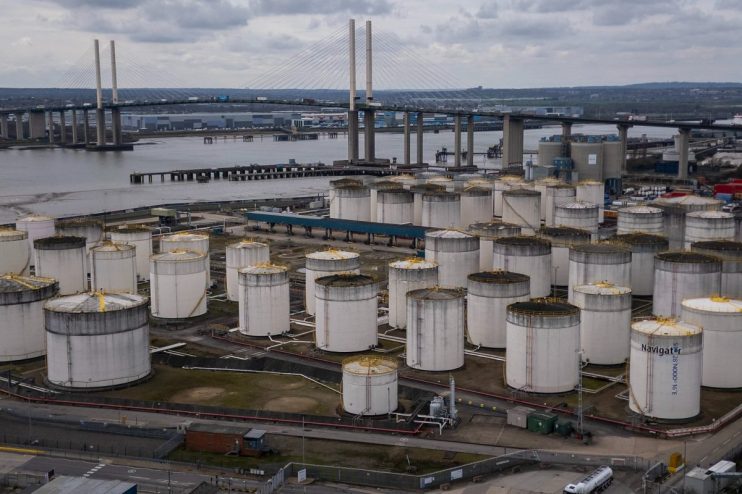
North Sea oil terminal with tankers, storage tanks, and cranes under a cloudy sky, highlighting energy industry infrastruc...

Share this article

  • Facebook
  • X
  • LinkedIn
  • WhatsApp
  • Email

Similarly tagged content:

Sections

  • Opinion
  • News

Categories

  • Opinion
  • Business

People & Organisations

  • Energy
  • henry jackson society
  • Iran
  • Keir Starmer
  • Oil
  • Oil prices

Trending Articles

  • Revolut founder’s wealth set to balloon amid talks of share award at $500bn valuation

  • Rupert Lowe axes pensions triple lock and pledges tax cuts in economic plan

  • Liverpool owners tipped to sell – but not to Amazon boss Bezos – by former CEO

  • As it happened: Stocks rise as oil fluctuates after Red Sea attack; US-Iran deal ‘being circulated’

  • WPP slashes jobs as revenue continues to fall

More from Morning Wire

  • Industry bodies call on Burnham to bring down energy bills to fire up growth

    Energy
    North Sea oil terminal with tankers, storage tanks, and cranes under a cloudy sky, highlighting energy industry infrastruc...
  • North Sea is not competitive, says BP boss days after exit

    Markets
    British Petroleum BP forecourt with fuel pumps and company signage visible in a business setting, highlighting energy serv...
  • IMF warns Bank of England against cutting interest rates

    Economics
    IMF Chief Kristalina Georgieva issues caution to Bank of England amid economic concerns
  • Oil prices return to crisis levels

    Markets
    Close-up of a petrol pump nozzle dispensing fuel at a gas station, highlighting rising fuel costs and economic impact.
  • As it happened: Stocks rise; oil falls after Trump pauses Iran strikes

    Markets
    Donald Trump holding a red TRUMP 2028 hat, wearing a tuxedo with an American flag in the background
  • Burnham can prove he’s pro-business by scrapping stamp duty on shares

    Opinion
    Andy Burnham, Mayor of Greater Manchester, in a professional setting.
  • Vance says ‘broken’ Britain must rebuild economy, not just change PM

    Politics
    Andy Burnham returns to Parliament
  • Non-compete clauses are restraining Britain’s talent market

    Opinion
    London office workers collaborating on AI and tech projects, surrounded by computers and digital interfaces in a modern wo...
MorningWire

Independent European business, markets and political news for decision-makers.

Morning Briefing

Europe

  • Germany
  • France
  • Europe
  • UK & Ireland

Business

  • Markets
  • Banking
  • Technology
  • Energy
  • Property
  • Fintech

Editorial

  • Opinion
  • Editorial Policy
  • Corrections
  • Contact

Company

  • About Morning Wire
  • Privacy Policy
  • Terms of Use
  • Cookie Policy
© 2026 Morning Wire Ltd · Published by Morning Wire Media, Bahnhofstrasse 65, 8001 Zürich, Switzerland
Privacy · Terms · Cookies · Facebook