Skip to content
Saturday 22 August 2026London --:--Frankfurt --:--Zurich --:--
NewslettersSearchEN · DE · FR
MorningWire

European business, markets and politics

FTSE 100
10,816.56
+0.64%
DAX
26,136.56
+0.59%
CAC 40
8,484.43
+0.37%
STOXX 50
6,462.22
+0.63%
  • Europe
  • Markets
  • Business
  • Economy
  • Regulation
  • Politics
  • Opinion
More
GermanyFranceEU InstitutionsCompetitionPublic AffairsBankingTechnologyEnergy
  • Germany
  • France
  • Europe
  • Markets
  • Business
  • Economy
  • Regulation
  • Politics
  • Opinion
  • DE
Thursday 18 April 2024 4:38 pm

Why the Bank of England might be wary of cutting interest rates before the Fed 

By: Chris Dorrell

Add as a preferred source on Google
The intervention comes as permanent staff positions in London fell at the sharpest rate in 22 months.

The path for the Bank of England to cut interest rates looks increasingly uncertain, particularly as the US Federal Reserve looks set to wait a while longer before loosening policy.

Inflation continued falling in March, but came in ahead of expectations at 3.2 per cent. Annual wage growth also exceeded economists’ predictions, pointing to continuing cost pressure for firms.

Combine this with an improving growth outlook, and the case for rate cuts seems much less strong than even a few months ago.

Ian Stewart, chief economist at Deloitte said: “A much-diminishing risk of an economic hard landing has weakened the case for big rate cuts. It’s quite possible now that quarterly growth in the UK this year could be close to, or even above, trend rates.”

Reflecting this, markets have dialled back their expectations for major rate cuts. Just two rate cuts are fully priced in for this year, down from as many as six at the beginning.

Even so, price increases in the UK are now below US levels for the first time since March 2022. The domestic economy is much weaker than the US, so there’s likely some scope to cut rates without reigniting inflation.

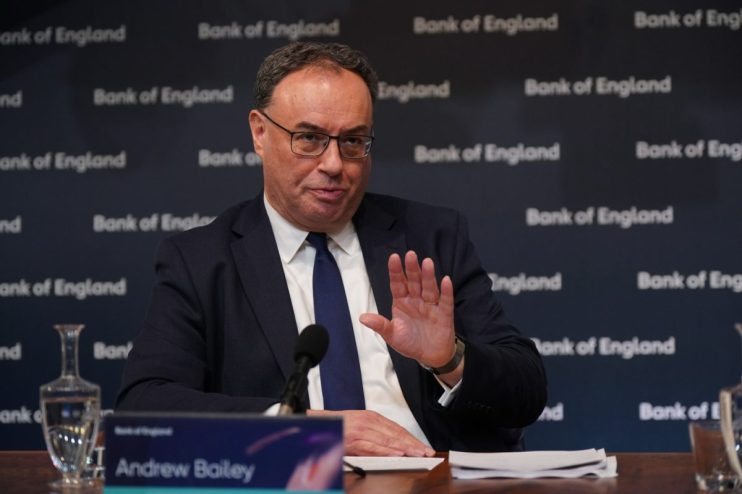
Speaking in Washington yesterday, Andrew Bailey, governor of the Bank, sounded relatively relaxed. Inflation was “pretty much on track” even after the slight upside surprise in March’s figures, he said.

“I expect that next month number will show quite a strong drop because we have a particularly unique energy to household energy pricing system in the UK,” he said.

Bailey pointed out that inflation dynamics in the UK were different to the US. “There is more demand led inflation in the US, while we’re seeing the unwind of supply shocks still going on,” he said.

Given this it still seems likely that, by August, the Bank of England will be in a position to cut interest rates.

The same cannot be said for the Fed. US inflation has come in ahead of expectations for three months in a row while data from the jobs market suggests the world’s largest economy continues to hum along.

Read more

22 months of cuts: Jobs crisis deepens despite growth boost 

London has defied national trends as job postings in the capital rose.

In a striking contrast to Bailey’s optimism, Jerome Powell sounded hawkish this week. “The recent data has clearly not given us greater confidence and instead indicates that is likely to take longer than expected to achieve that confidence,” he said on Tuesday.

All of this raises the question will the Bank of England be willing to cut rates before the Fed.

Many economists point out that starting the cutting cycle earlier would risk putting pressure on sterling, which in turn would put up costs for many firms importing from abroad.

Sterling has already weakened in anticipation of the Bank cutting rates before the Fed. It is currently trading around $1.245, down from near $1.29 in early March.

Stewart suggested that “sterling weakness” would make the Bank “wary of getting too far ahead of the Fed”.

In the short term, this is unlikely to be a major factor for the Bank, with the Monetary Policy Committee (MPC) more likely to concentrate on inflation and the labour market.

“Any decision will be based on the outlook for the UK economy where we have flattish growth, falling inflation, and fiscal constraints,” Dean Turner, UK economist at UBS said.

However, the Fed’s decisions will influence how far and fast the Bank is able to cut rates.

“If the Fed refrain from easing, or do so very slowly, then policy makers here may decide they have to moderate the pace of cuts through the end of the year and into next year,” Turner said.

Sanjay Raja, chief UK economist at Deutsche Bank, pointed out that “spillovers via stronger global trade and a weaker currency” could slow the pace of rate cuts.

The Bank won’t feel bound by the Fed this summer, but if the Fed holds on for a little longer then the MPC might start to feel the pressure.

Read more

Inflation leaps to 2.9 per cent in blow to Burnham 

Burnham cityscape showcasing modern architecture, bustling streets, and vibrant community life in a thriving urban setting

Share this article

  • Facebook
  • X
  • LinkedIn
  • WhatsApp
  • Email

Similarly tagged content:

Sections

  • Markets & Economics

Categories

  • Economics

People & Organisations

  • Bank of England
  • Inflation
  • The Federal Reserve
  • UK Interest Rates

Related Topics

  • Bank of England
  • UK inflation
  • UK interest rates
  • US interest rates

Trending Articles

  • House prices in wealthy London boroughs fall by up to £300,000

  • As it happened: FTSE 100 rallies after JD Sports drags on blue chips; oil jumps again

  • Mike Ashley’s Frasers offers to pay personal shoppers in Harvey Nichols takeover

  • Ratcliffe’s Ineos saves Runcorn plant

  • Amazon says it buys books in bulk to ‘improve products’

More from Morning Wire

  • 22 months of cuts: Jobs crisis deepens despite growth boost 

    Economics
    London has defied national trends as job postings in the capital rose.
  • Inflation leaps to 2.9 per cent in blow to Burnham 

    Economics
    Burnham cityscape showcasing modern architecture, bustling streets, and vibrant community life in a thriving urban setting
  • Lord O’Neill declines job in Burnham government

    Economics
    Jim ONeill, economist and former Goldman Sachs chairman, sitting on a yellow sofa in front of large windows.
  • How patient can the Bank of England be?

    AD
    Historic Royal Exchange building in London with modern skyscrapers behind, clear blue sky.
  • Soaring energy bills set to fuel inflation spike

    Economics
    Smartphone displaying an energy bill notification with British coins and a banknote nearby.
  • Public sector makes wage growth higher than expected

    Economics
    London has defied national trends as job postings in the capital rose.
  • Barclays in legal battle with MFS administrators over part of £160m holding

    Banking
    Barclays bank exterior with logo as it announces mortgage rate cuts amidst upcoming interest rate decision.
  • Rupert Lowe axes pensions triple lock and pledges tax cuts in economic plan

    Politics
    Rupert Lowe, former Southampton FC chairman, smiles while holding files on a city street, wearing a suit and pink tie
MorningWire

Independent European business, markets and political news for decision-makers.

Morning Briefing

Europe

  • Germany
  • France
  • EU Institutions
  • Europe

Business

  • Markets
  • Business
  • Economy
  • Regulation
  • Competition
  • Public Affairs

Editorial

  • Opinion
  • Editorial Policy
  • Corrections
  • Contact

Company

  • About Morning Wire
  • Privacy Policy
  • Terms of Use
  • Cookie Policy
© 2026 Morning Wire Ltd · Published by Morning Wire Media, Bahnhofstrasse 65, 8001 Zürich, Switzerland
Privacy · Terms · Cookies · Facebook