Skip to content
Saturday 22 August 2026London --:--Frankfurt --:--Zurich --:--
NewslettersSearchEN · DE · FR
MorningWire

European business, markets and politics

FTSE 100
10,816.56
+0.64%
DAX
26,136.56
+0.59%
CAC 40
8,484.43
+0.37%
STOXX 50
6,462.22
+0.63%
  • Europe
  • Markets
  • Business
  • Economy
  • Regulation
  • Politics
  • Opinion
More
GermanyFranceEU InstitutionsCompetitionPublic AffairsBankingTechnologyEnergy
  • Germany
  • France
  • Europe
  • Markets
  • Business
  • Economy
  • Regulation
  • Politics
  • Opinion
  • DE
Friday 11 August 2023 11:45 am  |  Updated:  Friday 11 August 2023 12:07 pm

After the economy grew again, will Bank of England’s rate hikes tip the UK into recession?


By: Chris Dorrell

Add as a preferred source on Google
Experts pointed to a range of factors behind the likely rebound, including the drop in temperature after an unusually mild October.

The UK economy grew faster than expected in June, expanded 0.5 per cent, helping to bring growth in the second quarter to 0.2 per cent – but analysts are divided about what the figures say for the coming months.

Growth in June was given a boost by a strong performance from the production sector, which includes manufacturing, as well as warmer weather attracting punters to pubs and restaurants.

The figure was also flattered by its comparison to May, when there was an extra bank holiday for the king’s coronation.

Samuel Tombs, chief UK economist at Pantheon Macroeconomics, said the figures are “probably the start of a sustainable recovery”. 

Tombs pointed out that household consumption grew 0.7 per cent in the second quarter despite the impact of soaring inflation. 

He argued that going forward households will be able to fuel expansion as cost-of-living pressures ease. Figures out next week are expected to show that wage growth surpassed inflation. 

“Looking ahead, we expect households’ real incomes to continue to rise further, as prices continue to rise less quickly than wages,” he argued. 
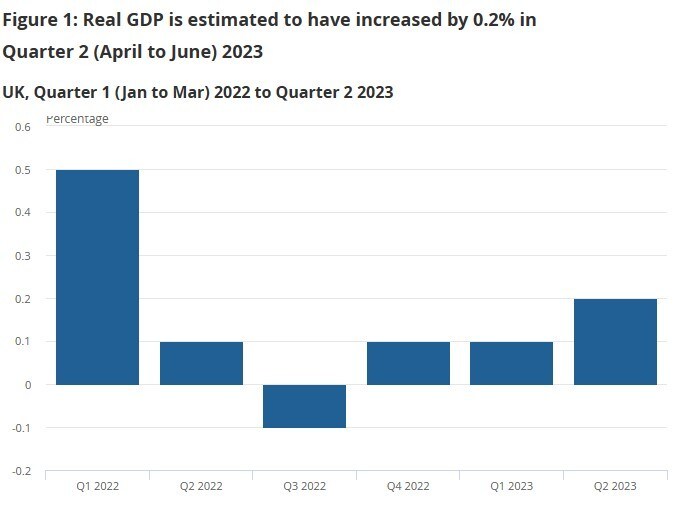
GDP in June

In contrast, Ruth Gregory, deputy chief UK economist at Capital Economics, was less sanguine. 

She argued the expansion could mostly be explained by the return to the normal number of working days following the king’s coronation which makes the economy “look stronger than it really is”.

She warned that the full impact of rising interest rates had yet to feed its way through the economy. Some of the most sensitive sectors to interest rates recorded weak performances, such as real estate which saw a third monthly fall in a row. 

Read more

UK economy to ‘reverse gains’ as construction drags growth

Retail sales slowed in September

“We still think that with most of the drag from higher interest rates still to come, GDP will fall in Q3 and a mild recession will begin,” she said. 

Making matters worse, Kitty Ussher, chief economist at the Institute of Directors, warned that trends in business investment could be an “early indicator of difficulties ahead”. 

While there was a 3.4 per cent increase in business investment in the quarter, this was driven by the imports of US aircraft in April. Elsewhere investment in ICT and machinery declined after the end of the government’s super-deduction allowance, which cut tax rates for business investment. 

Davidson suggested the quarter’s strength in business investment is “unlikely to last”.

What about interest rates?

Although analysts are divided about whether the figures signal a positive trend, most are convinced that they are unlikely to attract too much attention in the Bank of England. 

At 7.9 per cent, inflation remains well above the Bank’s two per cent target despite a larger than forecast fall in June. The fact that the economy has been able to grow in the second quarter despite the Bank’s aggressive monetary tightening will only strengthen its convictions as it readies for another interest rate hike in September. 

With further rate hikes priced in, and the full impact of previous hikes yet to be felt, growth is likely to remain subdued for the foreseeable future. 

A recent report published by the National Institute for Economic and Social (NIESR) research warned that it will take until the end of 2024 for UK output to surpass its pre-pandemic level, with the think tank highlighting five years of lost economic growth. 

NIESR director Jagjit Chadha described the challenges facing Britain, including high inflation, as “the re-emergence of ‘the British disease’.”

Read more

UK economy weathers Iran war shocks but slowdown incoming

Chancellor John Healey smiling, wearing a navy suit, white shirt, and red tie.

Share this article

  • Facebook
  • X
  • LinkedIn
  • WhatsApp
  • Email

Similarly tagged content:

Sections

  • News
  • Markets & Economics

Categories

  • Economics

Related Topics

  • Gross Domestic Product (GDP)

Trending Articles

  • House prices in wealthy London boroughs fall by up to £300,000

  • As it happened: FTSE 100 rallies after JD Sports drags on blue chips; oil jumps again

  • Mike Ashley’s Frasers offers to pay personal shoppers in Harvey Nichols takeover

  • Ratcliffe’s Ineos saves Runcorn plant

  • Amazon says it buys books in bulk to ‘improve products’

More from Morning Wire

  • UK economy to ‘reverse gains’ as construction drags growth

    Economics
    Retail sales slowed in September
  • UK economy weathers Iran war shocks but slowdown incoming

    Economics
    Chancellor John Healey smiling, wearing a navy suit, white shirt, and red tie.
  • As it happened: FTSE 100 drops as Antofagasta prompts miner sell-off; oil prices cool

    FTSE 100 Live
    Glencore floated on the London Stock Exchange in 2011 and is one of the largest members of the FTSE 100.
  • World Cup leads UK spending boost as confidence rebounds

    Banking
    Excited crowd celebrating, a man in an England jersey cheers with arms raised and beer splashing from a cup.
  • UK economy’s rebound fails to stem two years of mass job losses 

    Economics
    LONDON, UNITED KINGDOM - JANUARY 31: The Shard is seen on the horizon as commuters cross London Bridge during the morning rush hour on January 31, 2023 in London, United Kingdom. The IMF reports that the UK economy will contract by 0.6% in 2023, as opposed to the previous prediction it might grow, and will perform worse than many other advanced economies, including Russia.The cost of living continues to hit households with grocery inflation for the first four weeks of 2023 rising to 16.7% which would add a further £788 per year to family food bills. (Photo by Leon Neal/Getty Images)
  • War and tax: How the UK economy could get knocked off course

    Economics
    Andy Burnham speaking at a public event, emphasizing local governance and policy changes, wearing a suit and gesturing pas...
  • House prices in wealthy London boroughs fall by up to £300,000

    Property
    Waverton Investment Management and London & Capital combined into W1M.
  • Holiday Inn owner suffers Middle East slowdown as Iran war hits tourism

    Hospitality
    IHG opened 17,500 rooms across 98 hotels throughout the quarter.
MorningWire

Independent European business, markets and political news for decision-makers.

Morning Briefing

Europe

  • Germany
  • France
  • EU Institutions
  • Europe

Business

  • Markets
  • Business
  • Economy
  • Regulation
  • Competition
  • Public Affairs

Editorial

  • Opinion
  • Editorial Policy
  • Corrections
  • Contact

Company

  • About Morning Wire
  • Privacy Policy
  • Terms of Use
  • Cookie Policy
© 2026 Morning Wire Ltd · Published by Morning Wire Media, Bahnhofstrasse 65, 8001 Zürich, Switzerland
Privacy · Terms · Cookies · Facebook