Wielding pitchforks and flinging cow dung, the EU is beholden to angry farmers

Caving into romanticised notions of the ancient farmers’ ways of old won’t give us the modern, climate-friendly agriculture we so desperately need, writes Lucy Kenningham
It’s a hard graft. In an age where slick marketing execs quibble about the number of days they are permitted to work from home, working on a farm – where you might have to do six days a week, rising at 5am to shovel cow dung – doesn’t tempt many. No wonder the agricultural profession is ageing: a third of farm managers are now over 65.
“There is no other profession that suffers such a mental load,” says head of the French farmers union, Philippe Bardy, and it is a horrifying fact that French farmers faced a steep uptick in suicide rates following the global financial crisis.
Worse, farmers are feeling under attack from net zero policies due to their industry being amongst the biggest polluters of both land and air. In the European Union, farming amounts to 14 per cent of the bloc’s emissions overall.
So it is an existential question for governments: how to sustain the hand that feeds us whilst penalising high-carbon industries. More, the EU has been enamoured by the wonkish sounding idea of ‘strategic autonomy’ – a protectionist ideology that favours national production over imports.
But reaching net zero by 2050 necessitates change. The bloc is trying to tackle this through reducing the colossal €60bn of subsidies provided to farmers by the Common Agricultural Policy (amounting to one third of the EU’s budget) keeping them afloat. The policy also includes an obligation to devote four per cent of arable land to non-productive ventures and non-negotiable crop rotation and fertiliser reductions.
On top of all this, inflationary pressures have raised the price of everything and the EU’s concessions to Ukraine have been to the detriment of everyone else. Globalisation has been of increasing concern this century; farmers complain of being undercut by cheaper imports – which are often not subject to green tariffs. The amount of bureaucracy required to access EU aid is insufficiently rewarding despite the staggering size of handouts.
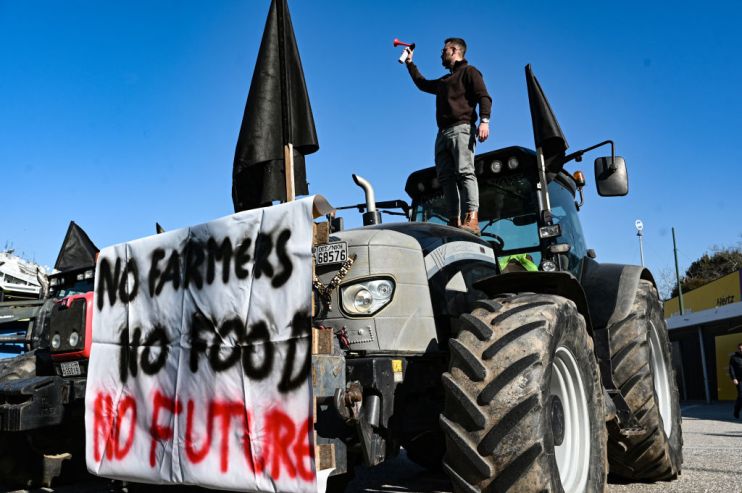
So farmers are furious. Countless colourful and volatile campaigns have coloured Europe’s cities, roads and villages over the past few months. France has perhaps been the most imaginative: in November angry farmers systematically turned over road signs in villages across the countryside, in an attempt to demonstrate how the world had turned upside down. Farmers had meticulously identified name-bearing roadside plaques, unscrewing them, flipping them over and reattaching them to their posts.
Last week, 200 tractors approached Paris to besiege the capital, with some farmers harbouring the expressly evil mission of “starv[ing] Paris”. The subsequent motorway blockades caused havoc, with reports of 97 miles of traffic jams. Protestors smeared manure and rotting produce on roads in front of government buildings.
A tree outside the EP even went up in flames, which bystanders said was symbolic of the death of politicians’ Green Deal.
Only in strike-crazy France, you might think. But no. The protests have grown and with it the scale of anger. Over the last week agriculturalists from Ireland to Greece have colluded in Brussels to throw eggs at the European parliament, set tyres alight, spark bonfires and topple a statue of John Cockerill, a 19th century British industrialist. A tree outside the EP even went up in flames, which bystanders said was symbolic of the death of politicians’ Green Deal.
Riot police were called in – but the reaction was far more sanguine than some felt the arson and violence warranted. If an environmental group – Extinction Rebellion or even Greenpeace, for example – blockaded the circumference of Paris, one can’t imagine a cabinet member responding by calling the protestors “our strength and our pride”. But new PM Gabriel Attal did just that, later announcing a slew of measures including €150m in aid and a decrease in taxes on farms.
Stunningly, the besieged French public agreed with him. Polls have found 87 per cent of the French public support the farmers’ protest.
The EU has been giving in too – in what the FT journalist Henry Foy termed “a veritable bonfire of the EU’s environmental agenda”. It has scaled back on its long-held green initiatives. European Commission chief Ursula von der Leyen this week announced that Brussels will cut a recommended target for lowering emissions, delay certain incoming rules for a year and scrap a plan to cut pesticide use in half.
In part, von der Leyen is concerned about upcoming European Commission elections. But there is a psychological element here too: romanticised as they are in national mythologies along with their ability to wield pitchforks threateningly, Europe has become beholden to fuming farmers, but this won’t do.
Agriculture accounts for 1.4 per cent of EU GDP, 4.2 per cent of EU employment and 14.3 per cent of greenhouse gas emissions from the bloc. That the sector receives subsidies that make up nearly 30 per cent of the EU budget is beyond unsustainable.
Many European farms are simply too small: two thirds are smaller than five hectares. In Britain, the average size of a farm in 2021 was 81 hectares, a whopping difference.
Finding a new farming future
What is to be done? Dieter Helm, an economist at the University of Oxford, suggests taking a step back. Try to picture the farming landscape in the year 2050 – what should it look like? Clean, non-polluting, competitive? What’s clear is it cannot stay as it is, killing our planet without even being economically viable.
The future must be different. Technology will provide the answer – through creating more efficient ways to produce food, maximising space and intensity, as well as reducing labour and emissions. Change will require realism and scaling up farms will be necessary, as will attracting the sort of investment seen in the US.
Flaming farmers understandably provoke an intense reaction inside us, but oftentimes emotion – despite what Rousseau said – should not outweigh reason.