Skip to content
Thursday 13 August 2026London --:--Frankfurt --:--Zurich --:--
NewslettersSearchEN · DE
MorningWire

European business, markets and politics

FTSE 100
10,761.96
-0.66%
DAX
26,327.50
-0.01%
CAC 40
8,652.92
-0.25%
STOXX 50
6,550.97
+0.26%
  • Europe
  • Markets
  • Business
  • Economy
  • Technology
  • Politics
  • Opinion
More
GermanyFranceBankingAIEnergyFintechPropertyCapital Markets
  • Germany
  • France
  • Europe
  • Markets
  • Business
  • Economy
  • Technology
  • Politics
  • Opinion
  • DE
Monday 17 November 2014 5:36 am  |  Updated:  Friday 07 June 2019 5:01 pm

Yorkshire duck farm bird flu outbreak: How is the disease transmitted and can it affect humans?

By: Sarah Spickernell

Add as a preferred source on Google

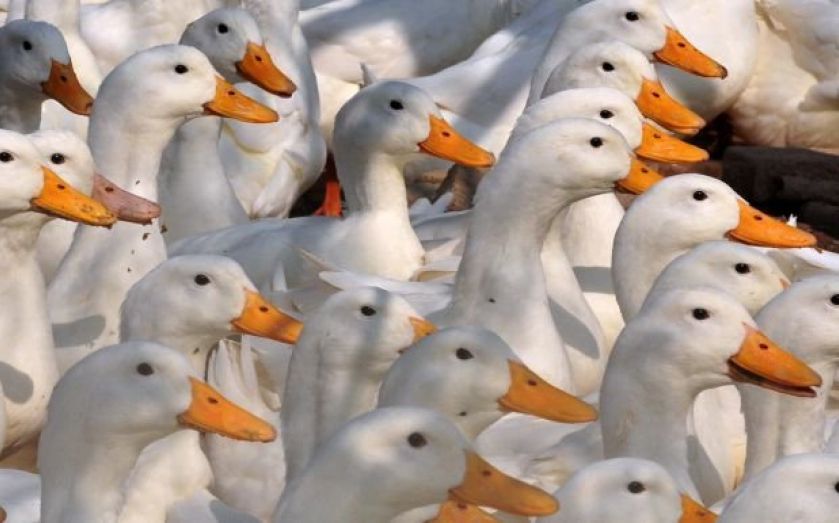
A case of bird flu has been confirmed at a duck breeding farm in East Yorkshire. 
 
The Department for Environment, Food and Rural Affairs (Defra) said it occurred in the village of Nafferton, and that an exclusion zone had been set up around the farm to prevent further transmission. It added that 6,000 ducks would be culled. 
 
"We are taking immediate and robust action which includes introducing a restriction zone and culling all poultry on the farm to prevent any potential spread of infection. A detailed investigation is ongoing,” a spokeswoman told the BBC.
 
"We have a strong track record of controlling and eliminating previous outbreaks of avian flu in the UK."     
 
The last time a case of bird flu occurred in the UK was in 2008, when chickens on a farm in Banbury, Oxfordshire tested positive for the virus.  

RISK TO HUMANS

 
Bird flu is mainly spread between birds, but under some circumstances humans can also catch the virus.
 
This happens when people come into close contact with infected birds or bird droppings, such as when cleaning or plucking infected birds or entering contaminated water.
 
But transmission to humans is extremely rare, and according to the World Health Organisation less than 500 people have died from the disease in previous outbreaks across the world. 
 
There are two strains – H5N1 and H7N9 – that have a particularly high mortality rate in humans and have resulted in serious concern in recent years, and Public Health England has already confirmed the case in Yorkshire was caused by neither of these strains. 
 
"Based on what we know about this specific strain of avian influenza, the risk to human health in this case is considered extremely low,” a spokesman said. The exact identity of the strain responsible is expected to be revealed at some point this week, but it is unlikely to be one that poses a significant threat to human safety. 
 
On its website, the NHS says most strains of bird flu are not dangerous to humans:  "There are many types of bird flu, most of which are harmless to humans. However, two types have caused serious concern in recent years. These are the H5N1 and H7N9 viruses.
 
"Although these viruses don't infect people easily and are usually not transmitted from human to human, several people have been infected around the world, leading to a number of deaths.
 
"Other bird flu viruses (particularly H7N7 and H9N2) have also infected people, but these have rarely caused severe illness."
 
Could it lead to a turkey shortage this year? 

Share this article

  • Facebook
  • X
  • LinkedIn
  • WhatsApp
  • Email

Similarly tagged content:

Sections

  • News

Categories

  • Business

Trending Articles

  • Five-star Mayfair hotel hit with HMRC winding-up petition

  • It’s not just Jason Arday, most of sociology is a scam

  • IT consultant ordered to pay £50,000 after being accused of stealing Soho House members’ personal details

  • Revolut takes flight with launch of new airport lounges

  • As it happened: FTSE 100 falls as Iran and US clash over Strait of Hormuz; Oil stockpiles ‘rapidly depleting’

More from Morning Wire

  • Pugdundee Safaris Redefines Indian Wildlife Tourism with a 2028 Carbon-Neutral Vision

    Business Wire
  • Emergency government meeting held over high temperature amid ‘strain on public finances’

    Economics
    Aerial view of dry, brown farm fields affected by high temperatures, with a road and farm buildings.
  • The City doesn’t compete with Britain’s regions – it competes for them

    Opinion
    Canada boundary dragon statue symbolizing economic uncertainty amidst political instability
  • Football may not come home but US investors will still cash cheques here

    Sport Business
    GettyImages 2278935920 likely depicts a relevant scene or subject based on the unspecified context provided in the article.
  • FCA charges City lawyer with insider dealing over maternity brand acquisition

    Legal
    The FCA said in June any scheme must keep the market afloat in order to curb rising costs for consumers.
  • ‘It’s military precision’: meet the chefs crafting summer’s £6k corporate hospitality dishes

    Life&Style
    Chefs preparing gourmet dishes for corporate hospitality at prestigious events like Silverstone and Ascot
  • Everything’s going to sh*t. Here are 25 of the best dystopian novels

    Life&Style
    Stack of popular dystopian novels including 1984 and Brave New World on a wooden table, perfect for book enthusiasts.
  • Hilton, Butlins left fuming over business rates snub 

    Hospitality
    Modern Butlins hotel building with multiple balconies, a path leading to it, and a small pond in the foreground.
MorningWire

Independent European business, markets and political news for decision-makers.

Morning Briefing

Europe

  • Germany
  • France
  • Europe
  • UK & Ireland

Business

  • Markets
  • Banking
  • Technology
  • Energy
  • Property
  • Fintech

Editorial

  • Opinion
  • Editorial Policy
  • Corrections
  • Contact

Company

  • About Morning Wire
  • Privacy Policy
  • Terms of Use
  • Cookie Policy
© 2026 Morning Wire Ltd · Published by Morning Wire Media, Bahnhofstrasse 65, 8001 Zürich, Switzerland
Privacy · Terms · Cookies · Facebook