Zelensky slams EU’s ‘blood money’ deals for Russian oil

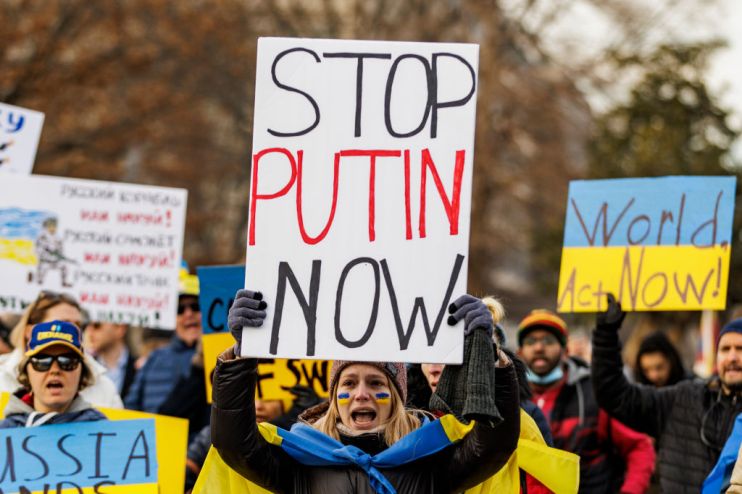
European countries which are continuing to buy Russian oil are “earning their money in other people’s blood”, warned Ukrainian President Voldoymr Zelensky.
Zelensky singled out Germany and Hungary, accusing them of blocking efforts to embargo energy sales, from which Russia could make £250bn ($326bn) this year.
He told the BBC: “Some of our friends and partners understand that it is a different time now, that it is no longer an issue of business and money, That it is an issue of survival.”
The European Union (EU) has joined Western allies in targeting Russian financial institutions and oligarchs – but has been more hesitant than the US and UK in imposing energy sanctions on Russia.
It has teamed up with the UK to phase out Russian coal imports, but has not imposed any restrictions on Russian oil and gas.
The trading bloc is considerably more dependent on Russia for oil and gas to meet its energy needs – relying on the Kremlin for around a third of its oil supplies and 40 per cent of its natural gas supplies.
Since Russian invaded Ukraine on February 24, the EU has spent €33.4bn on Kremlin-backed fossil fuels.
The president also urged the West to supply more weapons to Ukraine, and that time was of the essence.
He said: “The US, the UK, some European countries – they are trying to help and are helping.But still we need it sooner, sooner and faster. The key word is now.”
Russian troops have in recent weeks pulled back from around Ukraine’s capital, Kyiv, and other central and northern parts of the country.
However, there are fears of a bloody and protracted conflict in the east and south of the country, as Russian President Vladimir Putin refocuses his military campaign there in an effort to seize more territory.
The southern port city of Mariupol – a strategic goal for President Putin – has already been devastated by weeks of Russian artillery bombardment.
Russian energy sanctions divide EU
The EU’s stance towards Russia has hardened following reports of civilian executions in Ukraine earlier this month – leading to the announced coal ban – but member states remain concerned about supply shortages amid the energy crisis.
The European Commission is drafting proposals to ban Russian oil supplies, but with the measure requiring unanimity, it is unlikely to be approved.
While the Baltic states are particularly in favour of further energy sanctions, with Lithuania unilaterally banning Russian gas, Germany is still opposed to restrictions on oil and gas.
Germany has triggered the first phase of emergency gas plans amid fears of supply shortages, alongside Austria.
This has been a great source of frustration for the Ukrainian government, with Germany being the EU’s biggest economy.
Italy and Hungary have also raised concerns about meeting consumer needs without Russian oil and gas.
This anxiety is reflected in the latest reports from think tanks and analysts – with both Bruegel and UBS warning significant reductions in consumption would be required to offset the loss of Russian energy supplies.
Instead, the EU is committed to boosting gas supplies to ensure the bloc’s independence and to make it less vulnerable to market shocks.
Alongside securing liquefied natural gas (LNG) from partners such as the US, it is aiming for storage to be 90 per cent full heading into the winter.
Germany urges civilians to cut down consumption
Meanwhile, Germany’s Economy Minister Robert Habeck has encouraged Germans to start saving energy to reduce its dependence on fossil fuels.
The minister suggested Germany could become less dependent if citizens reduce their energy consumption, urging people to use the train or cycle instead of driving whenever possible.
He said: “Every kilometre not driven is a contribution to making it easier to get away from Russian energy supplies. We are also protecting the climate.”
Habeck argued cutting 10 per cent of individual energy consumption was possible, adding that employers could contribute by offering workers the option to work from home wherever possible.
He explained: “Wherever possible, one could work from home one or two days a week again – initially on a voluntary basis.”