Adam Smith 300: Adam Smith Institute founder Dr Eamonn Butler on how morality guided the father of economics

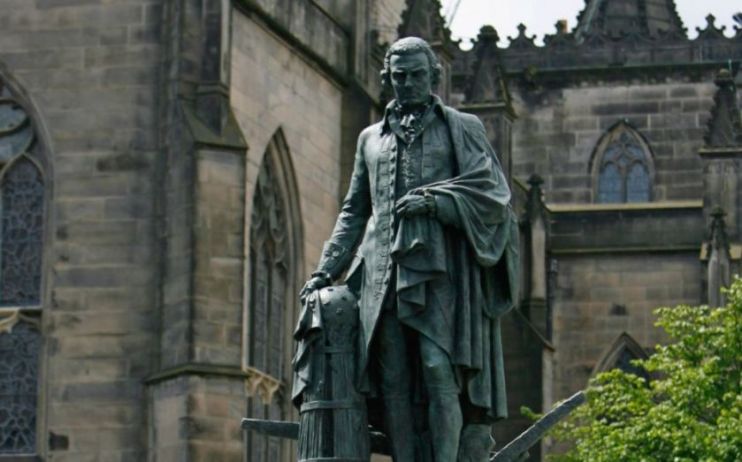
Nobody changed the dismal science of economics quite like Adam Smith, the Scottish philosopher, author of The Wealth of Nations and The Theory of Moral Sentiments, and father of market economics. June marks the 300th anniversary of Smith’s baptism – nobody quite knows his actual birthday – and to mark the occasion, German historian and sociologist Dr Rainer Zitelmann interviewed Dr Eamonn Butler, the founder of London’s Adam Smith Institute, on Smith’s life and work.
Dr Rainer Zitelmann: If you were to highlight the single most important thought in all of Smith’s work, what would it be?
Dr Eamonn Butler: The Wealth of Nations contains so many insights that changed our thinking that it is hard to single out any one of them. In the very first paragraph, for example, he invents the notion of GDP and then he goes on to describe the division of labour, the benefits of free commerce, and so many more new concepts including the Invisible Hand idea. But to answer your question, I would plump for his insight in The Theory of Moral Sentiments that human morality is driven by sympathy – our desire as social creatures to act in ways that bring the approval of others and to avoid actions that others disapprove of. It’s a very powerful idea, an evolutionary idea that was a century ahead of Darwin.
Dr Rainer Zitelmann: That sense of sympathy is interesting. Why does Smith not explicitly refer to the entrepreneur, who above all must be empathetic in order to develop and sell a product?
Dr Eamonn Butler: When he wrote The Theory of Moral Sentiments in 1759 he was a college professor with little experience of the business world. So that is hardly surprising. But interestingly, I have been asked to give talks on the relevance of Smith’s ethics to entrepreneurship and business, and his moral ideas are indeed very relevant. Take, for example, his emphasis on the virtue of prudence. Prudence means acting in your own best interest – your long-term interest, not what may seem good at the time (like keeping healthy rather than lazing on the sofa with beer and pizza). That’s entirely true in business. You do not build a business by trying to make a quick buck out of people, but in building up reputation for giving customers what they want and need. Customers will come back only if they trust you and see that you have integrity and good reputation.
Dr Rainer Zitelmann:What significance does the theme of poverty have in Smith’s work? Would you agree with me when I say that Adam Smith’s primary concern was to show the way out of poverty?
Dr Eamonn Butler: Definitely. Smith supported free trade and free commerce for the same reason I do, namely that it is the best way of improving the condition of the working poor – or more properly, the best way to allow the working poor to better their own condition. Bettering your condition, he thought, is a natural human desire, but it is too often blocked by onerous taxes and regulations imposed by people in authority. And too often, those rules are deliberately proposed by established businesspeople who want to keep out any competition, and imposed by their friends and cronies in government. Sweep that away, says Smith, and the ’system of natural liberty’ will bring prosperity to all.
Dr Rainer Zitelmann: Authors like Samuel Fleischacker and Elizabeth Anderson tend to associate Smith with leftist, even egalitarian values. Is this a distortion of Smith? Where do these authors have a point and where are they wrong? Did Smith perhaps attach greater importance to the state
than you and I would?
Dr Eamonn Butler: Smith was certainly motivated largely by the condition of the working poor. And he of course wrote that no country could count itself as prosperous if the greater part of the population was poor. So to that extent his motives are the same as those of the left. His solutions, however, are the exact opposite of theirs. Rather than arguing that the state should have more power in order to improve the lot of the poorest, he argues the exact opposite – that it is the oppression of those in authority that constrains the ambition of the poor and keeps them in poverty. His solution, therefore, is to set the people free of
all that.
Dr Rainer Zitelmann: To a modern reader, Smith’s books, especially The Theory of Moral Sentiments, are more reminiscent of self-help books (like Dale Carnegie’s How to Win Friends) than of modern economic texts, in which you largely find a lot of mathematical calculations and formulas. ‘Moral philosophy’ was, after all, also more concerned with teaching about human behaviour.
Dr Eamonn Butler: The point had not occurred to me, but yes, Smith’s analysis of the human mind is drawn from innumerable practical examples of real-live dilemmas. In The Theory of Moral Sentiments it is about what one might feel and think and do when faced with a moral problem, in The Wealth of Nations it is about the incentives that draw people into one economic action rather than another. So yes, they are very relevant for those who want to understand their own minds and put their thoughts and actions on a rational foundation.
Dr Rainer Zitelmann: More generally, if Smith were able to look down at us from heaven today and say something about our modern world, what do you think he would say?
Dr Eamonn Butler: It is always unwise to speculate about what an 18th-century character would say about our 20th-century lives. But I will break my rule. He would, of course, be amazed by the wealth around in the world and the sheer number of goods and services that are available, even to the poorest people in the developed countries. We are 50 or 100 times richer today than people were in Smith’s time. But equally, when he reviewed the laws and regulations that constrain our every action and cripple our enterprise, and when he discovered that governments routinely take 40 or 50 per cent of the nation’s product for their own purposes, he would undoubtedly conclude that we are, regrettably, living under the most profound tyranny.