Analysis: Braverman is gone and Cameron is back as the moderates take back control

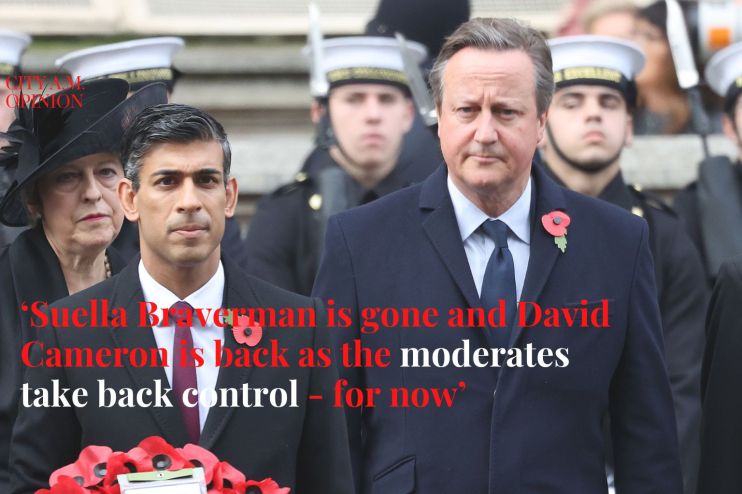
Suella Braverman is gone, and the 2010s are back. David Cameron, the former prime minister, who has found little favour since leaving office, has been given a peerage and made Foreign Secretary.
Rishi Sunak’s reshuffle was about pulling together a “united team” as the Conservatives prepare for a general election.
For a moment, at least, centre-right Conservatives have taken control of the government, without so much as a hat tip to the culture-war fiends on the backbenches.
When Sunak brought Suella Braverman back to government after she was sacked by Liz Truss, it was widely acknowledged in Westminster as a politically savvy move for Sunak to secure her endorsement and extend an olive branch to her coalition of right-leaning MPs.
Since then, it is possible Sunak realised that Braverman’s support on the backbenches may have been somewhat overstated.
And as Truss found last year, having Braverman in cabinet while she was quite clearly more interested in commanding her own fiefdom of backbenchers and members, was intolerable.
The former Home Secretary will no doubt continue to be a headache for the Prime Minister. The calculation Sunak is taking is that she will be more of a headache and do more damage to his premiership from within the government than she will be storming around the tearooms muttering about homeless people in tents.
In other words, he decided to commit to his own brand of Conservative politics and stop waving vaguely to those on the right, whose trust he would’ve found it harder to regain.
Enter stage right, David Cameron. He is hardly a figure in Tory politics to rally support around, but he brings with him genuine foreign policy experience, which the current Prime Minister lacks. This election, Britain will face huge domestic challenges, but it will also be flanked by our response to the conflict in Israel, the invasion of Ukraine and the brewing threat of China.
Cameron’s post-premiership legacy, however, has only served to hinder his stature. He was at the centre of one of the biggest lobbying scandals in modern history and his appointment therefore is not without problems.
As a prime minister, David Cameron presided over a remarkably pro-China government and was also seen as a pragmatic purveyor of “liberal interventionism” in the global sphere.
This attitude will go down very differently with the moderate Conservatives of today, as well as the general public.
Cameron was also seen, at the time, as weak-willed when he bowed out of Downing Street after losing the Brexit referendum. He insisted it would have been wrong for a prominent sceptic of the movement to have led the country through the withdrawal from the European Union. This may be true, but it did not lend him any sense of backbone.
What is especially striking is that we will have two leaders of political parties, Sunak and Starmer, both carrying significant backing from former prime ministers (Cameron and Blair). It seems to be an admission that there is very little new talent in politics. There are those in the shadows of the Labour Party who would admit to this, and, when looking at those who could theoretically replace Braverman, there was very little political heft in the current cabinet. James Cleverly, the new Home Secretary, was pretty much it.
There is talent among the crop of junior ministers, as well as the newly appointed Net Zero Secretary Claire Coutinho. But in terms of name recognition, most would probably connect more with those in Keir Starmer’s Shadow Cabinet.
Conservative MPs know this, even if they are unwilling to say it. But knowing it silently is one thing. Giving it a rubber stamp in the form of an ex-Prime Minister in one of the great offices of state is another entirely.
The Prime Minister thus far has been criticised for losing control of the party, and of his government, so his willingness to take the risk, both in sacking Braverman and appointing Cameron, is a sign of him finally gearing up for a fight. The reshuffle seems to say: there will be no more pandering, we either come together around this government, or we fall apart.
While this may be a win for the moderates of the Conservative Party for now, it could determine the fate of the Tory Party in opposition. If Sunak loses at the next election, and loses badly, it puts those to the right of the party in pole position to claim they are the ones who understand “true Conservative values”.