Skip to content
Monday 24 August 2026London --:--Frankfurt --:--Zurich --:--
NewslettersSearchEN · DE · FR
MorningWire

European business, markets and politics

FTSE 100
10,815.70
-0.01%
DAX
26,071.92
-0.25%
CAC 40
8,467.03
-0.21%
STOXX 50
6,445.05
-0.27%
  • Europe
  • Markets
  • Business
  • Economy
  • Regulation
  • Politics
  • Opinion
More
GermanyFranceEU InstitutionsCompetitionPublic AffairsBankingTechnologyEnergy
  • Germany
  • France
  • Europe
  • Markets
  • Business
  • Economy
  • Regulation
  • Politics
  • Opinion
  • DE
Wednesday 12 April 2023 3:43 pm  |  Updated:  Wednesday 12 April 2023 3:52 pm

Andrew Bailey stresses Bank of England focused on inflation fight rather than Credit Suisse and SVB fallout
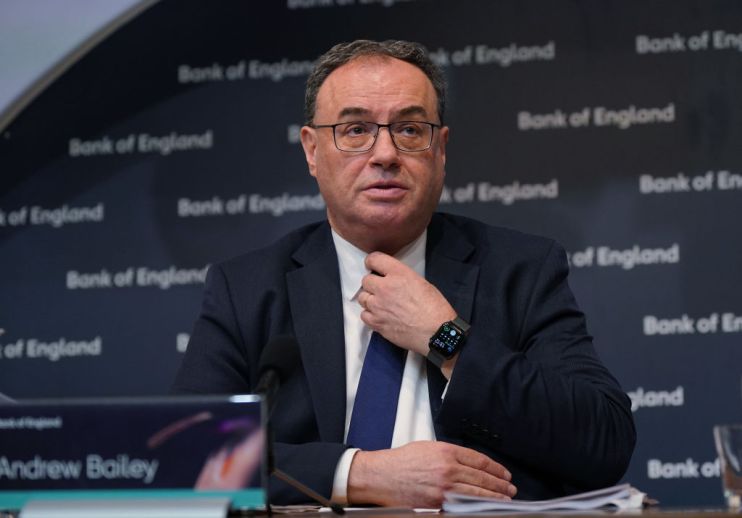
Bank of England Raises Key Interest Rate To 4%
Speaking at an event at the International Monetary Fund’s spring meeting, Andrew Bailey, head of the Bank and previously chief of the Financial Conduct Authority, said financial instability has not “in any sense” prompted the monetary policy committee (MPC) to “aim off our preferred setting of monetary policy” (Photo by Yui Mok - Pool/Getty Images)

The recent run of chaos in the global financial system that has laid waste to Credit Suisse and Silicon Valley Bank (SVB) has not distracted the Bank of England from trying to tame inflation in the UK, the monetary authority’s chief said today.

Speaking at an event at the International Monetary Fund’s spring meeting, Andrew Bailey, head of the Bank and previously chief of the Financial Conduct Authority, said financial instability has not “in any sense” prompted the monetary policy committee (MPC) to “aim off our preferred setting of monetary policy”.

Investors have been mulling whether the Bank and other top monetary authorities will pause interest rate rises to avoid heaping more pressure on an already strained financial network.

Globally, central banks have been hiking borrowing costs at the fastest pace since the 1980s, spearheaded by the US Federal Reserve, to tame scorching inflation.

Bailey and his team of experts have lifted borrowing costs eleven times in a row from 0.1 per cent to 4.25 per cent and are expected to lift them 25 basis points on 11 May. Those sharp moves have been in response to inflation racing to multi-decade highs over the past year. It is still in the double digits at 10.4 per cent.

While those efforts have chilled price increases, they have also weakened the banking sector by making it more costly to lend and borrow and putting downward pressure on asset prices.

When official borrowing costs rise, traders tend to sell government bonds until they reflect the level of return they could receive by parking their money with the central bank. Bond prices and yields move inversely.

Read more

How patient can the Bank of England be?

Historic Royal Exchange building in London with modern skyscrapers behind, clear blue sky.

SVB failed after customers wised up to the US tech lender’s huge bet on US government debt being on track to sour as a result of the Fed’s steep rate increases. Before it went to the wall, SVB had hundreds of billions of dollars of unrealised losses on its balance sheet.

That event amplified concerns about other lenders being snagged by the higher rate framework, igniting a rapid deposit flight at Credit Suisse that eventually forced Swiss regulators to engineer a fire sale to Credit Suisse’s main rival UBS.

Market jitters about future banking failures springing up have receded, but investors are still alert to any signs of stress emerging in the financial system.

Bailey said he has full confidence in the global banking system taking the weight of a higher interest rate environment, mainly because the sector has been fortified by post-financial rules that have beefed up capital buffers.

“The post [financial] crisis reforms to bank regulation have worked. Today I do not believe we face a systemic banking crisis,” he said.

“When I look at the UK banks, they are well capitalised, liquid and able to serve their customers and support the economy,” he added.

Read more

El Nino heatwaves to ‘fuel inflation next year’

Firefighter in helmet and uniform watching a blazing forest fire at night, red glow in the sky

Share this article

  • Facebook
  • X
  • LinkedIn
  • WhatsApp
  • Email

Similarly tagged content:

Sections

  • Markets & Economics
  • News

Categories

  • Economics
  • Banking

Related Topics

  • Bank of England
  • Credit Suisse

Trending Articles

  • Can debt-ridden Morrisons become a Big Four supermarket again?

  • Ratcliffe’s Ineos saves Runcorn plant

  • Amazon says it buys books in bulk to ‘improve products’

  • House prices in wealthy London boroughs fall by up to £300,000

  • HMRC mansion tax inspectors to target homes for property valuations

More from Morning Wire

  • How patient can the Bank of England be?

    AD
    Historic Royal Exchange building in London with modern skyscrapers behind, clear blue sky.
  • El Nino heatwaves to ‘fuel inflation next year’

    Economics
    Firefighter in helmet and uniform watching a blazing forest fire at night, red glow in the sky
  • Rupert Lowe axes pensions triple lock and pledges tax cuts in economic plan

    Politics
    Rupert Lowe, former Southampton FC chairman, smiles while holding files on a city street, wearing a suit and pink tie
  • Inflation leaps to 2.9 per cent in blow to Burnham 

    Economics
    Burnham cityscape showcasing modern architecture, bustling streets, and vibrant community life in a thriving urban setting
  • UK economy’s rebound fails to stem two years of mass job losses 

    Economics
    LONDON, UNITED KINGDOM - JANUARY 31: The Shard is seen on the horizon as commuters cross London Bridge during the morning rush hour on January 31, 2023 in London, United Kingdom. The IMF reports that the UK economy will contract by 0.6% in 2023, as opposed to the previous prediction it might grow, and will perform worse than many other advanced economies, including Russia.The cost of living continues to hit households with grocery inflation for the first four weeks of 2023 rising to 16.7% which would add a further £788 per year to family food bills. (Photo by Leon Neal/Getty Images)
  • War and tax: How the UK economy could get knocked off course

    Economics
    Andy Burnham speaking at a public event, emphasizing local governance and policy changes, wearing a suit and gesturing pas...
  • As it happened: Miners fuel FTSE 100 recovery; oil jumps as Trump claims Strait of Hormuz

    FTSE 100 Live
    FTSE 100 stocks rise as Brent crude oil prices jump 1.8% to $104.98 amid Strait of Hormuz tensions and Trumps Iran stance
  • 22 months of cuts: Jobs crisis deepens despite growth boost 

    Economics
    London has defied national trends as job postings in the capital rose.
MorningWire

Independent European business, markets and political news for decision-makers.

Morning Briefing

Europe

  • Germany
  • France
  • EU Institutions
  • Europe

Business

  • Markets
  • Business
  • Economy
  • Regulation
  • Competition
  • Public Affairs

Editorial

  • Opinion
  • Editorial Policy
  • Corrections
  • Contact

Company

  • About Morning Wire
  • Privacy Policy
  • Terms of Use
  • Cookie Policy
© 2026 Morning Wire Ltd · Published by Morning Wire Media, Bahnhofstrasse 65, 8001 Zürich, Switzerland
Privacy · Terms · Cookies · Facebook