Are we about to see one of the biggest shifts in monetary policy since the financial crisis?

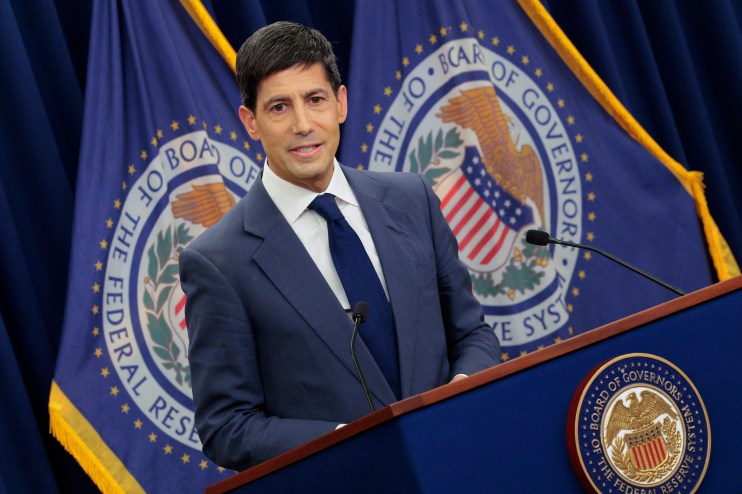
Chair Kevin Warsh believes the Federal Reserve should offer forward guidance, arguing that promises about future policy quickly become shackles around a central bank’s neck. He could be about to get his way, says Helen Thomas
As the first half of the year draws to a close, the world’s leading central bankers gather this week in Sintra, Portugal, for the ECB’s Annual Conference, effectively Europe’s answer to Jackson Hole. On Wednesday, Fed Chair Kevin Warsh joins ECB President Christine Lagarde, Bank of England Governor Andrew Bailey and Bank of Canada Governor Tiff Macklem for what will be the week’s marquee panel.
They meet against an increasingly uncomfortable backdrop.
Inflation has retreated from its post-pandemic highs but the world has hardly returned to stability. Conflict in the Middle East has once again exposed the fragility of global supply chains, fiscal deficits remain historically large, and AI investment is fuelling one of the biggest waves of capital expenditure in decades. In its latest annual report, the Bank for International Settlements warned that these pressures could combine with the “exuberant risk appetite” of financial markets to create the conditions for a systemic crisis.
The BIS’s general manager, Pablo Hernández de Cos, did not mince his words. “Policymakers must act now. Delay will only make the necessary adjustments more costly,” he warned. “Policy actions must reinforce each other to avoid a pull and push on the global economy. Ultimately, success depends on sound fiscal and financial foundations.”
The difficulty is that central bankers have little influence over many of those foundations. They cannot shrink the mountain of public debt accumulated since the pandemic, dictate governments’ fiscal choices or stop technology companies investing hundreds of billions in AI infrastructure. Regulators can try to contain leverage outside the banking system, but leverage has a habit of migrating to wherever regulation is weakest.
That leaves monetary policy as the principal lever. Yet monetary policy itself is undergoing a profound rethink.
The post-financial crisis era was defined by persistent disinflation, near-zero interest rates and central banks desperately trying to pull harder on an ever looser string. Forward guidance became the defining innovation of that world. Rather than simply setting interest rates, central banks increasingly told markets where they expected rates to go next, hoping to influence financial conditions through expectations as much as through today’s policy decision.
Warsh wants this practice to end. He has made clear that he no longer believes the Federal Reserve should offer forward guidance, arguing that promises about future policy quickly become shackles around a central bank’s neck. Long before becoming Fed Chair, he warned that previewing future decisions risks turning changing economic conditions into broken promises, eroding credibility precisely when central banks need it most.
Making markets work
Instead, he wants markets to do more of the work. As Warsh has argued, financial market prices are “probably the most important source of information to guide central bankers.” Investors should assess the incoming data themselves, assigning probabilities to different outcomes, while the Fed explains today’s decision and its reaction function rather than promising anything about what might take place at the next meeting.
Warsh is not the first central banker to question forward guidance. Former Bundesbank President Jens Weidmann warned back in 2019 that prolonged “lower for longer” commitments had important limitations for both credibility and financial stability. The Bank of England discovered the problem first-hand when Mark Carney’s pledge to keep rates low until unemployment reached a specified threshold was rapidly overtaken by events. Even the BIS has cautioned that prolonged forward guidance can encourage excessive risk-taking and leave markets less efficient at pricing risk for themselves.
But Warsh is going further than his predecessors by abandoning forward guidance altogether.
Markets that have grown accustomed to central banks signalling every future move will have to become comfortable with greater uncertainty. Interest-rate expectations are likely to become more volatile. Bond markets may react more sharply to economic data. Investors will have to spend less time parsing central bank speeches and more time analysing the economy.
That is precisely the point. For two decades, central banks sought to suppress uncertainty, believing that ever clearer communication made monetary policy more effective. Warsh believes the opposite: that excessive certainty traps policymakers in promises made for a world that no longer exists.
So while the spotlight this week will be on Sintra, the more important story may be what happens afterwards. If Warsh succeeds, markets will no longer wait for central bankers to tell them what comes next. They will once again have to discover prices for themselves, which would mark one of the biggest shifts in monetary policy since the financial crisis.
Helen Thomas is founder and CEO of BlongeMoney