Argentina can finally realise its potential following the election of its new “BoreCon” President Mauricio Macri

Buenos Aires was stopped in its tracks at 11.59pm on Saturday night. Restaurants, bars and clubs emptied abruptly and would-be revellers poured onto the streets and made their way home. In a city which can lay claim to being a true 24-hour hub along with New York, Tokyo and, maybe someday, London, this is quite a spectacle. The reason is an oddity of Argentina’s election laws. Not only does every man and woman under the age of 70 have to turn up to vote, but the country forbids the sale of alcohol on the day polling stations are open. Presumably, they are worried people would become too inebriated to show up – or forget who they support.
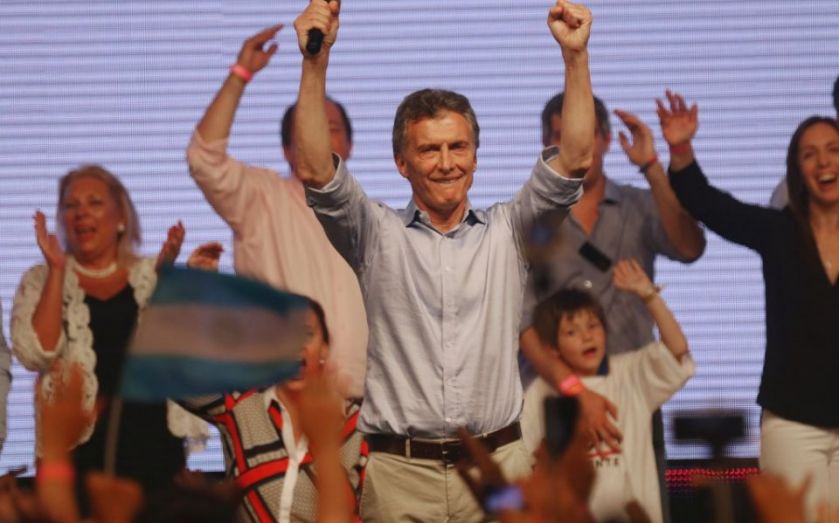
In the end, in Sunday’s presidential elections, clear-headed Argentinians voted for change. “You made the impossible possible,” the newly elected President, conservative Mauricio Macri, told the cheering crowds on Sunday night. These were not empty words. Daniel Scioli, the anointed successor of Cristina Fernandez de Kirchner, the two-term Peronist President, was expected to win comfortably. Early opinion polls suggested it would be a simple campaign. Even in the capital, a city Macri has run as mayor since 2007, Scioli dominated the poster war.
Most Argentinians I spoke to over the weekend claimed not to be passionate about the election. Compared to the resounding apathy which greets politics in the UK, this seemed a strange assertion. My taxi driver took every opportunity while stuck in the city traffic to shout to nearby cars the virtues of a potential Macri presidency. “We are a cosmopolitan and open nation,” he told us, just as loudly, “yet Kirchner has closed us off to the world. Macri will open us, he will be a global statesman.” For businesses who want to tap into Argentina’s markets, the signs are certainly encouraging. When Macri visited the IoD last year to meet British business leaders, he talked up that potential for stronger Anglo-Argentinian links. His country is behind both Brazil and Chile in terms of UK exports – failing to make it into the top 50 destinations for British goods and services.
It’s easy to see how a Macri presidency could also build closer political links between Argentina and the rest of the world. David Cameron has visited every nation in the G20 except Argentina – snubbing the South Americans after Kirchner publicly accosted him over the Falklands back in 2012. Moreover, Cameron and Macri share an ideology and a style – as much as is possible for politicians from different hemispheres and such different countries.
Unusually for a mayor of such a large and vibrant city, Macri, like Cameron, has never succumbed to a cult of personality, always expressing a preference to let his policies and actions demonstrate his ability, rather than engaging in great rhetorical flourishes. In this sense, Macri represents the latest victory of the “BoreCons” – a term columnist Tim Montgomerie uses to describe the generation of pragmatic and effective centre-right leaders, who lack the allure of a Blair or Obama. Think Angela Merkel in Germany and, until recently, Stephen Harper in Canada and Tony Abbott in Australia. Cameron, too, fits the bill. There is no great wave of adulation for these candidates, but they embody efficiency and effectiveness in an era where worldwide perception of politicians has never been lower.
With Macri’s victory, the opportunity for Argentina is immense. Brazil will capture the eyes of the world in the run-up to next year’s Olympics and the afterglow of the five rings will be long-lasting. But like the 2010 World Cup in South Africa, it will also cast a spotlight on the country’s already well-documented social and economic problems. Argentina will be determined not to let their arch-rivals streak further ahead – it too can benefit from having a major competition next door, quietly instigating reform, re-establishing international links, and realising its potential.