Skip to content
Tuesday 8 September 2026London --:--Frankfurt --:--Zurich --:--
NewslettersSearchEN · DE · FR
MorningWire

European business, markets and politics

FTSE 100
10,822.90
+0.01%
DAX
25,916.73
-0.35%
CAC 40
8,292.01
-0.17%
STOXX 50
6,391.22
-0.20%
  • Europe
  • Markets
  • Business
  • Economy
  • Regulation
  • Politics
  • Opinion
More
GermanyFranceEU InstitutionsCompetitionPublic AffairsBankingTechnologyEnergy
  • Germany
  • France
  • Europe
  • Markets
  • Business
  • Economy
  • Regulation
  • Politics
  • Opinion
  • DE
Wednesday 08 November 2023 5:15 am  |  Updated:  Tuesday 07 November 2023 5:05 pm

Bank of England has lost the delicate touch monetary policy needs

By: Charles White-Thomson

Add as a preferred source on Google

After decades of cheap debt, the swing towards high interest rates was a wrecking ball for monetary policy, writes Charles White Thomson

I have been reflecting on the highly damaging era of rock bottom interest rates and quantitative easing (QE).  The purveyors of “nanny finance” and super cheap money unleashed a financial time bomb for households which will be felt for many years to come. The consequences of the noble but misguided desire to play financial superhero and save, protect and bail out all of those with industrial scale liquidity include rampant inflation, asset bubbles, excess speculation, a generation of individuals and companies with a skewed attitude to risk. All of this has changed the value of money and  spurred on a cost of living crisis. 

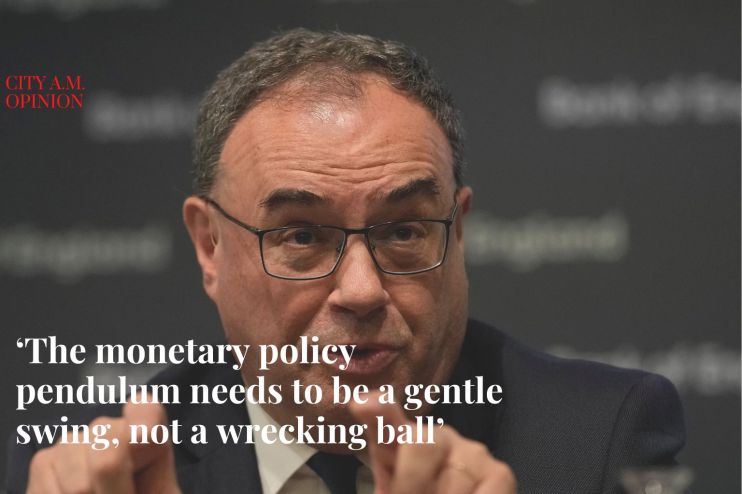
This doesn’t mean an abdication of central bankers, who can help global economies avoid deep, debilitating recessions. The monetary pendulum needs to have a gentler swing. As the economy slows or uncertainty emerges, the move to cut rates is a gradual one and as the economy heats up, a subtler raising of the rates takes place. This gentle swing is in tune with the natural ebbs and flows of the economy and the operators or central banks exude confidence supported by well-timed hints and thoughts to guide us all. Better to encourage and cajole than to handle the interest rate pendulum lever.  So, this is what good looks like to me – even in the face of unanticipated shocks. 

We’ve historically witnessed central banks making excessive rate adjustments, influenced by groupthink among economists and an overreliance on models and doctrine. Currently, the monetary pendulum swings rapidly, with the UK interest rate ranging from 10bps to 525bps in two years – more like a wrecking ball than a gentle swing. Central bankers appear uncertain, eroding confidence. 

Few have consistently benefited from this cycle, and those who have are often affluent with paid-off properties and diverse asset portfolios. For most, it’s been a roller coaster ending in reversed fortunes. With low rates, savers suffered, while borrowers thrived on the condition of repaying debt. As rates rise, savers earn more, though potentially offset by inflation, while borrowers grapple with costly debt. The prolonged low-rate period affected a significant portion of the population and inflated real asset prices. Younger generations, aware of this volatility, are rightfully frustrated by a mix of high taxes, sluggish growth, substantial debt, pricey assets, and a shrinking labour force.

As the rate of change starts to slow, we should begin reviewing how monetary policy has helped us in this period of economic uncertainty – and where it has hurt us. This will require open minds and careful consideration including a willingness to challenge the status quo. 

Sticking with the wrecking ball and crane operator’s analogy, this is not a time for central banks to hide behind the operating manuals or doctrine. The appointment of Ben Bernanke, the former Fed chair, to lead a review into the Bank of England’s forecasting and related processes during times of significant uncertainty is, sadly, more of the same. 

Going forward an open-minded and gentler hand is what is required with less wrecking ball, or we will find ourselves locked in an aggressive back-and-forth of tight and loose monetary policy. 

Read more

Bank of England’s Pill warns against ‘wait and see’ interest rates approach

Huw Pill, Bank of England Chief Economist, smiling in a suit and tie against a blue NABE banner.

Share this article

  • Facebook
  • X
  • LinkedIn
  • WhatsApp
  • Email

Similarly tagged content:

Sections

  • Opinion

Categories

  • Opinion

Trending Articles

  • Hedge fund billionaire Chris Rokos joins UK wealth exodus 

  • Iceland boss Richard Walker vows to set up shop on Falkland Islands

  • Britain ‘taxing itself to death,’ Burnham warned

  • £74m for branded condoms? UK must stop spaffing cash on foreign aid

  • Tesco and Boots lead 100,000 jobs pledge to tackle Neets crisis

More from Morning Wire

  • Bank of England’s Pill warns against ‘wait and see’ interest rates approach

    Economics
    Huw Pill, Bank of England Chief Economist, smiling in a suit and tie against a blue NABE banner.
  • Andrew Bailey: Populism a threat to global economy

    Economics
    Andrew Bailey, Bank of England governor, discusses economic policy during a press conference at the central bank headquart...
  • Five lenders hike mortgage prices as interest rate threat looms

    Banking
    Barclays shares have taken a hit since Trump's tariff announcement.
  • Mortgage nightmare as investors price in three interest rate hikes 

    Economics
    Bank of England building on Threadneedle Street, London, showcasing its historic architecture and financial significance
  • Fed chair Kevin Warsh faces Jackson Hole D-Day

    Economics
    Kevin Warsh, former Fed Governor, in a suit and blue tie, attending Jackson Hole meeting.
  • Inflation expectations softer than predicted ahead of interest rate decision

    Economics
    The Bank of England is expected to hold interest rates at four per cent due to stubbornly high inflation.
  • The Fed wants you to get used to higher interest rates

    Opinion
    Kevin Warsh, former Federal Reserve Governor, in a suit and tie at Jackson Hole conference
  • IMF sounds alarm on borrowing costs surge as bond rout deepens

    Economics
    Chancellor John Healey smiling, wearing a navy suit, white shirt, and red tie.
MorningWire

Independent European business, markets and political news for decision-makers.

Morning Briefing

Europe

  • Germany
  • France
  • EU Institutions
  • Europe

Business

  • Markets
  • Business
  • Economy
  • Regulation
  • Competition
  • Public Affairs

Editorial

  • Opinion
  • Editorial Policy
  • Corrections
  • Contact

Company

  • About Morning Wire
  • Privacy Policy
  • Terms of Use
  • Cookie Policy
© 2026 Morning Wire Ltd · Published by Morning Wire Media, Bahnhofstrasse 65, 8001 Zürich, Switzerland
Privacy · Terms · Cookies · Facebook